
Ergonomic Analysis of Age-Friendly Product Design: Focusing on Smart Device Brand “Osmile” in Taiwan
Copyright ⓒ 2026 The Digital Contents Society
This is an Open Access article distributed under the terms of the Creative Commons Attribution Non-CommercialLicense(http://creativecommons.org/licenses/by-nc/3.0/) which permits unrestricted non-commercial use, distribution, and reproduction in any medium, provided the original work is properly cited.

Abstract
This study examines age-friendly design in elderly-care wearables using Taiwan’s smart care brand “Osmile.” Four ergonomic dimensions—physical/motion, sensory/perception, cognitive/interaction, and emotional/trust—were correlated to perceived usefulness (PU), perceived ease of use (PEOU), and perceived service quality (PQS). Within an extended Technology Acceptance Model (TAM)/Unified Theory of Acceptance and Use of Technology (UTAUT) framework, PU, PEOU, and PQS explain the attitude toward use and behavioral intention. Survey data from 268 older adults and caregivers were analyzed using structural equation modeling. The results suggest that better ergonomic quality strengthens PU and PEOU and determines the perceived service quality. Additionally, the model clarifies the manner by which these beliefs translate into more positive attitudes and stronger intention to continue using elderly-care wearables, thus offering guidance for improving interface accessibility and support services for aging users.
초록
본 연구는 대만 스마트 케어 브랜드 Osmile을 사례로 노인 돌봄용 웨어러블의 고령친화 디자인을 분석한다. 신체·동작, 감각·지각, 인지·상호작용, 정서·신뢰의 4가지 인체공학 차원을 PU(유용성), PEOU(사용용이성), PQS(서비스 품질)과 연계하였다. 확장 TAM/UTAUT 모형에서 PU·PEOU·PQS는 사용 태도(ATU)와 행동의도(BI)를 설명하는 경로로 설정되었다. 268명의 고령자 및 보호자 설문을 구조방정식모형으로 분석한 결과, 인체공학 품질은 유용성과 용이성 인식을 높였고 특히 서비스 품질 인식에 큰 영향을 보였다. 또한 이러한 인식이 태도를 통해 지속 사용의도로 이어지는 과정을 제시하여, 고령 사용자를 위한 인터페이스 접근성과 지원 서비스 개선에 시사점을 제공한다.
Keywords:
Age-Friendly Product Design, Ergonomics, Wearable Devices, TAM, Osmile키워드:
고령친화 제품 디자인, 인체공학, 웨어러블 기기, Osmile(오스마일)Ⅰ. Introduction
1-1 Population Ageing and Ageing in Place
The UN Department of Economic and Social Affairs[1] reports that the global population aged 65 and above is growing in absolute numbers and as a proportion of the population, especially in high- and upper-middle income countries where ageing is described as deep and almost irreversible[1]. The WHO Active Ageing policy framework recognizes that three pillars of ageing policy comprise “health, participation, and security” and subsequently distills them into the concept of maintaining functional ability under its Healthy Ageing agenda[2]. Kasai, et al demonstrate (in the Western Pacific) that the age-associated rate of aging in the region exceeds the world average, but that there is no complete system to manage chronic diseases and provide long-term care in many other countries in the region[3]. In reference to Taiwan, the country entered an aged society in 2018 and is on track to become super-aged around 2025-2026, by then representing one of the OECD’s fastest ageing countries. These demographic changes also exert an additional strain on national health insurance plans, national long-term care systems, and family caregivers, particularly so-called “sandwich generation” who work and care for the older family members.
1-2 Osmile as a Local Brand Case
Osmile is a Taiwanese brand of smart-care devices that offer wristwatch-style and pendant-style devices, equipped with GPS tracking, geofencing, SOS buttons and caregiver apps. As opposed to global brands, Osmile has the advantages of localized Chinese interfaces, compatibility with local telecom plans, and after-sales service suited to Taiwan’s family care culture, where adult children are more likely to pay attention to and assist their parents’ health and safety[4],[5]. But earlier designs of Osmile devices have been linked to the design principles of mainstream smartwatches and phones, from design for interface text was small, to spacing of buttons was tight, menu hierarchies were deep, and feedback signaling was not always explicit, in preliminary observations and preliminary pilot interviews. Indubitably, the design assumptions implied by such choices assume that users have relatively good vision, fine motor control, and digital ability, an assumption that appears to go against average age-related deterioration in sensory, motor or cognitive ability among older adults. To make Osmile devices really supportive of aging in place, both ergonomics and technology adoption need to be tackled in a seamless manner.
1-3 Research Objectives and Questions
The Technology Acceptance Model (TAM) posits that Perceived Usefulness (PU) and Perceived Ease of Use (PEOU) are key predictors of Attitude toward Using (ATU) and Behavioral Intention (BI) and PEOU in part affects intention through PU[6]. The Unified Theory of Acceptance and Use of Technology (UTAUT) incorporates several different frameworks and provides evidence that Performance Expectancy, Effort Expectancy, Social Influence, and Facilitating Conditions are integrated to explain much of the variance in behavioral intention with the role of age and experience on major behavior paths[7]. In the study area of health technologies of older adults, a number of empirical works have expanded TAM/UTAUT to include health-related constructs like risk perception, health benefits and trust.
Using these literature perspectives, the current research aims to meet four objectives: (1) To establish a four-dimensional ergonomic framework of elder wearables (physical/motor, sensory/perceptual, cognitive/interaction, and affective/trust). (2) This study aims to integrate these ergonomic dimensions as upstream formative factors in an extended TAM/UTAUT model, including PU, PEOU, PQS, ATU, BI, HIE, and HC. (3) To validate this integrated ergonomics×adoption model through PLS-SEM and usability data, with Osmile as a brand-level case in Taiwan. (4) To create a prioritized set of design recommendations for Osmile and similar brands.
The following research questions are answered by the study:
RQ1: Which ergonomic dimensions have the greatest impact on PU, PEOU, and PQS in older users?
RQ2: Regarding elder-oriented wearables, does the mediation chain PU/PEOU/PQS → ATU → BI hold?
RQ3: Do HIE and HC show significant positive direct impact on BI?
Ⅱ. Literature Review
2-1 Age-Related Changes and Ergonomic Implications
However, Rogers and Fisk claimed in terms of cognitive aging that most older adults will have reductions in attention, working memory, and processing speed but that even they can use advanced tech if the interfaces decrease the unnecessary search load and reduce the memory load[8]. Charness and Boot similarly reiterated that interfaces built with exclusively young users in mind-small fonts, fine motor demands, and dense layouts-often lead to early frustration and eventual rejection among older users[9]. Wildenbos et al. propose the MOLD-US framework that integrates the extant literature around barriers of mobile health (mHealth) usability for seniors by organizing it into cognitive, motivational, physical, and sensory aspects. Typical problems involve small fonts, cramped buttons, cumbersome navigation flows, or unsatisfactory or ambiguous feedback[10]. Liu et al. (2022)’s systematic review of mHealth interfaces for older adults found that successful designs are characterized by larger targets, high-contrast text, simplified workflows, and clear persuasive cues[11]. Kascak et al. and Li et al. integrated universal design principles and the mobile guideline to advocate shorter memory requirements, multimodal information, and tolerance of errors as fundamental strategies to increase usability in older age[12],[13]. Compiling these findings, this study operationalizes ergonomics in terms of four dimensions: Physical/motor: Size and spacing of buttons and touch targets, actuation force needed, and wearing comfort. Sensory/perceptual: font size and contrast; the legibility of icons; salience of auditory and haptic cues. Cognitive/interaction: depth of navigation, consistency of interaction patterns, error tolerance, and availability of back/undo mechanism. Affective/trust: feelings of safety, predictability, and trust in the device when it is used. We speculate that these ergonomic dimensions work upstream of PU, PEOU, and PQS, leading to users’ attitudes and intentions.
2-2 Human-Centered and Inclusive Design
Human-centered and inclusive design emphasizes understanding users’ goals, contexts, and capabilities, and iteratively refining prototypes so that systems align with real needs. For older users, Rogers and Fisk argue that advanced technologies should function as cognitive and environmental supports that compensate for age-related sensory and motor declines (e.g., larger controls, clear labeling, and real-time feedback) [8]. Charness and Boot warn that training alone cannot overcome fundamental design misalignments; when interfaces remain complex and unwelcoming, older adults are effectively barred from digital services [9]. For mobile and mHealth apps, the MOLD-US framework and Liu’s review show that older users benefit from basic layouts, clear visual focus, and explicit tolerance for errors [10],[11]. Kascak et al. further demonstrate that applying universal design principles to smartphone interfaces can improve accessibility for older adults [12]. Li et al. showed that users can still effectively use mHealth apps for cognitively impaired older adults when their memory load is minimized and they are organized by intuitive icons[13]. This knowledge served as an input to the questions and tasks of this study, in which button size, hierarchy depth, and consistent feedback were operationalized as quantifiable correlates of ergonomic quality.
2-3 Technology Acceptance and Older Adults
Davis demonstrated that PU and PEOU explain a significant fraction of the variance in information system usage and that PEOU not only directly affects attitude, but indirectly alters intention through PU[6]. Venkatesh et al.’s UTAUT combines several acceptance models and presents that Performance Expectancy, Effort Expectancy, Social Influence, and Facilitating Conditions can jointly explain ~70% of the variation in behavioral intention, with age, gender, and experience moderating the relationship[7]. TAM/UTAUT have also been expanded to reflect health-related constructs in the area of health technologies for older adults. Farivar et al. used a mixed-methods study and found that older adults’ adoption of wearables is motivated by perceived health benefits and usability but limited by privacy concerns and discomfort[14]. Kononova et al.’s focus group study finds older adults like activity tracking capabilities, but tend to grouse about strap comfort, small screens, and unclear notifications[15]. Extending UTAUT2 and technological preparedness, Wang et al. and Wu et al. revealed that health-improvement expectancy, habit, and satisfaction were important factors in the willingness of older adults to keep using wearables[16],[17]. The systematic review of Kim (2006) reviews how TAM-based models have been adapted for elderly healthcare technologies and that trust and service quality should be considered as major constructs[18], and not as secondary add-ons. Collectively, these studies indicate that PU and PEOU remain not only relevant but also not enough in high-risk health contexts; service reliability, trust, and health-related values should be integrated directly into adoption models for older adults.
2-4 Wearables for Ageing in Place
The smart devices equipped with fall detecting, activity monitoring, and GPS tracking are commonly considered important technologies to promote ageing in place[14]-[18]. Farivar et al. reported that older adults are ready to adopt such devices if they are perceived to reduce fall risk and improve health monitoring, yet their adoption is rapidly waning if the technologies are uncomfortable, visually stigmatizing, or too complex to operate[14]. In Kononova et al.’s study, respondents appreciated seeing their activity data but worried about straps that were hard to fasten, screens that were too small, and notifications that could not be well understood[15]. Wang and Wu et al. found that perceived health improvement and system stability are important for continuance; persistent reminders that are delayed or corrupted quickly erode trust among users[16],[17]. Kim further argues that quality of service and trust are important for older people healthcare technologies in order to understand continuance and dropout[18]. These results suggest that the adoption and retention of elder wearables hinges not just on perceived functionality but also ergonomics and service dependability. Accordingly, the study presents PQS, HIE, and HC in the context of an extended TAM/UTAUT model and takes Osmile as a case specific to Taiwan.
2-5 Research Gap and Positioning
From the literature, there are three main gaps: The challenge of brand-level, context-specific studies: The majority of studies focus on “wearables” as a general type, and the specific brands and service ecosystems are not sufficiently investigated which makes it impossible to convey the specific product redesigns that emerge. Second: Integration of ergonomics with adoption models is quite limited: Ergonomics and TAM/UTAUT often have concurrent development, few models have explicitly linked “concrete ergonomic design → PU/PEOU/PQS → ATU/BI.” Third: Omission of constructs related to health-related value: While many of the studies have highlighted health-improvement expectation and health awareness, these are not always represented as direct predictors of BI. Lastly, to overcome these limitations, in this study ergonomics represents a multifaceted formative construct that is embedded in PU, PEOU, and PQS in an expanded TAM/UTAUT model, and is validated empirically through PLS-SEM and usability based on Osmile local brand as a case study.
Ⅲ. Methodology
3-1 Theoretical Framework and Hypotheses
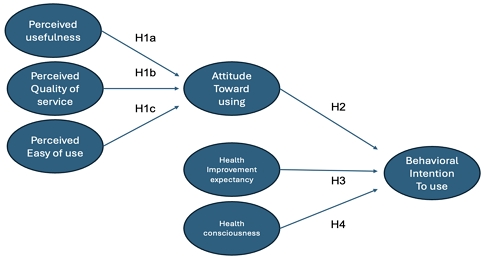
This study also develops the Technology Acceptance Model (TAM) and Unified Theory of Acceptance and Use of Technology (UTAUT) in the context of age-friendly wearable devices in older people. Perceived usefulness (PU) and perceived ease of use (PEOU) are retained as central cognitive appraisals that influence attitudes toward use (ATU) which eventually determine behavioral intention (BI) to adopt or continue using a technology[6],[7]. Furthermore, perceived service quality (PQS) is included as a third proximal determinant of ATU in order to emphasize the role of dependable connectivity, prompt customer service, and effective emergency assistance in the field of health-oriented wearables. In conceptual terms, the model constructs four ergonomic factors—physical/motor, sensory/perceptual, cognitive/interaction, and affective/trust—as upstream design properties that are incorporated in users’ experience in PU, PEOU, and PQS. Instead of representing these four dimensions as discrete latent units in the structural equation model, they are operationalized according to the items that evaluate the usefulness, ease of use, and level of service quality. Put another way, ergonomics is conceived as a formative design influence that is manifested in older adults’ beliefs about whether the device is easy to grip, visually legible, cognitively manageable, and emotionally reassuring when used. Following ATU, the model includes health-improvement expectancy (HIE) and health consciousness (HC) as related predictors of BI. HIE captures the degree to which older adults anticipate providing tangible health benefits (e.g., fall prevention, emergency response, and enhanced health monitoring) as a result of using the device, while HC reflects their overall orientation toward managing and safeguarding their health. In terms of how value is given to continual use of a device compared to the effort required for it to be learned and maintained, both constructs are particularly salient for senior wearers. Within this framework, these hypotheses are formulated (Fig. 1):
Conceptual framework
H1a: Perceived usefulness (PU) has a positive effect on attitudes toward use (ATU).
H1b: Perceived service quality (PQS) has a positive effect on attitudes toward use (ATU).
H1c: Perceived ease of use (PEOU) has a positive effect on attitudes toward use (ATU).
H2a: Attitudes toward use (ATU) have a positive effect on behavioral intention (BI).
H2b: Health-improvement expectancy (HIE) has a positive effect on behavioral intention (BI).
H2c: Health consciousness (HC) has a positive effect on behavioral intention (BI).
Furthermore, the model predicts that ATU would mediate the influence of PU, PEOU, and PQS on BI with improved ergonomic and service experiences leading to significant increases in behavioral intention through more positive attitudes toward Osmile device use.
3-2 Participants and Sampling
The target population consisted of middle-aged and older people living in Taiwan, along with their main caregivers. Participants were recruited from community colleges, lifelong learning centers, and caregiver associations through convenience and snowball sampling strategies. The inclusion criteria included: Age 50 years or older with experience or interest in wearing devices; or Being the primary caregiver of an adult aged 65 years or older and involved in setting up or managing health technologies for that person. Approximately 280 questionnaires were collected; the maximum number of valid responses was 268 after removing incomplete questionnaires and those failing the attention check. The ages of the sample were mostly 50-60 (40.30%) and 60-70 (33.96%), 40-50 (22.76%) and 30-40 (2.24%), with very few over 70 (0.75%). Females accounted for 54.10%. Education levels were concentrated in the upper secondary (32.84%) and undergraduate (31.34%) categories. Most respondents, 98.88%, have experience with personal smartwatches, fitness accessories, or emergency pendants, suggesting they have some exposure to wearable technology.
3-3 Procedure
The research was conducted in three steps: Pilot study and further development of the scale: About 30 participants filled out a pre-test questionnaire to test the clarity and reliability of the items. Feedback suggested some Chinese phrases might be misunderstood, so the phrasing was rewritten and retested with bilingual researchers for meaning equivalency between Chinese and English. Usability testing and testing of the questionnaire in a lab or community setting, participants used an Osmile device, either separately or in small groups. After a short demonstration, they were asked to perform four essential tasks:
Task 1: Call SOS emergency.
Task 2: Monitor location or current trajectory.
Task 3: Review information on health status (e.g., steps taken, heart rate).
Task 4: Set, change, or alter a geofence.
Additionally, each task was presented with a consistent script indicating the start and endpoint. The researcher recorded the completion time (seconds), errors, and task success for each participant and task. Observers also used a structured observation form to note problems and mis-taps. Semi-structured interviews: Some participants (caregivers) were invited to 15-30 minute semi-structured interviews. The questions explored perceptions concerning comfort, aesthetics, trust, perceived risks, and tangible suggestions for improvements. The interviews were audio-recorded (with consent) and transcribed to support the quantitative evidence.
3-4 Instrument
Items capturing the ergonomic and usability characteristics of the device were incorporated into the PU, PEOU, and PQS scales. This included four areas: Physical/motor: size and spacing of the buttons, ease of pressing, and comfort during prolonged use. Sensory/perceptual: legibility of written text, adequacy of contrast, clarity and contrast of icons, and prominence of auditory and haptic alerts. Cognitive/interaction: Steps required to perform core tasks, navigational clarity, interaction with “back” or “cancel” options, ability to correct errors. Affective/trust: perceived safety, confidence that alerts will be delivered correctly and on time, and willingness to continue wearing and recommending the device. All items were rated on 5 point Likert scales (1 = strongly disagree, 5 = strongly agree), providing information that contributed to the latent constructs PU, PEOU, and PQS within the measurement model.
The reflective constructs involved: PU and PEOU: Modified from Davis’s original scales, but designed for mHealth and wearables for older adults. PQS: perceived reliability and responsiveness of the device-cloud-app ecosystem, based on discussions on quality of service and trust in older-adult health technology. ATU and BI: standard attitude and intention items derived from TAM/UTAUT and past studies of wearable adoption. HIE and HC: HIE is expected health and safety improvements from engaging with the device, and HC is a personal tendency toward health maintenance. The specific items were derived from Farivar, Wang, and Wu’s work on wearable adoption and continuance.
3-5 Data Analysis
SPSS and AMOS/SmartPLS were used to analyze the following data: Reliability: Cronbach’s á was used to demonstrate internal consistency. Cronbach claimed that high values indicate that items are being evaluated in the same direction; values greater than 0.70 are normally accepted, with values above 0.80 considered good. An exploratory factor analysis (EFA) was conducted to determine the latent structure and ensure that items approximately matched the constructs planned before the CFA. Specifically, CFA measurement models were assessed in terms of factor loadings, AVE, and Composite Reliability (CR). According to Fornell and Larcker, AVE ≥ 0.50 and CR ≥0.70 imply good convergent validity; the square root of AVE for each construct should be greater than its relative correlations with other constructs to validate discriminant validity. Structural equation modeling (SEM).
The structural model estimation was done based on maximum likelihood and, to evaluate fit, included CMIN/DF, RMSEA, CFI, TLI, NFI. Bootstrapping was applied for estimating the indirect influence from PU, PEOU, and PQS on BI through ATU, following best practices for mediation analysis in SEM.
Ⅳ. Results
4-1 Features of the Samples and Descriptive Statistics
The membership of the 268 valid respondents was mainly middle-aged and older people having diverse educational backgrounds and some level of previous experience with wearable devices (Table 1). To improve the overall satisfaction regarding the main constructs, descriptive statistics were computed for seven dominant variables (PU, PQS, PEOU, ATU, HIE, HC, and BI). Mean scores ranged from 3.696 to 3.925 on a 5-point scale, all above midpoint (3), for the overall positive attitude towards smart wearables. HIE had the highest mean (M = 3.925, SD = 0.850), indicating that the survey respondents thought these devices could be helpful in supporting health management generally. PQS (M = 3.879, SD = 0.957) and ATU (M = 3.779, SD = 0.920) were also higher, indicating positive perceptions of service quality and general attitude. PEOU (M = 3.758) and BI (M = 3.751) showed moderately favorable perceptions toward usability and intention to use, whereas HC (M = 3.770) and PU (M = 3.696) were slightly lower, but still well above the mid-point, indicating a positive trend towards health perceptions and perceived usefulness. Standard deviations (0.817 to 1.056) indicated some individual variability, as well as providing more information for subsamples and structural correlations (Table 2).

Frequency distribution of basic information
Descriptive statistics of main constructs
4-2 Reliability and Validity
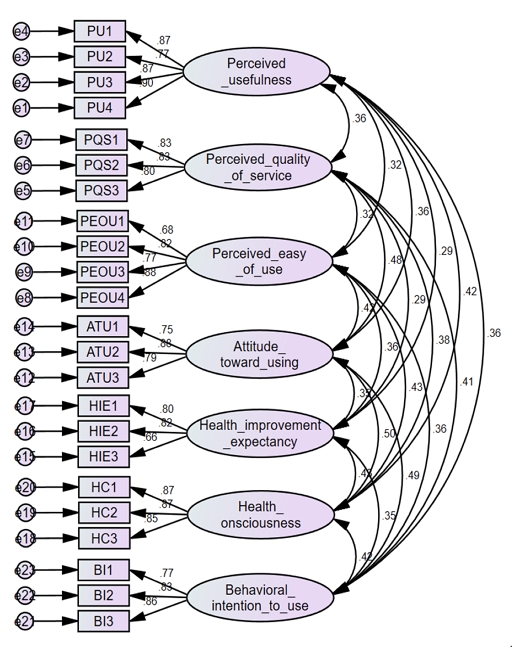
Cronbach’s alpha analysis showed that all reflective constructs had alpha coefficients larger than 0.80 (overall α = 0.909) that are consistent with the high internal consistency[19]. Corrected item-total correlations (CITC) were all higher than 0.50, and deleting an item did not raise the alpha of a construct, adding to the strength of the scales (Table 3). The EFA retrieved seven factors with a cumulative explained variance of 77.793%, which was broadly consistent with the intended constructs. KMO was 0.873 and Bartlett’s test of sphericity was significant (χ2 = 3645.143, df = 253, p < .001), suggesting data were appropriate for factor analysis (Table 4). Measurement model evaluation was carried out using CFA. All items loaded significantly on their respective constructs, thus providing support for convergent validity (Fig. 2).
Reliability analysis
KMO and Bartlett’s test
Measurement model of smart wearable device adoption (CFA results)
In the CFA, the loadings of the items were all ≥ 0.662, indicating strong relationships with their respective constructs. The AVE values ranged from 0.597 to 0.745, whereas CR values were all ≥ 0.813, meeting Fornell and Larcker’s criteria for convergent validity[20]. The square root of the AVE for each construct exceeded its correlations with the other constructs, supporting discriminant validity (Table 5). The measurement model fit indices were: CMIN/DF = 1.224, RMSEA = 0.030, CFI = 0.985, TLI = 0.982, NFI = 0.931, and IFI = 0.986, all indicating a good fit between the model and the data (Table 6).
Convergent validity summary
CFA model fit indices
4-3 Construct Correlations and Model
As per construct associations and model There were significant positive correlations (p < .01) for all of the major constructs, r = 0.239-0.433 (Table 7). The ATU to BI correlation was r = 0.404, which is in agreement with TAM/UTAUT emphasizing attitude as a strong antecedent of intention[6],[7]. The r-value of PQS to ATU was r = 0.424 that suggested the importance of regard to perceived service quality for attitude towards services, also in agreement with Kim’s suggestion that trust and the quality of service are core to older people’s healthcare technologies[18] (Table 8). The structural model demonstrated a reasonable fit: CMIN/DF = 1.330, RMSEA = 0.035, CFI = 0.980, TLI = 0.976, NFI = 0.924, IFI = 0.980 (Table 9).
Discriminant validity (Fornell-Larcker Criterion)
Correlation matrix among main constructs
Structural model fit indices
4-4 Hypothesis Testing
According to the measurement model exhibiting good reliability and validity, we estimated the structural model in order to evaluate our hypotheses (Table 10). The findings suggest that all three proximal predictors (PU, PQS, and PEOU) exert significant positive influence over attitudes toward use (ATU), and support H1a, H1b and H1c. Older people who considered the Osmile devices more useful, easier to use, and better-supported by higher-quality services reported better attitudes that favored the Osmile devices more often. In addition, ATU had a significant positive effect on behavioral intention (BI), further reinforcing H2a. In contrast to direct effects of constructs related to health, ATU was found to be the strongest predictor of BI, indicating the importance of attitudinal assessment in older persons’ intention to continue to use Osmile wearables. Health-improvement expectancy (HIE) and health consciousness (HC) also had a positive and statistically significant effect on BI, supporting both H2b and H2c. Older individuals who believed that the device would help them improve their health and who were more health-conscious overall were more likely to intend to use the device continuously. The mediation analyses also indicated that ATU partially mediates relationships between PU, PEOU, PQS, and BI. PU, PEOU, and PQS exerted indirect influences on BI through ATU by significant effects, suggesting the potential for ergonomic and service-related perceptions to directly as well as indirectly have an impact on behavioral intention in the devices through health-related constructs, as well as by conditioning affirmative or negative attitudes toward the devices. Collectively, these results further support the expanded TAM/UTAUT model and reveal the pivotal mediating role of attitudes in connecting ergonomic design qualities to older adults’ Osmile smart device usage in the long term (Table 11).
Structural path estimates
Hypothesis testing summary
4-5 Integration to Usability and Interview Results
SOS and geofence-setting tasks had the highest error rates from usability testing of the tasks. Common issues in these applications included mis-taps, failure to identify the correct functions, and the failure to know whether SOS signals or the settings had been successfully set in motion. During bright outdoor lighting, participants often found it difficult to read the smaller text (low contrast, or a low volume reading), often having to hold the device closer or by wearing reading glasses. The above- mentioned data on interview data suggests the implication of “if the SOS doesn’t go out and the alerts are delayed and it loses its quality”, highlighting the relationship between PQS and trust, reminiscent with the importance of service reliability for continuance stated by Farivar, Wang and Wu[14],[16],[17]. Caregivers often asked for simpler icons and flow, explaining that elderly relatives could not recall the multi-layered menu sequence and relied on caregivers to use the device. All of the above qualitative and quantitative findings suggest that enhancing physical and interaction ergonomics, e.g., through larger buttons, a reduced hierarchy depth and clearer feedback, may lead to increased PEOU and PU, while enhancing the device-cloud-app pipeline is associated with improvements in PQS and, in turn, via ATU and BI.
Ⅴ. Discussion
5-1 Theoretical Implications
This study empirically evidences that ergonomic quality, at the indirect level, impacts behavioral intention by PU, PEOU, and PQS, consistent with Rogers and Fisk’s claim that technology design is needed to counteract age-related declines in ability[8], and with Wildenbos and Liu’s research confirming that bad interface design in mHealth generates errors and abandonment among older adults[10],[11].
Secondly, PQS emerged as the best predictor of ATU among the perceptual constructs and thus, for health- and safety-critical wearables, service reliability and trust are essential. This is aligned with Kim’s argument that trust and service quality need to be primary-not secondary-constructs in TAM models involving elderly healthcare technologies[18]. The second and third direct effects of HIE and HC on BI highlight the fact that older adults buy wearables not only because they are useful, easy to use, but also because they want to experience concrete health improvements, and they identify more strongly with health maintenance behavior. This is consistent with Farivar, Wang, and Wu’s findings that health-improvement expectancy and health orientation were the main drivers for adoption and continuance in elder wearables[14],[16],[17]. In summary, this study extends the TAM/UTAUT model by integrating comprehensive ergonomics and health values into a single integrated model with real evidence of validity in a brand context.
5-2 Application to Osmile and Other Brands
Based on these insights synthesized from both the SEM and the usability data and interviews, some practical recommendations emerged:
(1) The size and spacing of the button and touch target size should be raised, particularly for the SOS button, and different tactile cues should be supplied to reduce mis-taps and failures (e.g., raised profiles and/or different materials). This directly targets the motor constraints defined in the MOLD-US framework.
(2) SOS, geofence-setting, and other essential workflows should be simple and be done in two or three steps to lessen memory requirements and interaction anxiety in the elderly.
(1) Increasing default font sizes and screen contrast can render information readable even in bright and low light conditions, echoing Liu’s recommendations of high-contrast, large-text mHealth interfaces for older adults.
(2) Consistent and redundant visual, auditory, and haptic feedback for critical events (e.g., SOS sent, location updated, geofence activated) enable both older adults and caregivers to quickly confirm the system status.
(1) Improve synchronization between devices, cloud servers, and caregiver apps, decreasing alert delays and failures, and displaying simple connection status indicators. Such information would strengthen PQS and trust, in concordance with Kim and Wang’s attention on service quality as a predictor of intention and continuance.
(2) Provide visual, easy-to-follow quick start and troubleshooting tips for common issues (e.g., connectivity, battery, SOS configuration) that caregivers can share with older people.
(1) Communicate immediate advantages, such as fewer falls, shorter emergency response time, and enhanced caregiver coordination, in marketing and appearance of interfaces-to establish health improvement expectations.
(2) The addition of educational content pertaining to awareness of health (e.g., daily step goals, safe zones for geofencing) can engage high HC users and facilitate their integration of the app into their daily health care management.
Following these guidelines can improve to a reasonable extent PU, PEOU, and PQS and accordingly ATU and BI and result in more sustainable uptake and utilization of the app.
5-3 Limitations and Future Research
First, this study is the examination of one single brand within a single country limiting its generalizability. Next steps include comparing different brands (e.g., local v/s global) and countries (e.g., Japan, Korea, and European contexts) to decide what findings are universal and what are contextual. Second, it is not possible to account for the dynamics of long-term use/dropout. Longitudinal studies and analyses of real-life use logs can trace the trajectories in older adults from early adoption to habit development (and, in some cases, abandonment), reinforcing the comprehension of continuance mechanisms[14]-[18]. Third, though this study involves caretakers, more extensive studies on very elderly people (e.g., over 80 years old) and people with mild cognitive impairment should be conducted through participative-design approach. Such work could investigate ways to further reduce interaction burdens and increase supportive features with user safety.
Ⅵ. Conclusion
Taking Osmile as a case, a Taiwanese elder-care wearable brand, this study develops and tests an integrated ergonomics × adoption model, where four ergonomic dimensions are integrated with TAM/UTAUT-derived constructs and health-related value factors. Together with usability testing, survey-based SEM analysis, and semi- structured interviews, this study provides evidence of:
(1) Ergonomic quality itself — the combination of interaction simplicity, sensory clarity, and trust — indirectly influences behavioral intention via PU, PEOU, and PQS[8]–[20].
(2) PQS is one of the dominant determinants of attitude in consideration of the health & safety-intensive context, demonstrating service reliability and trust at the heart of attitude[16],[18].
(3) HIE and HC have strong, direct impact on BI, further supporting that health-improvement expectations and health orientation are powerful factors that influence adoption and continuance among older adults[14]–[18].
From a practical standpoint, this study suggests some design recommendations for Osmile and similar brands to adopt, such as enlarging touch targets, increasing contrast and font size, simplifying critical task flows, strengthening multimodal feedback and service quality, and better communicating the health values.
In conclusion, the present study applies human-centered (or inclusive) design principles vis-à-vis the specific case of Taiwanese aging-in-place settings, providing empirically supported and applicable guidelines for businesses and designers to develop age- appropriate wearable devices and practices in fast- paced societies.
References
-
United Nations Department of Economic and Social Affairs, World Population Ageing 2019: Highlights, New York, NY: United Nations, 2019.
[https://doi.org/10.18356/9df3caed-en]

- World Health Organization (WHO), Active Ageing: A Policy Framework, WHO, Geneva, Switzerland, WHO/NMH/NPH/02.8, 2002.
- T. Kasai, T. Kasai, I. Hazarika, V. Lin, J. A. Thiyagarajan, H. Segura, and J. Beard, “Preparing for Population Ageing in the Western Pacific Region,” Western Pacific Surveillance and Response Journal, Vol. 11, No. 4, pp. 1-9, 2020.
- International Life Sciences Institute Taiwan, Health in a Super-Aged Society: Taiwan’s Challenges and Opportunities, Taipei, Taiwan: ILSI Taiwan, 2016.
- Ageing & AI Lab, Population Ageing in Taiwan and the Role of AI for Healthy Ageing, Oxford, UK: University of Oxford, 2025.
-
F. D. Davis, “Perceived Usefulness, Perceived Ease of Use, and User Acceptance of Information Technology,” MIS Quarterly, Vol. 13, No. 3, pp. 319-340, 1989.
[https://doi.org/10.2307/249008]
-
V. Venkatesh, M. G. Morris, G. B. Davis, and F. D. Davis, “User Acceptance of Information Technology: Toward a Unified View,” MIS Quarterly, Vol. 27, No. 3, pp. 425-478, 2003.
[https://doi.org/10.2307/30036540]
-
W. A. Rogers and A. D. Fisk, “Toward a Psychological Science of Advanced Technology Design for Older Adults,” Journal of Gerontology: Series B, Vol. 65B, No. 6, pp. 645-653, 2010.
[https://doi.org/10.1093/geronb/gbq065]
-
N. Charness and W. R. Boot, “Aging and Information Technology Use: Potential and Barriers,” Current Directions in Psychological Science, Vol. 18, No. 5, pp. 253-258, 2009.
[https://doi.org/10.1111/j.1467-8721.2009.01647.x]
-
G. A. Wildenbos, L. Peute, and M. Jaspers, “Aging Barriers Influencing Mobile Health Usability for Older Adults: A Literature-Based Framework (MOLD-US),” International Journal of Medical Informatics, Vol. 114, pp. 66-75, 2018.
[https://doi.org/10.1016/j.ijmedinf.2018.03.012]
-
N. Liu, J. Yin, S. S.-L. Tan, K. Y. Ngiam, and H. H. Teo, “Mobile Health Applications for Older Adults: A Systematic Review of Interface and Persuasive Feature Design,” Journal of the American Medical Informatics Association, Vol. 28, No. 11, pp. 2483-2501, 2021.
[https://doi.org/10.1093/jamia/ocab151]
-
L. R. Kascak, C. B. Rébola, and J. A. Sanford, “Integrating Universal Design (UD) Principles and Mobile Design Guidelines to Improve Design of Mobile Health Applications for Older Adults,” in Proceedings of the IEEE International Conference on Healthcare Informatics, Verona, Italy, pp. 343-348, 2014.
[https://doi.org/10.1109/ICHI.2014.54]
-
C. Li, J. Neugroschl, C. W. Zhu, A. Aloysi, C. A. Schimming, D. Cai, ... and M. Sano, “Design Considerations for Mobile Health Applications Targeting Older Adults,” Journal of Alzheimer’s Disease, Vol. 79, No. 1, pp. 1-8, 2021.
[https://doi.org/10.3233/JAD-200485]
-
S. Farivar, M. Abouzahra, and M. Ghasemaghaei, “Wearable Device Adoption Among Older Adults: A Mixed-Methods Study,” Telemedicine and e-Health, Vol. 26, No. 10, pp. 1317-1329, 2020.
[https://doi.org/10.1016/j.ijinfomgt.2020.102209]
-
A. Kononova, L. Li, K. Kamp, S. R. Cotten, W. Peng, B. Alhabash, “The Use of Wearable Activity Trackers Among Older Adults: Focus Group Study of Tracker Perceptions, Motivations, and Preferences,” JMIR mHealth and uHealth, Vol. 7, No. 11, e15532, 2019.
[https://doi.org/10.2196/mhealth.9832]
-
Y. Wang, L. Lu, R. Zhang, Y. Ma, S. Zhao, and C. Liang, “The Willingness to Continue Using Wearable Devices Among the Elderly: SEM and FsQCA Analysis,” BMC Medical Informatics and Decision Making, Vol. 23, No. 1, 218, 2023.
[https://doi.org/10.1186/s12911-023-02336-8]
-
C. Wu, J. Zhang, X. Chen, and Y. Li, “Investigating Older Adults Users’ Willingness to Adopt Smart Wearable Devices Based on an Integrated UTAUT2 and TRI Model,” Frontiers in Public Health, Vol. 12, 1449594, 2024.
[https://doi.org/10.3389/fpubh.2024.1449594]
-
S. D. Kim, “Application and Challenges of the Technology Acceptance Model in Elderly Healthcare: Insights from ChatGPT,” Technologies, Vol. 12, No. 5, 68, 2024.
[https://doi.org/10.3390/technologies12050068]
-
L. J. Cronbach, “Coefficient Alpha and the Internal Structure of Tests,” Psychometrika, Vol. 16, No. 3, pp. 297-334, 1951.
[https://doi.org/10.1007/BF02310555]
-
C. Fornell and D. F. Larcker, “Evaluating Structural Equation Models with Unobservable Variables and Measurement Error,” Journal of Marketing Research, Vol. 18, No. 1, pp. 39-50, 1981.
[https://doi.org/10.2307/3151312]
저자소개

2015:Ming Chuan University (Bachelor - Digital Media Design)
2018:Communication University of China (Master - Animation Theory)
2025~Present: Doctoral Student, Graduate School of International Design School for Advanced Studies, Hongik University
※Interest:Digital Media Design, Animation design, User Experience Design, Service Design.

1987:Bachelor of Fine Arts (BFA) in Visual Communication Design, Department of Industrial Design, College of Fine Arts, Hongik University, Seoul, Korea
1997:Bachelor and Master of Fine Arts (BFA & MFA) in Film, ArtCenter College of Design, Pasadena, USA
2010:Doctor of Philosophy (Ph.D.) in Performing Arts, Interdisciplinary Program in Performing Arts, Graduate School, Sungkyunkwan University, Seoul, Korea
2001~Present: Professor of Digital Media Design, Graduate School of International Design School for Advanced Studies (IDAS), Hongik University, Seoul, Korea
※Interest:User experience Design, Brand Experience Design, Service Design