
Analytical Study on Audience Experience in AR Installation Art Using the Immersion-Flow-Participation Framework
Copyright ⓒ 2025 The Digital Contents Society
This is an Open Access article distributed under the terms of the Creative Commons Attribution Non-CommercialLicense(http://creativecommons.org/licenses/by-nc/3.0/) which permits unrestricted non-commercial use, distribution, and reproduction in any medium, provided the original work is properly cited.

Abstract
With the advancement of digital technology, AR installation art has become a significant domain within contemporary media art. This study investigates the enhancement of immersion and participatory experience by AR installations using immersion theory, flow theory, and participatory aesthetics as the analytical framework. Using case analyses of works such as Imagine Ainu and Chasing the Sun combined with audience survey data for assessing perception, interactivity, and engagement, the study reveals that AR installations offer heightened spatial awareness, deeper interactivity, and increased multisensory responsiveness compared to traditional installations. These characteristics support more structured narrative experiences and context-dependent participation. The results demonstrate the value of AR technologies in reshaping audience engagement and provide theoretical implications for future AR-based installation development and exhibition design.
초록
디지털 기술의 고도화로 증강현실(AR) 설치미술은 현대 미디어아트의 핵심 영역으로 부상하고 있다. 본 연구는 몰입·플로우·참여미학을 통합한 이론적 틀을 통해 AR 설치미술의 경험 구조를 분석하였다. 사례 분석과 관람자 설문(paired t-test) 결과, AR 설치는 전통 설치보다 공간 인지, 시스템 기반 상호작용성, 정서·미학적 몰입에서 유의하게 높은 수준을 보였다(p<.001). 이는 AR이 사용자 중심의 내러티브와 참여성을 강화함을 시사한다. 본 연구는 AR 설치미술의 경험 메커니즘을 규명하고 향후 창작·전시 전략 수립에 기초적 시사점을 제공한다.
Keywords:
Augmented Reality Technology, Installation Art, Interactivity, Artistic Expression, Audience Engagement키워드:
증강현실 기술, 설치 미술, 상호작용, 예술적 표현, 관객 참여도Ⅰ. Introduction
1-1 Research Background
AR is a technology that overlays digital information such as images, sounds, texts, and 3D models onto real-world environments, enabling users to perceive and respond to virtual elements within physical space. Through the fusion of digital and physical spatial perception, AR supports enhanced sensory perception, interaction understood as the user’s behavioral engagement and interactivity understood as the system’s capacity to register inputs and generate real–time responses.
Installation art, meanwhile, is an interdisciplinary form that organizes materials, sound, lighting, and spatial elements to construct context-specific aesthetic experiences. Through spatial arrangement and material transformation, installation art conveys cultural, sensory, and emotional meanings that extend beyond traditional representational approaches.
The integration of AR and installation art has progressed in parallel with technological development. Since the 2000s, AR technology has matured, allowing artists to explore new modes of immersion and higher levels of system interactivity. With the widespread adoption of mobile devices in the 2010s and the emergence of dedicated AR hardware after 2015, artistic applications expanded to include more complex and responsive installations. By the 2020s, advances in computer vision and motion tracking enabled the incorporation of AR into installation practice on a broader scale, supporting customizable, multisensory, and spatially adaptive experiences. Among various forms of installation art, including environmental, interactive, digital, acoustic, and light-and-shadow installations, AR has been most extensively applied in interactive and digital formats, opening new possibilities for artistic expression and reshaping the boundaries of contemporary installation art.
1-2 Research Objectives and Significance
This study aims to systematically examine the application of AR in installation art through a multi-theoretical framework that includes immersion theory, flow theory, and participatory aesthetics. Using questionnaire surveys and paired sample t-tests, the study compares AR-based and traditional installation forms across six dimensions: immersive experience, interactivity (system-level responsiveness), behavioral engagement, emotional–aesthetic engagement, co-creative potential, and overall evaluative tendencies.
At the theoretical level, this research refines the concept of immersive experience by examining how multisensory integration and virtual–physical feedback operate within AR installations. It applies flow theory to analyze how AR systems, through mechanisms such as immediate feedback and the balance between challenge and user ability, enable users to enter a flow state. Furthermore, drawing on participatory aesthetics, the study explains how AR facilitates active engagement and co-creation, thereby expanding theoretical understandings of participatory art and its experiential potential within contemporary media environments.
At the practical level, this study provides insights for artists and curators by illustrating how AR can transcend the spatial limitations of conventional exhibitions and broaden user engagement. The findings offers empirical evidence for the cross-disciplinary integration of digital media and installation art, contributing to innovation in artistic production, exhibition design, and cultural communication. Furthermore, the results inform museums and cultural institutions exploring display strategies that emphasize immersion, interactivity, and enhanced experiential value[1].
1-3 East Asian Research on AR Installation Art
Beyond Western scholarship, AR installation art has been actively developed in East Asia, where media art practices follow distinct cultural and institutional trajectories. Korean research highlights how AR expands spatial perception, enhances participatory engagement, and supports hybrid exhibition environments that integrate digital and physical elements. Japanese studies, particularly those analyzing teamLab’s immersive environments, emphasize interactive visualization, collective participation, and algorithmic responsiveness as key features of contemporary digital aesthetics. In China, research focuses on AR’s integration with cultural heritage and public art spaces, showing how AR enables narrative layering, user-driven exploration, and new forms of participatory storytelling. Together, these studies provide regional perspectives that complement Western models and situate AR installation art within a broader transnational media art framework[2].
Ⅱ. Theoretical Framework
This study employs Immersion Theory, Flow Theory, and Participatory Aesthetics as the core analytical framework for examining experiential characteristics in AR installation art.
2-1 Immersion Theory
Immersion Theory highlights states in which individuals become fully absorbed and cognitively engaged within mediated environments. In the context of AR installations, immersion arises through the combined effects of multisensory stimulation such as visual, auditory, and tactile inputs, behavioral interaction with virtual elements, and the emotional or aesthetic resonance generated by system feedback and spatial composition[3].
2-2 Flow Theory
Proposed by Csikszentmihalyi, Flow Theory describes a state of optimal experiential engagement in which individuals demonstrate deep concentration, intrinsic motivation, and sustained involvement. Within AR installation art, flow emerges when the system provides clearly defined goals or tasks, real-time and meaningful feedback, and an appropriate balance between the level of challenge and the user’s abilities, enabling a continuous and self-reinforcing cycle of interaction. The theory thus offers a lens for examining how AR environments support focused participation and seamless engagement[4].
2-3 Participatory Aesthetics
Participatory Aesthetics emphasizes the transformation of users from passive receivers into active meaning-making agents. In AR installation art, this transformation occurs as users freely navigate the space, choose their own viewpoints, activate or influence virtual content through their actions, and contribute to the evolving narrative structure of the work through co-creation.
Together, these perspectives establish the conceptual foundation of the analytical framework and inform the design of the study’s survey items and qualitative interview protocols[5].
2-4 Distinctions and Interrelationships Among Immersion, Flow, and Participatory Aesthetics
While immersion theory, flow theory, and participatory aesthetics address different dimensions of audience experience, they collectively form a coherent framework for analyzing AR installation art. Immersion theory explains how multisensory and spatial stimuli draw users into a mediated environment by reducing external awareness. Flow theory focuses on optimal experiential engagement, emphasizing the balance between challenge and skill, the presence of clear goals, and real-time feedback as conditions that sustain focused interaction. Participatory aesthetics, by contrast, highlights the user’s agency in shaping meaning, emphasizing exploratory behavior, user-driven transformation, and co-creation.
Despite these conceptual distinctions, the three perspectives operate synergistically within AR contexts. Immersion provides the perceptual foundation, flow supports sustained engagement during interaction, and participatory aesthetics enables users to actively construct narrative or visual outcomes. This interrelationship underpins the experiential logic of AR installations and justifies the integrated analytical framework adopted in this study[6].
In this study, participatory aesthetics functions as the overarching theoretical lens for understanding user agency and meaning-making within AR installation art. In contrast, the questionnaire dimension participation/co-creation operationalizes this concept by measuring users’ perceived behavioral involvement during the experience. In other words, participatory aesthetics refers to the conceptual framework, whereas participation/co-creation reflects users’ self-reported degree of exploratory engagement and influence over the artwork.
Ⅲ. Methodology
3-1 Case Selection Criteria
The cases selected for this study were chosen according to three criteria aligned with the theoretical framework of immersion theory, flow theory, and participatory aesthetics. First, the selected AR installation artworks—Imagine Ainu, Chasing the Sun, Dawn Chorus, and Mirages & Miracles—demonstrate strong multisensory immersion, incorporating visual, auditory, and occasionally tactile elements within mixed-reality spatial environments. Second, these works feature a high degree of system-level interactivity, defined as the system’s capacity to register user inputs and generate real-time feedback that alters visual or spatial outcomes. Third, each AR case facilitates active participant involvement, enabling users to navigate space, modify virtual elements, or contribute to evolving narrative structures[7].
For contrast, a representative traditional installation artwork, Lens, was selected because it embodies spatial and material characteristics typical of non-digital installations while lacking digital interactivity or virtual augmentation. This contrast enables a systematic comparison between AR and traditional installation art across key experiential dimensions, including immersion, interactivity, and participatory engagement.
3-2 Research Design
This study adopts a mixed-methods research design that integrates qualitative analysis with quantitative investigation. The qualitative component includes a literature review and case analysis grounded in immersion theory, flow theory, and participatory aesthetics, establishing a theoretical basis for interpreting the experiential characteristics of AR installation art. The quantitative component employs a structured questionnaire to measure differences in audience experience between AR installation art and traditional installation art.
Participants were recruited through convenience sampling, targeting exhibition visitors, art major students, and individuals interested in new media art. All participants were required to evaluate both AR and traditional installation art, ensuring comparability across conditions. A minimum sample size of 30 respondents was set to meet the statistical requirements for inferential analysis.
3-3 Survey Design
The questionnaire for this study was developed based on three core theoretical frameworks—immersion theory, flow theory, and participatory aesthetics—and informed by validated measurement models from immersive media and interactive art research. Drawing on Slater and Wilbur’s model of immersion and presence as well as Grau’s work on multisensory integration, items on sensory immersion assess the richness and coherence of visual, auditory, and tactile stimuli. interactivity-based immersion items were adapted from Steuer’s definition of system-level interactivity and refined using criteria from digital performance studies[7], emphasizing real-time system feedback and user influence. Emotional and aesthetic engagement items were developed with reference to Bishop’s framework for participatory art and Jennett et al.’s measurement of emotional involvement in immersive environments. Participation and co-creation items reflect the principles of participatory aesthetics, evaluating user agency, exploratory behavior, and perceived contribution to shaping the artwork. Additional items on authenticity and artistic value draw on Paul’s analysis of artistic integrity in digital art, while overall evaluation items follow established behavioral intention measures from cultural experience research.
All items were rated on a five-point Likert scale (1 = strongly disagree, 5 = strongly agree). The questionnaire consists of two structurally parallel sections: one evaluating AR installation art and one evaluating traditional installation art. Respondents were instructed to watch the designated video materials for all cases prior to completing the questionnaire to ensure a consistent experiential basis.
3-4 Data Collection and Analysis Methods
Data collection followed a paired-sample procedure in which each participant evaluated both AR and traditional installation artworks under comparable conditions. After viewing the designated video materials in a fixed sequence, participants completed the two corresponding sections of the questionnaire. This procedure ensured that the experiential ratings from the same individual could be directly compared, fulfilling the assumptions required for a paired-sample design.
All questionnaire data were analyzed using SPSS. Descriptive statistics (means, standard deviations) were computed to summarize each experiential dimension. A paired-sample t-test was used to determine whether significant differences existed between AR and traditional installation art across sensory immersion, interactivity-based immersion, emotional–aesthetic engagement, participation/co-creation, authenticity/artistic value, and overall evaluation. In addition, Pearson correlation analysis was conducted to examine the relationships between immersion-related dimensions and overall satisfaction, providing insight into how immersive experience influences participants’ evaluative judgments and behavioral intentions.
Ⅳ. Research Content
This section examines four representative AR installation artworks—Imagine Ainu, Chasing the Sun, Mirages & Miracles, and Dawn Chorus—analyzing their AR technological features, interactional behaviors, system-level interactivity,and modes of spatial presentation. The discussion further interprets their experiential mechanisms through the frameworks of immersion theory, flow theory, and participatory aesthetics.
4-1 Case Analysis of AR Applications in Installation Art
Imagine Ainu (イマジン アイヌ), first exhibited at New Chitose Airport in 2021, combines LED based visual presentation with AR technology to extend its cultural narrative from physical installation into a mixed-reality environment. The AR layer introduces virtual forests, animals, and traditional Ainu motifs that appear through mobile devices, enabling audiences to experience Ainu cultural elements that shift dynamically according to their position and movement. This integration of virtual imagery with sound, traditional music, and environmental audio constructs a multisensory experience that enhances affective immersion and cultural resonance. By blending physical space with virtual overlays, the work deepens user engagement, transforming viewers into active explorers who navigate cultural symbols rather than passive observers. Such real-time responsiveness and spatially contingent visual shifts align with immersion theory through multisensory integration, support flow-like engagement through continuous feedback, and reflect participatory aesthetics by encouraging audiences to construct personal interpretations within an expanded narrative environment[8].

Imagine Ainu
Presented at Sculpture by the Sea in 2023, Chasing the Sun integrates a physical sculpture with AR elements developed in collaboration with Snapchat. Through an AR lens, viewers can extend the sculpture beyond its material boundaries, projecting virtual structures into the sky while observing how the work transforms in response to real-time sunlight conditions. Light tracking technology synchronizes the virtual sculpture with the sun’s position, generating perceptual shifts across different times of day and creating a temporally dynamic visual field. Audience movement further activates the AR layer, with the virtual component responding to device orientation to produce varied lighting and shadow effects. This system driven interactivity breaks from the static viewing model typical of traditional sculpture, cultivating a more participatory and responsive aesthetic experience. The work’s temporal fluidity enhances sensory immersion, its continuous feedback loop fosters flow engagement, and its device mediated agency underscores the expanded participatory potential enabled by AR[9].

Chasing the Sun
In Mirages & Miracles, AR is used to animate otherwise static sculptural forms by overlaying virtual dancers whose movements appear only when viewed through a tablet device. As audiences shift their viewing angle, the virtual figures adjust accordingly, transforming the installation into a dynamic choreographic scene that unfolds within and around the physical works. This integration of virtual motion introduces a layered spatiality in which attention oscillates between tangible objects and digital bodies, reshaping the temporal and perceptual rhythm of the installation. The experience heightens immersion by merging physical sculpture with movement based virtual imagery, while the need for users to actively navigate the space to reveal new sequences supports a flow-like exploratory engagement. At the same time, the viewer’s choices regarding perspective function as a form of participatory co-authorship, consistent with participatory aesthetics, as each movement creates a unique visual and narrative pathway.
Dawn Chorus employs HoloLens based AR to populate the exhibition space with virtual birds whose motions trigger real-time notes on electronically modified pianos. As visitors walk through the installation, their changing position influences the trajectories of virtual birds and, consequently, the evolving soundscape, producing an audiovisual environment shaped collaboratively by human behavior and digital agents. The merging of spatialized AR imagery with responsive musical output generates a multisensory field that heightens immersion and situates the viewer within a continuously adapting sonic ecosystem. This real-time behavioral coupling fosters focused, sustained engagement characteristic of flow experiences, while the audience’s direct influence on musical generation exemplifies an elevated form of participatory involvement. Through its hybridization of real space, virtual bodies, and dynamic sound, Dawn Chorus demonstrates how AR can expand the expressive and experiential range of installation art beyond the limits of material form[10].
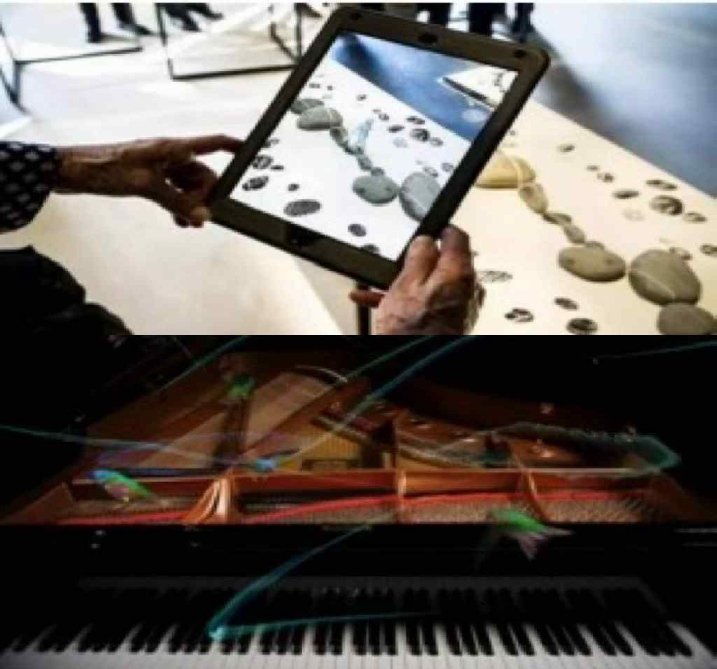
The other installation works
4-2 Traditional Sculpture Installations
Lens by Joel Adler from Sculpture by the Sea 2022 in Sydney is a mirrored sculptural installation that employs reflective surfaces to merge the viewer, the surrounding landscape, and the artwork into a unified visual field. Through controlled optical reflection, the work encourages audiences to re-examine their spatial relationship with the environment, a strategy characteristic of traditional mirrored installations grounded in material presence, spatial configuration, and the dynamics of natural light. As a physical installation, Lens produces its experiential impact through scale, materiality, and environmental context. Audience engagement occurs solely through bodily movement, which produces shifting visual outcomes without altering the artwork itself. This reflects traditional phenomenological interaction based on embodied perception, rather than system-level interactivity enabled by computational responsiveness.
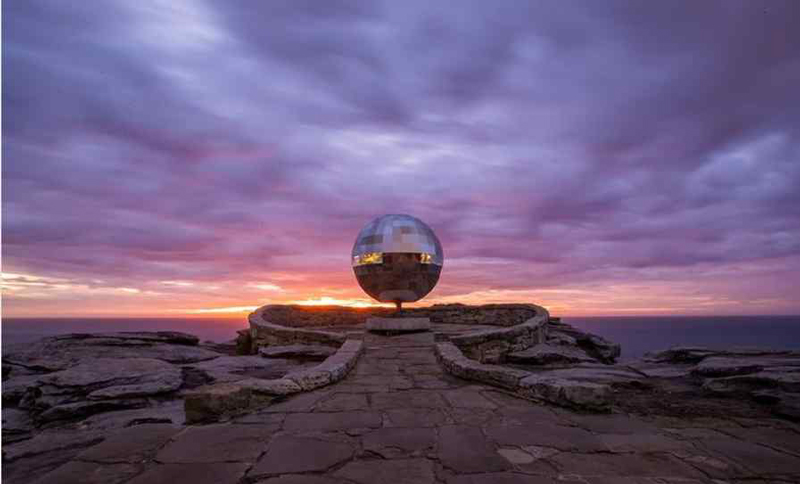
Lens

Comparisonof AR vs traditional installation
4-3 Questionnaire Results
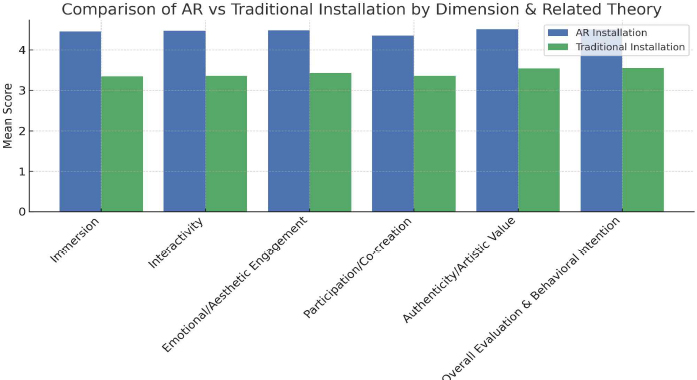
Comparison of AR vs traditional installation by dimension & related theory
This study analyzed questionnaire data collected from 37 respondents. Participants were recruited online and completed the survey on August 12, 2025, by scanning a QR code to view video materials of both AR based and traditional installation artworks before answering the questionnaire. The demographic profile of the respondents indicates that 54% identified as female and 46% as male, with ages ranging from 20s to 50s (20s: 32%, 30s: 27%, 40s: 24%, 50s: 17%). Regarding educational background, 56.76% had training in art-related disciplines, while 43.24% did not. This participant group was intentionally selected because their general exposure to art and sufficient media literacy enable them to make informed and reliable comparisons between AR and traditional installation art after viewing the video materials.
A paired sample t-test was conducted to examine differences in audience experience between AR installation art and traditional installation art across six dimensions: immersion, , interactivity (system-level responsiveness), emotional–aesthetic engagement, sense of participation and co-creation, authenticity/artistic value, and overall evaluation and behavioral intention. The results indicated that AR installation art received significantly higher scores across all six dimensions (p < 0.001).
As shown in Table 2, AR installation art received significantly higher scores than traditional installation art across all dimensions, including immersion, interactivity, emotional–aesthetic engagement, participation/co-creation, authenticity/artistic value, and overall evaluation (all ps < .001). These statistical differences provide the basis for interpreting the experiential characteristics observed in the case comparison.
Paired samples t-test results (AR vs traditional installation)
Traditional sculptural installations such as Joel Adler’s Lens rely on material presence, spatial composition, and environmental reflection to generate perceptual engagement. Audience interaction occurs mainly through bodily position changes, which aligns with the relatively lower interactivity and co-creation scores in Table 2.
In contrast, AR installations enhance user engagement through device-based manipulation, virtual–physical integration, and high interactivity supported by real-time system feedback. These features correspond directly to the significantly higher AR scores in interactivity, participation, and overall evaluation. Whereas Lens emphasizes embodied perception shaped by physical space, AR installations expand experiential possibilities through computational responsiveness and hybrid spatial layers.
Overall, the comparison demonstrates two distinct experiential modes: traditional installations foreground materiality and environmental presence, while AR installations extend immersion and participation through digital augmentation.
Ⅴ. Research Results & Discussion
5-1 Questionnaire Results Analysis
The paired-sample t-test results indicate that AR installation art scored significantly higher than traditional installation art across all experiential dimensions (p < 0.001). Overall, participants consistently rated AR installations as more immersive, interactive, emotionally engaging, participatory, and artistically valuable. This pattern aligns closely with the three theoretical frameworks.
From the perspective of immersion theory, AR’s multisensory stimulation and virtual physical integration contributed to substantially higher immersion ratings. Flow theory is supported by AR’s stronger interactivity and emotional–aesthetic engagement, suggesting that real-time feedback and dynamic variation more effectively facilitate focused, continuous engagement. In line with participatory aesthetics, AR installations also received higher evaluations in participation and co-creation, indicating that users felt a greater sense of agency and influence over the artistic experience.
Taken together, the statistical results and theoretical expectations are mutually reinforcing, demonstrating AR’s clear advantages in enhancing immersive experience, supporting flow-like engagement, and fostering participatory involvement within installation art.
5-2 The Impact of AR Technology on Installation Art
Analysis of AR installation art shows that AR not only changes how installation art is presented but also reshapes the creative process. By simulating and adjusting virtual elements in real time, artists gain greater flexibility and expressive possibilities, as in Dawn Chorus, where virtual birds’ behavior and appearance can be dynamically adapted. AR extends artworks beyond physical scale, enabling audiences to interact via mobile devices and actively influence a piece’s visual form. This transforms viewers from passive observers into participants, breaking the static, one way experience of traditional installations[11].
In works less focused on material texture or craftsmanship, AR’s real time changes and multisensory effects enhance interactivity, immersion, and personalization. By integrating visual, auditory, and other sensory channels, AR broadens the narrative scope and emotional depth of installation art, creating richer, more dynamic, and more engaging audience experiences[12].
Ⅵ. Conclusion
This study examined how AR reshapes installation art by introducing new forms of immersion, interactivity, and participatory engagement. The theoretical analysis and case studies show that AR enhances sensory integration, provides real-time feedback, and enables flexible user participation, features that traditional material installations cannot fully achieve. Works such as Chasing the Sun, Imagine Ainu, and Dawn Chorus demonstrate how AR can deepen experiential involvement and, in some cases, support flow-like engagement through continuous interaction.
However, these advantages are not universal. AR’s digital mediation may diminish the material presence valued in traditional installation art. The study is also limited by a small sample size, video-based exposure rather than in situ viewing, and a narrow range of cases. Future research should involve more diverse participants, conduct field-based evaluations, and explore how spatial context and technological reliability affect AR experiences. Comparative studies across East Asian and Western practices may further clarify regional aesthetic differences.
Overall, AR offers valuable possibilities for expanding installation art, but its effectiveness depends on thoughtful integration rather than technological novelty. Recognizing both its strengths and limitations underscores the need for ongoing interdisciplinary research into how AR can be meaningfully incorporated into different artistic and exhibition environments.
References
-
M. Slater and S. Wilbur, “A Framework for Immersive Virtual Environments (FIVE): Speculations on the Role of Presence in Virtual Environments, Presence: Teleoperators and Virtual Environments, Vol. 6, No. 6, pp. 603-616, 1997.
[https://doi.org/10.1162/pres.1997.6.6.603]

-
M. Lombard and T. Ditton, “At the Heart of It All: The Concept of Presence,” Journal of Computer-Mediated Communication, Vol. 3, No. 2, September 1997.
[https://doi.org/10.1111/j.1083-6101.1997.tb00072.x]
-
J. Chen, “Flow in Games (and Everything Else),” Communications of the ACM, Vol. 50, No. 4, pp. 31-34, April 2007.
[https://doi.org/10.1145/1232743.1232769]
- C. Bishop, Artificial Hells: Participatory Art and the Politics of Spectatorship, Verso Books, 2012.
-
J. Steuer, “Defining Virtual Reality: Dimensions Determining Telepresence,” Journal of Communication, Vol. 42, No. 4, pp. 73-93, December 1992.
[https://doi.org/10.1111/j.1460-2466.1992.tb00812.x]
-
R. T. Azuma, “A Survey of Augmented Reality,” Presence: Teleoperators and Virtual Environments, Vol. 6, No. 4, pp. 355-385, 1997.
[https://doi.org/10.1162/pres.1997.6.4.355]
-
Y. Qi and S. Zhang, “Research on the Characteristics of Immersive Installation Art from the Perspective of Digital Media,” Frontiers in Art Research, Vol. 6, No. 9, 2024.
[https://doi.org/10.25236/FAR.2024.060902]
-
Z. Gong, R. Wang, and G. Xia, “Augmented Reality (AR) as a Tool for Engaging Museum Experience: A Case Study on Chinese Art Piecesview,” Digital, Vol. 2, No. 1, pp. 33-45, 2022.
[https://doi.org/10.3390/digital2010002]
-
C. Zeller, “Language of Immediacy: Authenticity as a Premise in Benjamin’s The Work of Art in the Age of Its Technological Reproducibility,” Monatshefte, Vol. 104, No. 1, pp. 70-85, 2012.
[https://doi.org/10.1353/mon.2012.0015]
-
H. Ahn and K. C. H. Kim, “A Study on the Interaction of Immersive Contents Focusing on the National Museum of Korea Immersive Digital Gallery and Arte Museum Jeju,” Journal of Digital Convergence, Vol. 20, No. 4, pp. 575-584, 2022.
[https://doi.org/10.14400/JDC.2022.20.4.575]
-
J. Guo, Research on the Application of Painting Language in AR Installation Art from the Perspective of Children’s Participation, Zhongkai University of Agriculture and Engineering, 2023.
[https://doi.org/10.27700/d.cnki.gzcny.2023.000311]
-
D.-J. Kim, “A Study on Utilizing Media Art for Creating Immersive Spaces in Digital Art Museums,” Journal of Digital Art Engineering & Multimedia, Vol. 11, No. 2, pp. 275-284, June 2024.
[https://doi.org/10.29056/jdaem.2024.06.12]

2019.09:Digital Media Art, Nanjing Forestry University (BFA)
2024.02:Department of Multimedia, Graduate School of Digital Image and Contents, Dongguk University
2024.02~Present: Master of Multimedia Department, Graduate School of Digital Image and Contents, Dongguk University
※Research Interests:Contents Design, 3D Computer Graphic, AI Art

2014.02:Department of Video Design, Pyeongtaek University (BFA)
2016.02:Department of Multimedia, Graduate School of Digital Image and Contents, Dongguk University (MFA)
2023.08:Department of Multimedia, Graduate School of Digital Image and Contents, Dongguk University (Ph.D Degree)
2014.10~2016.04: ABITS Communications
2016.12~2018.07: ableMEDIA
2018.08~2022.02: Associate Professor, School of Art, Shandong Yingcai University, China
2024.02~Present: Lecturer, School of Fine Arts and Design, University of Jinan, Shandong, China
※Research Interests:Contents Design, 3D Computer Graphic, Intelligent Product Development, AI Art, Interaction Design, etc

1992:Department of Visual Design, College of Fine Arts, Hongik University KOR (BFA)
1999:Computer Arts, Academy of Art University USA (MFA)
2001~Present: Professor of Multimedia Department, Graduate School of Digital Image and Contents, Dongguk University
※Research Interests:VR, Contents Design, 3D Computer Graphic, Computer Animation, Visual Effects, AI Art, etc