
조직 및 개인역량 진단을 위한 표준평가 모델 및 시스템 개발구축 방안에 관한 연구
Copyright ⓒ 2025 The Digital Contents Society
This is an Open Access article distributed under the terms of the Creative Commons Attribution Non-CommercialLicense(http://creativecommons.org/licenses/by-nc/3.0/) which permits unrestricted non-commercial use, distribution, and reproduction in any medium, provided the original work is properly cited.

초록
본 연구를 통하여 조직 내 인력평가를 위한 객관적인 지표를 도출하고, 이를 기반으로 시스템을 구축하여 조직의 특성과 인력의 역량을 지속 분석·개선할 방안을 제시하고자 한다. 기존 연구를 분석하여 조직 내 인력의 특성/역량 평가 주요지표 도출하고자 한다. 최종적으로 인력을 고용할 것인지 판단할 수식도 제시하고 자 한다. 본 연구는 조직의 구조와 인력이 기업마다 다른 특성을 고려하여 객관적 평가를 할 수 있는 지표를 제시하는 것이다. 인력을 선발할 때 비 객관적 선택으로 기업이 지향하는 목표 달성에 어려움에 직면할 수 있게 된다. 따라서, 본 연구에서 제안하는 평가항목과 평가 수식 및 시스템 구축 방안을 도출함으로써, 기업의 인재 채용의 객관적이고 합리적인 체계를 제시하여 조직의 목표 및 비전 부합성 및 효율성을 극대화하고자 하였다.
Abstract
This study develops objective indicators for personnel evaluation and proposes a system for the continuous assessment and improvement of both organizational characteristics and individual competencies. Drawing on a comprehensive review of existing literature, it identifies key indicators that capture the attributes and capabilities of personnel across diverse organizational settings. A formula-based evaluation framework is introduced to support rational hiring decisions. Given the variability in organizational structures and workforce profiles, the findings highlight the need for standardized and objective metrics to mitigate risks associated with subjective or arbitrary hiring practices. The proposed indicators, computational formulas, and system architecture collectively aim to establish a transparent and systematic talent evaluation process. This approach seeks to enhance organizational efficiency and promote strategic alignment with long-term goals and vision.
Keywords:
Organizational and Personnel Evaluation, Evaluation Indicators, Competency Indicators, Standardized Evaluation Model, Prototype System키워드:
조직 및 인력평가, 평가지표, 역량측정지표, 표준평가 모델, 프로토타입 시스템Ⅰ. 서 론
최근 기업 환경은 빠르게 변화하고 있으며, 조직의 지속적인 성장은 내부 인력의 특성과 역량을 효과적으로 관리하는 데 크게 의존하고 있다[1],[2]. 기업이 목표로 하는 성과를 달성하기 위해서는 조직 내 인력의 역량을 정확히 진단하고, 이를 기반으로 적절한 의사 결정을 내리는 것이 필수적이다[3]. 그러나 최근 많은 기업에서는 인력의 역량을 체계적으로 평가할 수 있는 표준화된 측정항목이 부재한 상태이며, 이로 인해 조직 내 인력평가 과정에서 주관성이 개입될 가능성이 높다[4].
조직과 인력의 역량을 객관적으로 분석하기 위해서는 명확한 측정 기준과 표준화된 평가 모델이 필요하다[5]. 기존 연구에서도 인력의 능력과 태도, 조직 내 적응성을 종합적으로 평가할 수 있는 표준 지표의 중요성이 강조되고 있으며, 이러한 지표가 조직 성과 및 운영 효율성과 직결됨이 확인되었다[6],[7]. 특히, 업무성향, 긍정 및 부정성향, 관계성향, 문제 해결 능력, 과오와 실수에 대한 반응, 변화 대응능력, 라이프스타일, 매슬로의 욕구성향, 의식 수준 등의 요인은 조직 내에서 인력의 성과 및 협업에 직접적인 영향을 미치는 주요 요소로 확인되고 있다[8],[9].
본 연구는 조직 및 인력의 특성과 역량을 평가하기 위한 표준화된 측정 지표를 도출하고, 이를 기반으로 한 프로토타입 평가 시스템을 구축하는 것을 목적으로 한다. 이를 통해 조직의 특성과 인력의 역량을 지속 분석하고 개선할 수 있는 체계를 마련하고자 한다. 구체적으로 다음과 같은 연구 질문을 설정하였다. 연구 질의 1. 조직 내 인력의 특성과 역량을 평가하기 위해 가장 적절한 표준 측정항목은 무엇인가? 연구 질의 2. 기존 연구에서 제안된 인력 역량 평가지표는 무엇이며, 이를 기반으로 공통된 평가 기준을 어떻게 도출할 수 있는가? 연구 질의 3. 도출된 측정 지표를 반영한 시스템을 구축함으로써, 조직 운영의 효율성을 어떻게 향상할 수 있는가? 본 연구는 기존의 인력평가 방식이 갖는 주관성 및 일관성 부족 문제를 해결하고, 조직 내에서 인력의 특성과 역량을 객관적으로 측정할 수 있는 표준화된 지표를 제공하는 데 기여 할 것이다.
또한, 연구 결과를 반영한 프로토타입 시스템을 개발함으로써 기업이 실무적으로 활용할 수 있는 평가 모델을 제안하고, 이를 통해 조직의 목표와 인력의 역량 간 균형을 유지하는 방안을 제시할 것이다. 나아가, 본 연구는 기업뿐만 아니라 공공기관, 비영리 단체 등 다양한 조직에서도 활용할 수 있는 보편적인 평가 모델을 제공함으로써 조직 역량 관리의 객관성과 신뢰성을 높일 수 있게 된다.
Ⅱ. 이론적 배경
1) 업무성향
업무성향은 개인이 조직 내에서 업무를 수행하는 방식과 태도를 의미하며, 이는 개인의 직무 만족도 및 성과와 밀접한 관계가 있다[10]. 주요 측정 지표는 다음과 같다. 첫 번째는 목표 지향성(Goal Orientation)이다. 이는 주어진 과업에 대해 명확한 목표를 설정하고 이를 달성하려는 성향[11]. 두 번째는 직무 몰입도(Job Involvement): 업무에 대한 몰입 수준과 조직 목표와의 연계성이다[12]. 세 번째는 자기 효능감(Self-efficacy): 자신의 능력에 대한 신뢰와 업무 수행에 대한 자신감이다[13].

Definitions of work orientation
위의 업무성향의 3가지 요소는 그렇다면 지식기반 업무 수행(Knowledge-work)과 상황 기반 업무 수행(Manual work)과의 관계는 어떻게 되는지 살펴볼 필요가 있다. 왜냐하면, 목표지향 달성, 직무몰입도 향상, 업무처리에 대한 자기효능 감이 과연 지식기반을 가지고 업무를 수행했을 때에는 어떤 효과가 있는지도 중요하기 때문이다. 즉, Knowledge Work에서는 학습 목표 지향성과 자기 효능감을 높이는 교육과 동기부여 전략이 필요하다. Manual Work에서는 성과 목표 지향성과 직무 몰입도를 증가시키는 보상 및 동기부여 시스템이 중요하다고 할 수 있다. 조직에서는 각 업무 유형에 맞는 동기부여 전략을 마련하여, 직원들의 목표 지향성과 자기 효능감을 높이고, 직무 몰입도를 증진 시킬 필요가 있기 때문이다. 표 2는 업무성향 3요소와 지식기반 업무 수행과 상황 기반 업무 수행의 관계를 정의한 것이다.
Relationship of Knowledge vs. Manual work
2) 긍정과 부정성향
개인이 긍정적 또는 부정적인 정서를 얼마나 자주 경험하는지에 따라 업무 태도와 조직 내 관계가 영향을 받는다[14]. 긍정적 정서(Positive affectivity, PA)는 활력, 열정, 낙관적인 태도를 말하며[15], 부정적 정서(Negative affectivity, NA)는 불안, 스트레스, 불만 등 부정적인 감정 경험 빈도를 의미한다[16]. 정서 조절 능력(Emotional Regulation)은 감정을 조절하고 관리하는 능력을 말한다[17].
Positive/negative meaning in organization
3) 관계성향
조직 내에서 타인과의 관계를 맺고 유지하는 성향으로, 협업-팀워크에 중요 역할을 한다[18]. 사회적 유능감(Social Competence)는 원활한 대인관계 및 커뮤니케이션 능력을 의미한다[19]. 두 번째로는 협업 태도(Collaboration Attitude)이다. 이는 조직 내 팀워크와 상호 의존성을 말한다[20]. 세 번째는 신뢰 형성(Trust-building)으로 동료와 상사의 신뢰를 형성하고 유지하는 능력을 말한다[21].
Relational orientation meaning in organization
4) 문제 해결 능력 성향
조직 내에서 문제를 정의하고 해결하는 능력은 개인 및 조직 성과에 필수적인 요소이다[22]. 그러한 요소에는 분석적 사고(Analytical Thinking)가 있는데, 이는 문제를 논리적으로 분석하고 해결책을 도출하는 능력을 말한다(Sternberg, 1985). 두 번째는 창의적 문제 해결(Creative Problem Solving)로 창의적 아이디어를 활용한 문제 해결 능력을 의미한다[23]. 세 번째는 의사 결정 능력(Decision-making Ability)인 복잡한 상황에서 최적의 결정을 내리는 능력이 있다[24].
Problem solving meaning in organization
5) 과오 및 실수에 대한 반응
개인이 실수에 대해 보이는 태도와 대응 방식은 업무 효율성과 조직문화에 영향을 미친다[25]. 학습 지향성(Learning Orientation)은 실수를 학습 기회로 받아들이는 태도를 말한다[26]. 책임 수용성(Accountability)은 실수에 대한 책임을 인정하는 태도를 의미한다[27]. 이에 대한 조직 내 중요성을 정리하면 표 6과 같다.
Response to mistakes and errors meaning
6) 변화 대응능력
조직 환경 변화에 대한 유연성과 적응력은 직무 수행의 핵심 요소이다[28]. 핵심 요소에는 유연성(Flexibility)이 있는데, 이는 변화에 대한 수용력 및 적응 능력을 의미한다[29]. 또한, 회복 탄력성(Resilience)은 변화와 스트레스에 대한 대처능력을 말한다[30].
Adaptability to change meaning
유연성은 빠르게 변화하는 시장 환경에서 기업이 생존하고 성장하는 데 필수적인 요소이다. 회복 탄력성이 높은 조직 구성원은 스트레스를 효과적으로 관리하며 위기 상황에서도 생산성을 유지한다. 두 요소 모두 조직 내 적응성과 지속 가능성을 높이는 데 중요한 역할을 한다.
7) 라이프 스타일
개인의 생활 방식이 직무 태도와 성과에 미치는 영향을 연구하는 요소이다[31]. 이러한 요소에는 균형 유지(Work-Life Balance)가 있으며, 이는 직장-개인 생활균형을 의미한다[32]. 또한, 건강관리(Health Management) 요소로 신체적·정신적 건강 유지 능력이 있다[33].
Life style meaning in organization
이러한 직장과 개인의 라이프스타일 불균형 시 예상 결과는 다음과 같다. 첫째, 직장과 개인 생활 간 균형이 맞지 않으면 직원의 스트레스가 증가하고, 이는 건강 문제와 직무 만족도 저하로 이어질 수 있다. 둘째, 업무 과부하로 인해 신체적 피로와 정신적 번아웃이 발생하여 장기적인 생산성 감소가 초래된다. 셋째, 개인 생활의 부족으로 인해 가족 및 사회적 관계가 악화될 가능성이 높아진다. 넷째, 직무 만족도가 낮아지면서 이직률이 상승하고 조직 내 불안정성이 증가할 수 있다. 다섯째, 조직 전체적으로 동기부여가 저하되고, 혁신성과 창의성이 감소할 가능성이 있다.
8) 매슬로의 욕구성향
매슬로(1943)의 욕구 위계 이론에 기반하여, 개인의 동기부여와 관련된 요소이다. 5가지 욕구가 있는데 생리적 욕구(Physiological Needs), 안전 욕구(Safety Needs), 사회적 욕구(Social Belonging Needs), 존경 욕구(Esteem Needs), 자기실현 욕구(Self-actualization Needs)가 있다. 매슬로(A. H. Maslow, 1943)는 인간의 동기와 행동을 설명하기 위해 욕구 위계 이론(Theory of Human Motivation)을 제안했다[34]. 그는 인간의 욕구를 5단계 위계 구조로 설명하며, 하위 욕구가 충족될수록 상위 욕구를 추구하게 된다고 주장했다. 각 욕구는 개인의 삶뿐만 아니라 조직 환경에서도 중요한 역할을 하며, 특히 인력 관리 및 조직 개발에 있어 동기부여와 성과 향상의 핵심 요인으로 작용한다.
9) 의식수준
개인의 자기 인식과 내적 성찰이 조직 행동에 미치는 영향을 말한다[35]. 주요개념은 자기 인식(Self-awareness)과 감성 지능(Emotional Intelligence)가 있다.
Maslow's need orientation meaning in organization
Consciousness level meaning
조직에서 의식 수준이 미치는 영향은 다음과 같다. 첫째, 조직에서 개개인의 의식 수준이 높을수록 팀워크와 협업이 원활해지며 긍정적인 조직 문화가 형성된다. 둘째, 자기 인식이 높은 직원은 자신의 감정을 조절하고 스트레스를 관리하여 업무 수행능력을 유지한다. 셋째, 감성 지능이 높은 조직 구성원은 갈등 상황에서도 효과적으로 커뮤니케이션하여 문제 해결 능력을 높인다. 넷째, 리더가 높은 감성 지능을 가질수록 직원들의 동기부여가 강화되며 조직 충성도가 향상된다. 다섯째, 의식 수준이 낮으면 조직 내 불신과 불안정성이 증가하여 팀워크와 생산성이 저하될 가능성이 크다. 여섯째, 결과적으로, 조직 내 의식 수준이 높을수록 혁신성과 지속 가능성이 증가하며 장기적인 성과가 향상된다.
Ⅲ. 연구방법론
9가지 구성개념에 대하여 도출한 세부 질의항목 도출 후 시스템 구축 절차 및 활용까지 구체적인 방법을 제시하면 아래와 같다.

Research process
1번의 조직 및 역량 평가 기존 문헌 조사를 통하여 평가항목 이전에 구성개념(Construct)을 도출하고 2번에는 조직 및 역량 평가항목을 도출하였다. 1번과 2번은 II. 이론적 배경에서 기존 연구에서 제시하는 측정항목들이 어떤 근거를 가졌는지 정의하고 조직 내에서 왜 중요한지 제시하였다.
3-1과 3-2는 평가항목을 도출하였다 하더라도 직무 적합성을 평하는 항목인지, 혹은 조직 적합성을 평가하는 것인지 구분이 필요하다. 왜냐하면, 직무 적합성은 역량에 관한 관점을 평가하는 것이고, 조직 적합성은 조직문화, 규칙 등에 대한 적응성을 평가하는 관점이기 때문이다. 4번째 항목은 평가항목을 종합하되 역 문항을 제시하여 응답에 객관성을 확보하려고 하였다. 최종적으로 5번째 항목은 지원자의 응답을 보고 평가하여 고용할 것인지를 확정하는 단계에서 평가결과 보고서라 할 수 있다. 6번째로 시스템 구성도와 UI를 제시하고 프로토타입(Prototype)으로 개발할 시스템 구성을 제시하였다.
Ⅳ. 실증분석 결과
4-1 표준측정 지표 도출
II 이론적 배경에서 도출한 구성개념에 대하여 직무 적합성 및 조직 적합성을 분류하고자 한다. 조직 적합성은 조직문화, 팀워크, 상호작용, 변화수용 등을 말하며, 직무 적합성은 실질적인 업무처리, 문제해결력, 자기 인식, 동기부여 수준을 의미한다. 이를 종합하면 표 11과 같이 정리할 수 있다.
Classification of fit types by construct
구체적으로 업무성향에 대하여 정의하고 세부적인 질의를 생성하고자 한다. II 이론적 배경에서 다룬 기존 연구를 바탕으로 질의문을 구성한 것이며 세부 구성개념을 분류하여 표 12와 같이 정리하였다.
Questionnaire design for work orientation
업무성향에 대한 6가지 세부 구성개념은 다시 3가지 유형으로 묶을 수 있다. 첫째는 업무수행 역량 기반성향으로 신규업무의 적응성과 업무자의 내면에 있는 암묵지에서 지속 개선할 수 있는 형식지를 만들어 업무효율을 증진하는 것을 말한다. 두 번째는 커뮤니케이션의 효율성에 대하여 협업에 대한 유형이다. 개인의 업무가 아닌 조직의 업무를 담당하고 있는 차원에서 평소에 이러한 성향을 보이는지 측정이 필요하다. 세 번째로 동기부여 및 자기 주도 기반의 성향이 있는지 확인하는 것이다. 이는 적극성과 지속성, 조직과 개인 간의 목표 부합성이 이에 해당 된다. 표 12와 같이 유형을 분류한 이유는 향후에 점수로 평가할 때 주요지표로 사용될 수 있다.
Work orientation: Item structure
긍정/부정성향은 예외상황 대체능력, 부정인식 성향, 분노 및 회피 성향으로 세부 구성개념을 분류하여 제시하고자 한다. 예외상황은 준비되지 않은 상태에서의 태도와 인식을 평가하는 것이며, 부정인식은 평소에도 그러한 성향이 있는지 확인하는 것이다.
Positive/negative tendency: Item structure
또한, 긍정/부정성향 중 분노 및 회피 성향에 있어 업무 중에 협업하는 가운데 일어날 수 있는 대응법에 대한 평가이다. 긍정/부정성향은 다양한 개인적인 측면이 있어 조직 내에서 협업하는 일에는 위에서 제시한 측정항목 중에 매우 방해될 수 있다.
표 15와 같이 부정성향 감지 및 인식성향과 정서적 반응 및 조절 성향에 대하여 채용하기 전에 반드시 확인해야 할 것이다.
Positive/negative tendency: Reduced item set
조직에서는 타인에 대한 도움과 배려가 기반이 되어야 업무 효율성이 높아진다. 또한, 이해 타산적으로 돼서는 안 된다. 이러한 관계성향은 협업이 절실히 필요한 조직 내에서 협업능력 및 소통 스타일의 고착화가 되어 조직의 전반적인 분위기가 달라질 수 있다. 따라서, 이를 정리하면 표 15와 같이 제시할 수 있다. 타 구성개념 항목보다 개념축소가 필요하지 않아 표 16과 같이 유지하고자 한다. 이타주의 및 헌신이 조직에서 중요한 이유는 다음과 같다. 이 성향은 조직이나 팀의 공동 목표를 위해 자발적으로 이바지하고, 타인을 돕는 데에서 보람을 느끼며 헌신하려는 경향을 의미한다. 구성원이 이타적이고 헌신적인 태도를 보일수록 조직 내 협업, 신뢰, 공동체 의식이 강화되고, 위기 상황에서도 자발적인 지원과 책임감 있는 행동을 기대할 수 있다. 이해 타산적 성향은 자신의 이익이나 성과와 직접 연결되지 않는 일에는 참여를 꺼리는 경향으로, 행동의 기준이 주로 손익이나 보상 여부에 따라 결정되는 특징을 갖는다. 이 성향이 강한 구성원은 효율적이고 목표 지향적인 판단을 내릴 수 있지만, 조직 내 협업이나 관계 형성에는 다소 소극적일 수 있으며, 이로 인해 지식 공유나 팀워크에 제약이 생길 가능성도 있다.
Relationship orientation: Item structure
조직에서 발생하는 문제는 항상 존재하는 문제, 새롭게 등장한 문제로 나눌 수 있으나 신규채용인력의 문제 해결 능력을 측정할 때는 평소에 문제 발견, 설득, 방법, 해결 방법론 기획 능력이 있는지 확인하는 것이다. 또한, 문제가 발생하였을 때 같이 해결하는지, 체계적인 프로세스가 있는지, 타인과 문제를 공유하고 있는지 측정해야 할 것이다. 문제 해결 능력은 업무 수행 중 발생하는 다양한 상황에서 적절한 판단을 내리고 실행 가능한 대안을 도출할 수 있는 역량으로, 조직의 성과와 직결되는 핵심 역량이다.
Problem-solving orientation: Item structure
문제 해결 능력이 뛰어난 구성원은 예기치 못한 문제에 유연하게 대응하며, 복잡한 과제를 논리적으로 분석하고 해결책을 찾아 실행에 옮기는 데 강점을 보인다. 따라서 이러한 능력은 개인의 업무 성과뿐만 아니라 팀 전체의 생산성과도 밀접하게 연결된다. 문제를 해결하는 과정에서의 체계성은 문제를 감정적으로 반응하기보다 단계적이고 논리적인 절차에 따라 해결해 나가는 능력을 의미한다. 체계적인 문제 해결 접근은 문제의 본질을 정확히 파악하고, 반복되는 실수를 줄이며, 조직 전체에 일관된 해결 기준과 프로세스를 정착시키는 데 이바지한다. 이를 통해 조직은 예측 가능한 방식으로 문제를 처리할 수 있고, 지속적인 개선과 혁신을 할 수 있는 기반을 마련하게 된다.
조직에서 발생하는 과오와 실수에 대한 반응은 개인별로 천차만별일 수 있으나 과오 실수에 대하여 책임감과 시행착오를 통한 개선의 기회로 전환하는 능력이 부재한 사람은 채용하는데 좋은 평가점수를 부여할 수 없다. 조직이 과오나 실수를 책임감 있게 수용하지 않고 회피하거나 은폐하는 문화가 형성되면, 구성원들은 실수를 두려워하게 되어 도전과 혁신을 회피하게 된다. 이는 학습과 성장의 기회를 잃는 결과로 이어지며, 조직의 문제 해결 역량과 창의성이 점차 약화된다. 또한, 실수에 대한 책임 전가가 반복되면 조직 내 신뢰가 무너지고, 심리적 안전감이 낮아져 구성원 간 협업이 위축된다. 피드백과 개선이 이루어지지 않는 구조 속에서는 같은 오류가 반복되어 운영의 비효율성이 심화한다. 결국, 이러한 문화는 장기적으로 조직의 경쟁력을 떨어뜨리고, 우수 인재의 이탈을 가속할 수 있다.
Error/mistake response tendency: Item structure
조직은 기술 발전, 제도 변화, 정책 개편, 업무 방식의 전환 등 다양한 외부 및 내부 요인에 따라 끊임없이 변화에 직면한다. 이러한 변화는 예고 없이 빠르게 다가오며, 이에 유연하게 대응하지 못하면 조직은 경쟁력을 잃고 뒤처질 수 있다. 구성원 개개인이 변화에 대한 긍정적이고 수용적인 태도를 보인다면, 변화는 위기가 아닌 성장과 혁신의 기회가 된다. 특히 조직의 변화 수용력은 새로운 전략 실행, 디지털 전환, 인원 구성 재편 등과 같은 핵심 과제의 성공 여부에 직접적인 영향을 미친다. 반대로 변화에 대한 저항이 크면 조직 내 갈등과 혼란이 발생하고, 전략 실행 속도가 느려지며 성과 저하로 이어질 수 있다. 변화에 적응하고자 하는 태도는 개인의 학습 의지, 협업능력, 도전 정신과도 연결되며, 이는 곧 조직의 민첩성과 회복 탄력성으로 이어진다. 따라서 변화에 대한 적응성과 긍정적 태도는 지속 가능한 조직 운영을 위한 필수 역량이라 할 수 있다.
Change response items
조직에서 개인의 워라벨은 중요하지만, 그것만을 우선시하면 협업, 일정 조율, 커뮤니케이션 등에 비효율이 발생할 수 있다. 개인이 추구하는 업무 욕구와 회사가 요구하는 업무 간에 일관성이 없을 때, 집중력이 저하되고 이직이나 잦은 직무 변경의 원인이 될 수 있다. 반대로 조직과 개인의 업무 목표가 잘 부합할 때, 구성원은 더욱 몰입하며 지속적인 성과를 낼 수 있다. 특히 자신이 하는 일에 대해 자존감을 느끼고, 잘하고 있다는 긍정적인 감정과 성취감을 느끼는 것은 업무 만족도와 조직 충성도를 높이는 핵심 요소다. 이러한 정서적 만족은 구성원의 동기부여와 장기적인 업무 지속성에도 긍정적인 영향을 미친다. 결국, 조직은 개인의 일과 삶의 균형뿐만 아니라, 업무 일관성, 자존감까지 고려한 통합적 인재 관리가 필요하다. 다시 한번 강조하지만, 개인의 라이프스타일이 조직과 조화를 이루지 못하면, 업무 몰입도와 책임감이 낮아져 성과에 부정적인 영향을 줄 수 있다. 이러한 결과로 협업과 커뮤니케이션 과정에서 마찰이 발생하며, 조직 내 갈등과 분열이 심화 될 가능성이 있다. 또한, 개인은 조직에 소속감을 느끼지 못하고 이직이나 이탈을 고려하게 된다. 결국, 이는 조직 전체의 안정성과 생산성을 저해하는 요인이 된다.
Lifestyle orientation items
조직에서 매슬로의 욕구성향을 적용하면 첫 번째 단계인, 기본적 욕구는 개인이 조직 내에서 안정적인 급여, 적절한 근무 환경, 휴식 등 생존을 위한 기초적인 조건이 충족되기를 바라는 욕구를 의미한다. 두 번째 욕구는 소속 욕구이다. 자신이 조직의 일원으로 받아들여지고, 팀원들과의 유대감과 소속감을 통해 정서적 안정과 참여 의식을 느끼고자 하는 욕구를 말한다. 세 번째 인정 및 자존 욕구는 자신의 능력과 성과가 조직 내에서 공식적으로 인정받고, 이를 통해 자존감과 자부심 확보하고자 하는 욕구이다. 네 번째 성취 욕구는 도전적인 목표를 달성하거나 중요한 업무를 완수함으로써 성취감과 개인적 성장의 만족을 느끼려는 욕구를 의미한다. 다섯 번째 지적 욕구는 새로운 지식과 기술을 습득하고, 학습과 탐구를 통해 끊임없이 성장하고자 하는 내적 동기를 의미한다. 여섯 번째 타인의 성공을 돕고자 하는 욕구는 자신만의 성장을 넘어, 동료나 조직 구성원들의 발전을 도우며 공동의 가치를 실현하려는 헌신적이고 초월적인 욕구이다. 현재 욕구성향이 어떤단계에 있는지 평가하기 위한 것이다. 세부 구성개념 6개 중 1~5점 척도로 측정하였을 때 각 단계에서 얼마나 욕구성향을 표현하고 있는지 알 수 있다.
Maslow’s need orientation items
조직 내에서 긍정성향이 강한 구성원은 변화나 어려움 속에서도 유연하게 대처하며, 팀 분위기를 밝고 협력적으로 만드는 데 기여 한다. 반면 부정성향이 강한 구성원은 갈등을 유발하거나 회피하는 경향이 있어, 조직의 의사소통과 문제 해결 과정에 부정적인 영향을 줄 수 있다. 이러한 정서적 성향은 개인의 업무 성과뿐만 아니라 조직 전체의 분위기와 생산성에 직결된다. 또한, 이러한 구성원은 변화나 스트레스 상황에 쉽게 좌절, 회피하는 경향이 있다. 즉, 문제 해결보다 불만 제기에 집중할 수 있다. 이는 팀 내 소통을 저해하고, 협업 분위기를 냉소적으로 만들며 조직 전체의 사기 저하로 이어질 수 있다. 부정적 감정이 전파되면 다른 구성원들도 방어적으로 변하고, 신뢰 기반의 조직문화가 약화 된다.
Self-Awareness Item Structure
또한, 건설적인 피드백보다 비판적인 태도가 앞서 조직의 개선 흐름에 제동을 걸 수 있다. 결과적으로 조직의 민첩성, 창의성, 생산성이 모두 저하될 위험이 있다. 이러한 부정성향을 측정해야 하는 이유는, 단순한 성격 평가를 넘어서 조직 내에서 발생할 수 있는 위험을 사전에 파악하고, 팀 구성의 균형을 맞추기 위함이며, 긍정성향의 균형을 분석함으로써, 조직문화에 적합한 인재를 선발하고, 필요한 경우 조직 차원의 정서적 회복력 강화 프로그램을 설계할 수 있기 때문이다.
4-2 역량측정 평가 산식 개발
조직 적합성에는 긍정/부정성향, 관계성향, 과오 및 실수에 대한 대응성향, 변화와 대응능력, 라이프스타일의 각 측정항목을 적용한다. 직무 적합성에서는 업무성향, 문제 해결, 과오및 실수에 대한 대응성향, 매슬로 욕구성향, 자기인식 항목으로 측정한다. 단. 역 항목은 1점을 5점으로 대체하여 계산하여야 한다. 또한, 각 성향에 대하여 세부구성개념별로도 평균을 내어 평가할 수 있어야 한다. 첫 번째 조직 적합성에서 긍정/부정성향은 예외상황대처능력, 부정인식성향, 분노 및 회피 성향을 평가해야 한다. 관계성향은 이타주의적 및 헌신, 이해 타산적 정도에 대해서도 평균을 내어 측정한다. 과오 및 실수에 대한 대응성향은 책임감, 시행착오 획득을 평가하고, 변화와 대응능력은 변화 적응성, 변화 태도를 측정한다. 마지막으로 라이프스타일은 워라벨 중요도, 욕구 일관성, 자존감을 평가한다. 두 번째 직무 적합성은 업무성향으로 업무 수행 역량 기반성향, 커뮤니케이션 및 협업기반 성향, 동기, 자기 주도 기반성향을 평가하며, 문제 해결 성향에는 문제 해결 능력, 문제 해결 체계성을 평가한다. 과오 및 실수에 대응성향은 직무 적합성에서 계산한 결과를 활용한다. 매슬로 욕구성향은 6단계 중 어디에 가장 많이 점수가 포진해 있는지 평가한다. 마지막으로 자기인식은 부정과 긍정성향이 어느 쪽으로 치우쳤는지 평가한다. 이를 정리하면 표 23과 같다.
Result of the evaluation items
9가지 구성개념에 대하여 우선 각 항목은 1~5점 척도로 측정하고, 아래와 같이 조직 적합성 점수와 직무 적합성 점수를 산정하여 각각 3.5점 이상이 되면 “채용추천”, 만약 한쪽이 3.0~3.5점이면 “조건부 채용” 또는 “추가면접”으로 판단하고, 둘 중 하나가 3.0 미만이면 “채용 비추천”으로 한다. 이를 정리하면 다음과 같다. 다만, 아래의 산식에서 가중치는 조직이나 직무별 특성을 반영해 유연한 조정이 필요하다. 가중치는 조직 적합성 점수의 4가지 항목을 모두 합하였을 경우 1.0으로 한정하였다. 직무적합성 점수도 마찬가지로 가중치는 조직이나 직무별 특성에 따라 다르게 설정할 수 있다.
- • 조직 적합성 점수
= (긍정/부정성향 평균 × 0.3) + (관계성향 평균 × 0.3)
+ (과오 및 실수에 대한 대응성향 평균 × 0.2)
+ (변화대응능력 평균 × 0.2)
OFS = 0.3 × P̅ + 0.3 × R̅ + 0.2 × E̅ + 0.2 × C̅
- • P̅ = Average of Positive/Negative Disposition
• R̅ = Average of Relationship Disposition
• E̅ = Average of Response to Faults and Mistakes
• C̅ = Average of Change Response Ability
직무 적합성 점수 계산시 매슬로의 욕구성향 6단계의 산정방식은 몇가지 고려해야 할 사항이 있다. Maslow’s 6단계 점수를 단순히 평균으로 산정하는 경우, 6단계 동기수준 중 가장 높은 수준이 우세하면 높은 점수로 평가하는 방식인 듯하다. 즉, 단순 산술평균은 특정 단계에 집중된 동기 수준을 왜곡할 수 있으므로, 가장 높은 단계 점수의 비율이나 최빈값 중심 평가 방식도 고려되어야 한다는 것을 의미한다. 정확한 계산법이 제시되지 않는 경우 가장 높은 단계에 점수가 집중된 경우를 긍정적으로 판단하는 오류가 발생한다. 따라서, 단순 평균으로 나타날 수 있는 점수의 왜곡을 최소화하기 위하여 가장 높은 점수를 받은 단계에 대한 비율이나 최빈값 기반 평가 방식을 고려할 필요가 있다. 따라서 아래와 같이 두가지 방법을 제시하고자 한다.
① 최빈 단계 기반 평가방식(Mode-based)
가장 많이 선택된 단계(최빈값)가 어느 수준인지에 따라 점수를 부여한다. 예를 들어 최빈 단계가 6인(자기실현) 점수는 5점을, 5단계 (존경)은 4점, 4단계 (사회적 욕구)는 3점, 3단계 이하는 2점 이하를 부여하는 방식을 적용한다. 즉, 매슬로 최빈단게 점수에 가중치를 곱하는 방식을 말한다.
② 상위단계 집중도 기반 평가방식(Ratio-based)
6단계 중 5단계 또는 6단계 응답이 전체 차지하는 비율(%)을 산출하여 가중 점수화 하는 방식을 제안하다. 즉, 매슬로 고단계 응답비율은 5단계 이상 응답 개수 나누기 전체 6개 항목 수를 먼저 계산하고, 매슬로 점수는 매슬로 고단계 응답비율에 5점을 곱하고 설정할 가중치를 곱하는 방식이다. 이를 정리하면 다음과 같이 산식을 제시할 수 있다.
- • 직무 적합성 점수
= (업무성향 평균 × 0.2) + (문제해결 성향 평균 × 0.2)
+ (과오 및 실수에 대한 대응성향 평균 × 0.2)
+ (매슬로 욕구성향 6단계 평균 × 0.2)
+ (자기인식 긍정성향 × 0.2)
- JFS = 0.2 × W̅ + 0.2 × S̅ + 0.2 × E̅ + 0.2 × M̅ + 0.2 × A̅
- • W̅ = Average of Work Disposition
• S̅ = Average of Problem-Solving Disposition
• E̅ = Average of Response to Faults and Mistakes (also used commonly)
• M̅ = Average of Achievement Motivation 6-Step Scale
• A̅ = Positive Self-Perception Disposition
자기인식 부분에서 부정성향은 평균에서 차감 요인으로 포함하지 않았다. 역 항목에 대해서도 차감 요인으로 평균을 산출할 때 총합에서 1~5점 사이의 응답 값을 빼서 평균을 산출해야 한다. 단. 각 역 항목은 5점인 경우는 매우 안 좋은 성향을 말함으로 5점을 차감한다. 예를 들어 “2-1. 나는 불안함을 자주 느끼곤 한다. (하루에 1번 이상).(역 문항)”에서 응답자가 5점으로 응답한 경우 –5점으로 계산한다. 3점으로 응답 한경우 에도 –3점으로 계산한다. 조직 적합성 점수와 직무 적합성 점수에 설정하는 가중치는 조직에서 중요한 요인에 대하여 사전에 조사하여 설정하고, 조직의 특성을 반영하지 못한 결과일 경우 재조정하여 활용할 수 있다. 다만, 이러한 평가체계를 시스템으로 만들어 가중치를 학습하여 제시하는 시스템을 구현하는 것도 필요하다. 따라서, 다음과 같이 최종 채용 판단 기준으로 하여 채용을 결정한다.
- • 채용추천 : 조직 적합성 ≥ 3.5점 AND 직무 적합성 ≥ 3.5점
- • 조건부 채용 또는 추가면접: 한쪽이 3.0~3.5 점인 경우
- • 채용 비추천: 둘 중 하나가 3.0 미만인 경우
위의 3가지 결론은 결국 채용해야 할 사람을 찾기 위한 평가로써 조직 적합성과 직무 적합성 평가항목으로 구분하여 놓은 것이다. 조직 적합성은 개인의 성향, 가치관, 행동 방식이 조직의 문화나 분위기와 얼마나 잘 맞는지를 의미하며, 장기적인 조직 생활과 팀워크에 큰 영향을 미친다. 반면 직무 적합성은 개인의 지식, 기술, 경험 등이 해당 직무의 요구사항과 얼마나 일치하는지를 나타내며, 업무 성과와 직접 연결된다. 조직 적합성이 높으면 갈등이 줄고, 협업과 몰입이 자연스럽게 이루어져 안정적인 근무가 가능하다. 직무 적합성이 높으면 업무 효율성과 성과가 높아지고, 직무 만족도도 함께 상승한다. 따라서 두 적합성이 모두 충족될 때, 개인과 조직 모두에게 긍정적인 성과를 창출할 수 있다.
4-3 프로토타입 구축 방안
시스템 구축 환경은 Tomcat 11 이상의 최신 버전을 설치하고, JDK는 21, MYSQL은 8.0.41로 프로토타입을 생성하는 환경으로 설정하였다. 개발 언어는 JSP(Java Server Programming)를 사용하였다. JAVA와 MYSQL의 연결 브리지는 mysql-connector-j-9.2.0.jar 사용하여 구현하였다. 이를 정리하면 다음과 같다.
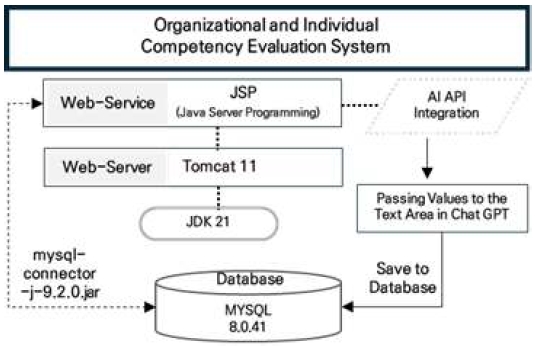
System architecture and API integration
AI의 API KEY를 획득하고 웹 서비스 내에 텍스트 영역에 값을 전달하여 데이터베이스에 저장이 되도록 하였다. AI API 서비스는 합격/불합격을 판단할 때 관리자가 판단한 근거를 작성하는 공간으로 채용하는 회사의 내규, 규칙, 기준을 작성할 수 있으며, 법적 사항이나 전문적인 의견 반영 시 검색을 통하여 작성할 수 있다.
조직 및 개인역량 진단 평가시스템은 사용자 시스템과 관리자 시스템으로 나누어 구성한다. 사용자 시스템에는 회원가입, 로그인을 통해 본인 인증을 마친 상태에서 9개 영역에 대하여 질의에 응답하도록 구성한다. 설문을 마치면 입력한 결과를 확인하고 수정할 수 있는 화면으로 이동하게 된다. 또한, 사용자 화면에서 최종결과발표 화면을 구성하고 결과화면을 제공한다.
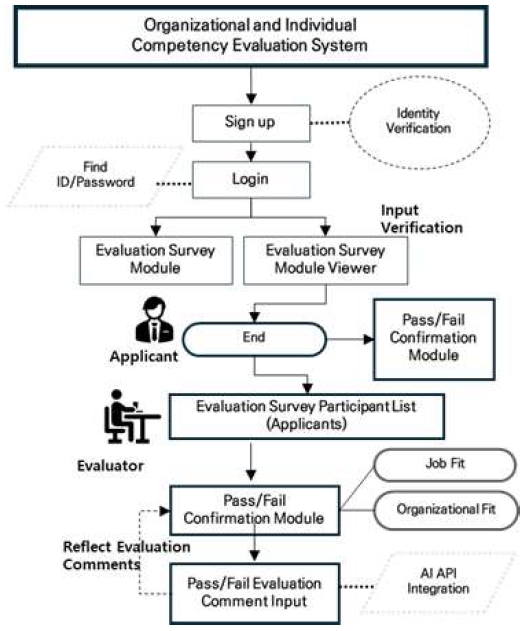
UI and authentication/integration structure
회원은 입사지원자이며 인증(핸드폰, PASS, 이메일)을 통하여 최종 회원가입이 확정된다. 평가를 위해 로그인하고 평가 설문 모듈에 들어가 질의에 응답한다. 응답한 사항에 대하여 다시 확인할 수 있도록 뷰어 모듈을 제공한다. 또한, 관리자에게는 지원자의 입력내용을 확인 수 있도록 리스트를 제공하여 합격/불합격/보류/재평가 등의 결과에 대하여 AI API 서비스 활용을 통해 근거를 작성하여 데이터베이스에 저장한다. 이렇게 저장된 의견은 채용결과를 지원자가 확인할 때 열람할 수 있도록 하였다. 채용결과에 대한 의견을 작성할 관점은 직무 적합성, 조직 적합성이며, 이에 대한 평가점수 및 의견을 지원자가 동시에 열람할 수 있어 평가 의견에 설득력 있게 수용하게 될 것이다. 기존 시스템과 다르게 평가항목에 대한 객관성이 확보된 질의항목과 AI API 서비스를 활용한 전문적인 지식을 검색하고 저장하여 향후, 비슷한 유형의 지원자가 있는 경우 기존 의견을 참고하여 채용 여부를 판단하는 정보로 활용할 수 있게 된다.
Ⅴ. 결 론
본 연구는 기업에서 조직을 구성할 때 신규로 채용하고자 할 때 평가 기준에 대하여 합리적이고 지속 관리할 수 있는 지표들이 부재로부터 출발하였다. 기존 연구에서 인재 채용에 있어 다면적으로 평가하여 객관성과 형평성을 확보하려는 노력이 있었다. 그러나, 대부분 항목들은 순 항목, 즉 긍정 항목에만 치우쳐 부정적 성향에 대하여 차감 요인으로 고려하고 있지 않았다. 또한, 이러한 산식개발로 지속 관리할 평가지표를 제시한 것은 매우 드물다.
본 연구에선 다음과 같은 이론적, 실무적 공헌을 제시하고자 한다. 첫째 이론적 공헌을 언급하기 위해서는 기존 연구 패턴을 언급하지 않을 수 없다. 기술 수용성 평가에서도 일반적으로 기술수용모델(TAM: Technology Acceptance Model)을 활용하는데 이는 모두 원인변수가 긍정요인밖에는 없다. 이때 부정요인에 대하여 지각된 가치에 영향을 미치는 구성개념을 고려하지 않는다. 이러한 부재에 대하여 가치기반 수용모델(VAM: Value based Acceptance Model)을 제시하여 결국 지각된 가치에 영향을 주는 긍정, 부정의 요인을 같이 평가하게 되었다. 따라서 긍정에 대해서는 강화하는 요인으로 부정에 대해서는 개선하는 요인으로 제시할 수 있게 되었다. 본 연구의 이론적 공헌은 긍정, 부정(역 항목)을 추출하여 제시할 평가항목 및 기준을 제시한다는 점이다. 이는 응답자의 신뢰성을 확보하는 역할을 한 것이다.
둘째, 실무적 공헌에서는 조직에서 인재를 채용하기 위해서는 다면적인 평가를 시행하지만 이를 정량화하여 객관적인 지표로 저장하고 관리하며, 채용의 의사 결정을 내리는 것은 드물다. 본 연구에서는 인재 채용의 구성개념뿐만 아니라 세부 구성개념과 측정항목을 제시하여 보편적으로 사용할 수 있도록 하였다. 다만, 기업의 특성을 반영하여 가중치를 변경하거나 측정항목을 선택적으로도 사용할 수 있다.
결론적으로 본 연구는 단순히 설문항목을 만드는 것이 아니라 역량진단을 위한 체계성을 확보하기 위한 노력을 가한 것이다. 본 연구의 체계성을 시스템으로 구현하여 데이터를 지속 수집하여 분석한 결과를 다시 시스템에 피드백하여 반영한다면 본 연구에서 제시한 측정항목에 대한 검증 및 신뢰성을 확보하는 점진적 향상을 보장한 시스템이 될 것이다.
이러한 시스템에 대하여 어떻게 구현해야 할지 실질 고객을 대상으로 프로토타입 시스템 제시와 이에 대한 피드백을 받아 개선해야 할 것이다. 또한, 본 연구에서 제시하는 측정항목에도 선택적으로 사용한 경우 평가에서 무엇이 부재해지며, 어떤 개념이 남을지 추가적인 연구가 필요하다. 본 연구는 조직 및 개인역량 진단의 많은 솔루션에도 불구하고 다시 연구한 이유는 무엇보다 측정항목의 신뢰성과 인재 선발에 대한 객관성을 확보하기 위한 것이었다.
References
-
J. Barney, “Firm Resources and Sustained Competitive Advantage,” Journal of Management, Vol. 17, No. 1, pp. 99-120, 1991.
[https://doi.org/10.1177/014920639101700108]

-
J. N. Baron and J. Pfeffer, “The Social Psychology of Organizations and Inequality,” Social Psychology Quarterly, Vol. 57, No. 3, pp. 190-209, 1994.
[https://doi.org/10.2307/2786876]
-
J. E. Delery and D. H. Doty, “Modes of Theorizing in Strategic Human Resource Management: Tests of Universalistic, Contingency, and Configurational Performance Predictions,” The Academy of Management Journal, Vol. 39, No. 4, pp. 802-835, 1996.
[https://doi.org/10.5465/256713]
-
A. Denisi and C. E. Smith, “Performance Appraisal, Performance Management, and Firm-Level Performance: A Review, a Proposed Model, and New Directions for Future Research,” Academy of Management Annals, Vol. 8, No. 1, pp. 127-179, 2014.
[https://doi.org/10.5465/19416520.2014.873178]
-
D. P. Lepak and S. A. Snell, “The Human Resource Architecture: Toward a Theory of Human Capital Allocation and Development,” The Academy of Management Review, Vol. 24, No. 1, pp. 31-48, 1999.
[https://doi.org/10.5465/amr.1999.1580439]
-
A. L. Rowe and N. J. Cooke, “Measuring Mental Models: Choosing the Right Tools for the Job,” Human Resource Development Quarterly, Vol. 6, No. 3, pp. 243-255. 1995.
[https://doi.org/10.1002/hrdq.3920060303]
-
R. M. Yusuf, S. Fidyawan, and I. S. Wekke, “Ulrich Model on Practices of Human Resource Strategic Roles,” Journal of Engineering and Applied Sciences, Vol. 12, No. 6, pp. 1657-1661, 2017.
[https://doi.org/10.31227/osf.io/ysnu8]
- R. E. Boyatzis, D. Goleman, and K. Rhee, “Clustering Competence in Emotional Intelligence: Insights from the Emotional Competence Inventory (ECI),” in Handbook of Emotional Intelligence, San Francisco, CA: Jossey-Bass, pp. 343-362. 2000. https://www.eiconsortium.org/pdf/eci_acticle.pdf
-
G. Özcelik and M. Ferman, “Competency Approach to Human Resources Management: Outcomes and Contributions in a Turkish Cultural Context,” Human Resource Development Review, Vol. 5, No. 1, pp. 72-91, 2006.
[https://doi.org/10.1177/1534484305284602]
-
G. J. Greguras and J. M. Diefendorff, “Why Does Proactive Personality Predict Employee Life Satisfaction and Work Behaviors? A Field Investigation of the Mediating Role of the Self-Concordance Model,” Personnel Psychology, Vol. 63, No. 3, pp. 539-560, 2010.
[https://doi.org/10.1111/j.1744-6570.2010.01180.x]
-
C. S. Dweck, “Motivational Processes Affecting Learning,” American psychologist, Vol. 41, No. 10, pp. 1040-1048, 1986.
[https://doi.org/10.1037/0003-066X.41.10.1040]
-
R. N. Kanungo, “Measurement of Job and Work Involvement,” Journal of Applied Psychology, Vol. 67, No. 3. pp. 341-349, 1982.
[https://doi.org/10.1037/0021-9010.67.3.341]
- F. Pajares, “Current Directions in Self-Efficacy Research,” in Advances in Motivation and Achievement, Vol. 10, Greenwich, CT: JAI Press, pp. 1-49, 1997
-
D. Watsona and A. Tellegen, “Toward a Consensual Structure of Mood,” Psychological Bulletin, Vol. 98, No. 2, pp. 219-235, 1985.
[https://doi.org/10.1037/0033-2909.98.2.219]
-
B. L. Fredrickson, “The Role of Positive Emotions in Positive Psychology: The Broaden-and-Build Theory of Positive Emotions,” American Psychologist, Vol. 56, No. 3, pp. 218-226, 2001.
[https://doi.org/10.1037/0003-066X.56.3.218]
-
D. Watson and L. A. CLARK, “Negative Affectivity: The Disposition to Experience Aversive Emotional States,” Psychological Bulletin, Vol. 96, No. 3, pp. 465-490, 1984.
[https://doi.org/10.1037/0033-2909.96.3.465]
-
J. J. Gross, “The Emerging Field of Emotion Regulation: an Integrative Review,” Review of General Psychology, Vol. 2, No. 3 pp. 271-299, 1998.
[https://doi.org/10.1037/1089-2680.2.3.271]
- D. Goleman, Working with Emotional Intelligence, New York, NY: Bantam, 1998.
-
R. E. Riggio, “Assessment of Basic Social Skills,” Journal of Personality and Social Psychology, Vol. 51, No. 3, pp. 649-660, 1986. https://psycnet.apa.org/buy/1987-00174-001
[https://doi.org/10.1037//0022-3514.51.3.649]
-
E. Salas, D. E. Sims, and C. S. Burke, “Is there a “Big Five” in Teamwork?,” Small Group Research, Vol. 36, No. 5, pp. 555-599, 2005.
[https://doi.org/10.1177/1046496405277134]
-
R. C. Mayeer, J. H. Davis, and F. D. Schoorman, “An Integrative Model of Organizational Trust,” Academy of Management Review, Vol. 20, No. 3, pp. 709-734, 1995.
[https://doi.org/10.5465/amr.1995.9508080335]
-
M. D. Mumford, S. J. Zaccaro, F. D. Harding, T. O. Jacobs, and E. A. Fleishman, “Leadership Skills for a Changing World: Solving Complex Social Problems,” The Leadership Quarterly, Vol. 11, No. 1, pp. 11-35, 2000.
[https://doi.org/10.1016/S1048-9843(99)00041-7]
-
T. M. Amabile, “The Social Psychology of Creativity: A Componential Conceptualization,” Journal of Personality and Social Psychology, Vol. 45, No. 2, pp. 357-376, 1983.
[https://doi.org/10.1037/0022-3514.45.2.357]
-
M. H. Bazerman, “The Relevance of Kahneman and Tversky's Concept of Framing to Organizational Behavior,” Journal of Management, Vol. 10, No. 3, pp. 333-343, 1984.
[https://doi.org/10.1177/014920638401000307]
-
A. Edmondson, “Psychological Safety and Learning Behavior in Work Teams,” Administrative Science Quarterly, Vol. 44, No. 2, pp. 350-383, 1999.
[https://doi.org/10.2307/2666999]
-
E. L. Decl and R. M. Ryan, “The Empirical Exploration of Intrinsic Motivational Processes,” Advances in Experimental Social Psychology, Vol. 13, pp. 39-80, 1980
[https://doi.org/10.1016/S0065-2601(08)60130-6]
-
P. E. Tetlock, “Accountability: A Social Check on the Fundamental Attribution Error,” Social Psychology Quarterly, Vol. 48, No. 3, pp. 227-236, 1985.
[https://doi.org/10.2307/3033683]
-
T. A. Judge, C. A. Higgins, C. J. Thoresen, and M. R. Barrock, “The Big Five Personality Traits, General Mental Ability, and Career Success Across the Life Span,” Personnel Psychology, Vol. 52, No. 3, pp. 621-652, 1999.
[https://doi.org/10.1111/j.1744-6570.1999.tb00174.x]
-
E. D. Pulakos, S. Arad, M. A. Donovan, and K. E. Plamomdon, “Adaptability in the Workplace: Development of a Taxonomy of Adaptive Performance,” Journal of Applied Psychology, Vol. 85, No. 4, pp. 612-624, 2000.
[https://doi.org/10.1037/0021-9010.85.4.612]
-
C. M. Youssef, F. Luthans, “Positive Organizational Behavior in the Workplace: The Impact of Hope, Optimism, and Resilience,” Journal of Management, Vol. 33, No. 5, pp. 774-800, 2007.
[https://doi.org/10.1177/0149206307305562]
-
S. Schwartz, “Toward Refining the Theory of Basic Human Values,” in Methods, Theories, and Empirical Applications in the Social Sciences, VS Verlag für Sozialwissenschaften, pp. 39-46, 2012.
[https://doi.org/10.1007/978-3-531-18898-0_6]
-
J. H. Greenhaus and N. J. Beutell, “Sources of Conflict Between Work and Family Roles,” Academy of Management Review, Vol. 10, No. 1, pp. 76-88, 1985.
[https://doi.org/10.5465/amr.1985.4277352]
- J. C. Quick, C. L. Cooper, D. L. Nelson, J. D. Quick, and J. H. Gavin, “Stress, Health, and Well-Being at Work,” in Organizational Behavior: The State of the Science, 2nd ed. Mahwah, NJ: Lawrence Erlbaum Associates Publishers, pp. 53-89, 2003. https://psycnet.apa.org/record/2003-02890-002
-
A. H. Maslow, “A Theory of Human Motivation,” Psychological Review, Vol. 50, No. 4, pp. 370-396, 1943.
[https://doi.org/10.1037/h0054346]
- K. Wilber, “Waves, Streams, States and Self. Further Considerations for an Integral Theory of Consciousness,” Journal of Consciousness Studies, Vol. 7, No. 11-12, pp. 145-176, 2000.
Appendix
부 록
Real measurement example
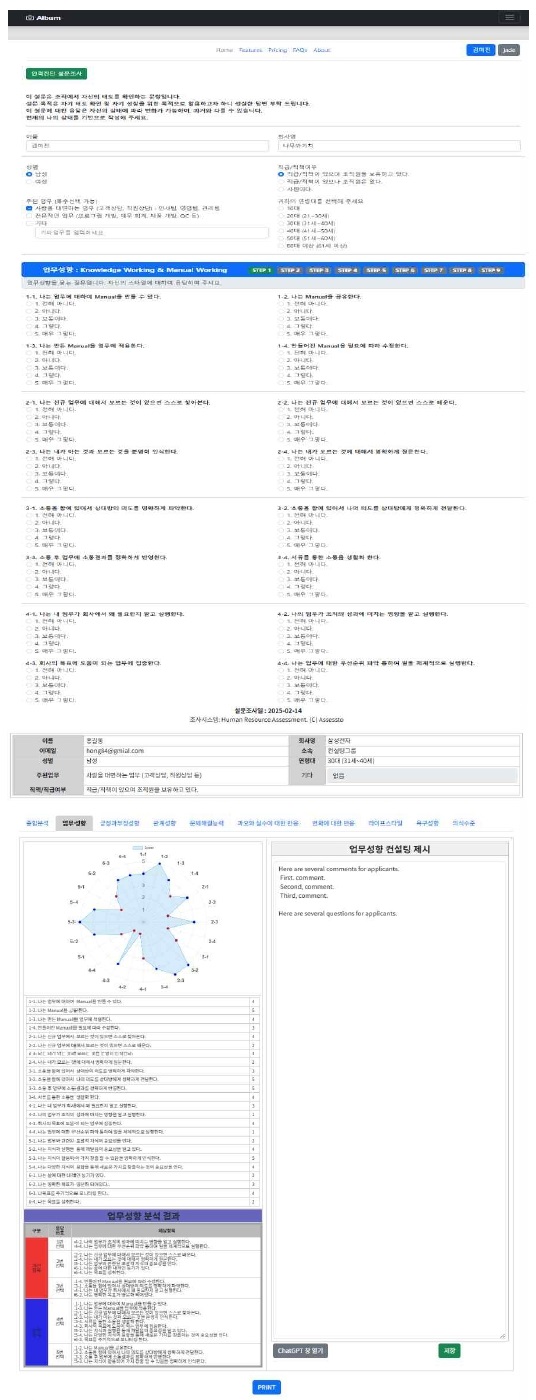
System development example*Currently, the program is written only in Korean, but it is planned to be developed in English as well in the future.
저자소개

1996년:카톨릭대학교 사회학과 (학사) 졸업
2014년:고려대학교 경영대학원 EMBA학과 (경영석사)
2023년:건국대학교 신산업융합학과 (공학박사)
1996년~1998년: 동서할부금융주식회사
1997년~현 재: 경쟁력개발연구소 소장
※ 관심분야:인공지능(AI), 정보보안, 자동화, 인적자원 경쟁력분석, 인적자원혁신, 조직혁신, 기업가정신

2000년:건국대학교 컴퓨터공학과 (공학사)
2010년:건국대학교 정보통신대학원 (공학석사-정보시스템감리)
2014년:경희대학교 일반대학원 (경영학박사-MIS)
2025년:ICT 폴리텍대학교 IT융합학과 조교수(전임)
2000년~2003년: 중소 벤처기업 진흥공단, 전산팀
2003년~2016년: 소프트웨어 기획/개발자
2017년~2018년: 피엔티 컨설팅, 정보화 전략계획(ISP), 지능화 의사 결정 시스템개발
2018년~2022년: 글로벌 오픈파트너스, 경영/기술컨설팅, 정부정보화전략계획 수립, 경제성분석, 스마트시티, 예타
2022년~2024년: 슈타겐, 경영/기술컨설팅, 메타버스
2025년~현 재: ICT 폴리텍대학교, IT융합학과, 조교수(전임)
※관심분야:소프트웨어 개발(방법론), 빅데이터 기획/분석, 인공지능 개발/활용, 사물인터넷, 스마트시티