
국내 시뮬레이션 기반 및 실제-가상 연계 교육의 교과·전공별 동향과 디지털트윈 교육의 출현 양상: 키워드 네트워크 및 BERTopic 분석
Copyright ⓒ 2026 The Digital Contents Society
This is an Open Access article distributed under the terms of the Creative Commons Attribution Non-CommercialLicense(http://creativecommons.org/licenses/by-nc/3.0/) which permits unrestricted non-commercial use, distribution, and reproduction in any medium, provided the original work is properly cited.

초록
본 연구는 국내 시뮬레이션 기반·실제–가상 연계 교육과 디지털트윈 교육의 동향 및 출현 양상을 키워드 네트워크 분석과 BERTopic으로 분석하였다. KCI Open API를 통해 2020년 1월부터 2026년 6월까지 국내 학술문헌 611편을 수집하고, 604편에 BERTopic을 적용하였다. 문헌 수는 2024년 105편, 2025년 119편으로 전년 대비 각각 26.5%, 13.3% 증가했으며, 의료·보건과 과학 분야가 전체의 80.5%를 차지하였다. 주요 키워드는 simulation, simulation-based education/training, nursing students, nursing 및 virtual reality였다. BERTopic에서는 간호 임상역량, 로봇·인공지능, 가상·실제–가상 연계, 응급·재난, 디브리핑·성찰 중심의 5개 토픽이 도출되었다. 디지털트윈 후보 문헌 12편은 디지털 모델 5편, 디지털 섀도 1편, 디지털트윈 2편 및 인접 유형 4편으로 분류되었으며, BERTopic에 포함된 11편은 독립적인 토픽을 형성하지 않았다. 엄격한 기준을 충족한 디지털트윈 연구 2편(전체의 약 0.3%)은 교육성과를 정량적으로 검증하지 않았다. 이러한 결과는 디지털트윈 교육이 아직 초기 연구영역임을 보여준다. 향후에는 양방향 물리–디지털 연계와 교육성과 검증을 결합한 연구가 필요하다.
Abstract
This study examined the trends in simulation-based, physical–virtual linkage education as well as digital-twin education in the Republic of Korea using keyword network analysis and BERTopic. We collected 611 publications from the Korea Citation Index from January 2020 to June 2026 and applied BERTopic to 604 records. Publications increased to 105 in 2024 and 119 in 2025, up by 26.5% and 13.3%, respectively. Medical and health sciences and science accounted for 80.5% of the records. The major keywords included simulation, simulation-based education/training, nursing students, nursing, and virtual reality. Five topics emerged: nursing clinical competence, robotics and artificial intelligence, virtual and physical–virtual practice, emergency and disaster training, and debriefing and reflection. Of the 12 digital-twin-related candidates, there were five digital models, one digital shadow, two digital twins, and four adjacent types. The 11 records included in BERTopic formed no distinct topic. The two strict digital-twin studies (0.3%) did not quantitatively assess educational outcomes. These findings suggest that digital-twin education remains an emerging research area. Future research should integrate bidirectional linkage with educational outcome validation.
Keywords:
Simulation-Based Education, Digital-Twin Education, Educational Research Trends, Keyword Network Analysis, BERTopic키워드:
시뮬레이션 기반 교육, 디지털트윈 교육, 교육 연구동향, 키워드 네트워크 분석Ⅰ. 서 론
디지털 전환이 교육 전반으로 확산되면서 학습환경은 온라인 콘텐츠 제공을 넘어 실제 시스템과 현상을 디지털 환경에서 탐색하고 조작하는 방향으로 확대되고 있다. 시뮬레이션 기반 교육은 실제 실습의 비용, 안전, 장비 접근성 및 시간적 제약을 보완하고, 학습자가 가상 모델이나 시나리오를 반복적으로 관찰·조작·분석할 수 있도록 지원한다. 이에 따라 과학실험, 의료·보건 훈련, 공학실습, 제조공정 및 수학적 모델링 등 다양한 교과·전공 분야에서 활용되고 있다[1],[2].
최근에는 센서, 로봇, 제어시스템, 사이버물리시스템(CPS) 및 스마트제조 기술을 활용하여 실제 시스템과 가상환경을 연계하는 교육환경도 나타나고 있다. 디지털트윈(Digital Twin)은 대응하는 물리 시스템과 디지털 모델 간의 자동화된 데이터 연계를 토대로 실제 시스템의 상태를 반영·분석·예측하고, 필요한 경우 그 결과를 물리 시스템에 다시 반영하는 기술이다[3]. 시뮬레이션은 특정 물리 시스템과의 자동화된 연계 없이도 가상 모델이나 시나리오를 활용할 수 있다는 점에서 디지털트윈과 구별된다. Kritzinger 등은 데이터 연계의 자동화 여부와 방향에 따라 자동 연계가 없는 디지털 모델, 물리 시스템의 데이터가 디지털 모델에 단방향으로 반영되는 디지털 섀도, 양방향 자동 연계가 이루어지는 디지털트윈을 구분하였다[4].
국내 시뮬레이션 기반 교육 연구는 간호학생의 임상역량과 환자안전을 중심으로 축적되어 왔다[5],[6]. 디지털트윈 관련 교육 연구는 스마트팩토리와 제조·직업교육 등의 실습환경을 중심으로 제한적으로 나타나고 있다[7],[8]. 그러나 기존 연구는 특정 전공이나 개별 교육프로그램의 개발 및 효과 검증에 초점을 둔 경우가 많아, 국내 교육 연구 전반의 분야별·기술별 활용 동향을 종합적으로 설명하는 데 한계가 있다. 또한 디지털트윈이 디지털 모델, 시뮬레이션, 가상·원격실험, CPS 및 스마트제조 등의 인접 개념과 혼용되고 있어, 관련 문헌을 데이터 연계 수준에 따른 기술적 기준으로 재검토할 필요가 있다.
이에 본 연구는 분석 범위를 두 층위로 설정하였다. 첫째, 국내 교육 연구의 전반적인 흐름을 파악하기 위해 시뮬레이션, 가상·원격실험, 로봇·센서 기반 실습, CPS 및 스마트제조 등을 포함한 시뮬레이션 기반 및 실제–가상 연계 교육 연구를 포괄적으로 분석하였다. 둘째, 제목, 초록 또는 저자키워드에 디지털트윈·디지털 섀도 관련 용어가 포함된 문헌과 디지털트윈 검색식으로 수집된 문헌의 합집합을 구성하여 후보 문헌을 추출하였다. 후보 문헌은 원문 검토를 거쳐 물리 시스템과 디지털 모델의 존재, 자동 데이터 연계 여부 및 데이터 흐름의 방향에 따라 디지털 모델, 디지털 섀도, 디지털트윈 및 인접 유형으로 재분류하였다. BERTopic 결과는 기술적 판정 기준이 아니라 후보 문헌의 의미적 토픽 분포를 확인하는 보조자료로 활용하였다. 단순 온라인교육과 연구범위에 해당하지 않는 일반적인 디지털 콘텐츠 활용 연구는 제외하였다.
본 연구는 KCI Open API를 통해 수집한 KCI 수록 국내 학술문헌을 대상으로 키워드 네트워크 분석과 BERTopic 기반 토픽모델링을 수행하였다. 키워드 네트워크 분석을 통해 주요 개념의 동시출현 관계와 연결 구조를 파악하고[9], 문서 임베딩, 차원 축소, 밀도 기반 군집화 및 class-based TF-IDF를 결합한 BERTopic을 활용하여 의미적 토픽을 도출하였다[10]. 이를 바탕으로 연도별 변화, 교과·전공 분야와 적용 기술의 분포, 핵심 키워드의 연결 구조 및 주요 토픽을 분석하였다. 디지털트윈 관련 후보 문헌은 데이터 연계 방향과 교육적 활용 특성을 중심으로 별도의 원문 내용분석을 수행하였다.
본 연구의 연구문제는 다음과 같다.
RQ1. 국내 시뮬레이션 기반 및 실제–가상 연계 교육 연구는 연도별 및 교과·전공 분야별로 어떠한 분포를 보이며, 적용 기술은 분야별로 어떠한 활용 특성을 나타내는가?
RQ2. 관련 연구에 나타난 핵심 키워드와 개념 간 연결 구조는 어떠한가?
RQ3. BERTopic 기반 토픽모델링 결과, 관련 연구는 어떠한 토픽 구조를 형성하는가?
RQ4. 디지털트윈 관련 후보 문헌은 데이터 연계 수준에 따라 디지털 모델, 디지털 섀도, 디지털트윈 및 인접 유형으로 어떻게 분류되며, 어떠한 출현 양상과 교육적 특징을 보이는가?
본 연구는 국내 시뮬레이션 기반 및 실제–가상 연계 교육 연구의 분야별·기술별 흐름을 종합적으로 제시하고, BERTopic의 의미적 토픽 구조와 디지털트윈 후보 문헌의 기술적 분류 결과를 구분하여 분석한다는 점에 의의가 있다. 이를 통해 실제–가상 연계 교육환경의 설계, 교과·전공 내용과의 연계, 학습자 상호작용 및 교육성과 검증을 위한 후속 연구의 기초자료를 제공하고자 한다.
Ⅱ. 이론적 배경
2-1 시뮬레이션 기반 교육과 디지털트윈 교육의 개념 및 구분 기준
시뮬레이션 기반 교육은 실제 시스템이나 현상을 가상 모델이나 시나리오로 재현하여 학습자가 반복적으로 관찰·조작·분석하도록 지원하는 방식이다[1],[2]. 이는 대응하는 물리 시스템이나 자동 데이터 연계 없이도 구현될 수 있다. 반면 디지털트윈은 물리 시스템과 디지털 모델 간의 자동화된 데이터 연계를 바탕으로 실제 상태를 반영·분석·예측하고 그 결과를 물리 시스템에 다시 반영하는 기술이다[3].
본 연구는 인접 개념과의 구분을 위해 Kritzinger 등의 분류체계를 적용하였다[4]. 디지털 모델은 데이터가 수동으로 갱신되는 경우, 디지털 섀도는 물리 시스템의 데이터가 디지털 모델에 단방향으로 자동 반영되는 경우, 디지털트윈은 두 대상이 양방향으로 자동 연계되는 경우를 의미한다. 구체적인 구분 기준은 표 1과 같다.

Conceptual and Operational Distinctions among Simulation and Physical–Virtual Linkage Environments
디지털트윈 기반 교육은 공학·산업교육에서 실제 장비와 가상모델을 연계하는 방식으로 논의되어 왔다[11], [12]. 가상·원격실험은 대응하는 디지털 모델이나 자동 데이터 연계를 반드시 요구하지 않으며[13], 로봇 기반 교육은 제어·프로그래밍 학습에 활용된다[14]. CPS와 스마트제조 역시 실제–가상 연계를 구현하는 기술환경이지만[15], 그 자체를 디지털트윈으로 간주할 수는 없다.
따라서 본 연구는 시뮬레이션, 가상·원격실험, 로봇, CPS 및 스마트제조 교육을 전체 분석범위에 포함하되, 디지털트윈 관련 후보 문헌은 물리 시스템과 디지털 모델의 존재 및 자동 데이터 연계 방향에 따라 별도로 분류하였다. 학습자에게 제공되는 시각적·언어적 피드백은 교육적 피드백으로 보았으며, 이를 물리 시스템에 대한 자동 데이터 연계나 제어로 판정하지 않았다.
2-2 혁신확산이론과 실제–가상 연계 기반 교육의 수용·확산
혁신확산이론은 새로운 기술이나 아이디어가 사회체계에서 수용·확산되는 과정을 설명한다. Rogers는 혁신 수용에 영향을 미치는 특성으로 상대적 이점, 적합성, 복잡성, 시험 가능성 및 관찰 가능성을 제시하였다[16]. 시뮬레이션 기반 및 실제–가상 연계 교육에서는 기존 실습의 제약을 보완하는 정도가 상대적 이점에, 교과·전공의 학습목표 및 실습 방식과의 부합 정도가 적합성에 해당한다. 반면 장비 구축, 디지털 모델 구현, 데이터 연계 및 교수자의 기술 활용 역량은 복잡성을 높일 수 있으며, 소규모 적용 가능성과 학습과정·성과의 확인 가능성은 각각 시험 가능성과 관찰 가능성에 연결된다.
본 연구에서는 의료·보건 분야의 높은 활용 비중을 반복 실습과 안전 확보의 이점 및 교육적 적합성 측면에서, 공학·제조 분야의 제한적 활용을 인프라 구축과 데이터 연계의 복잡성 측면에서 해석하였다. 다만 이론의 구성요소를 문헌별 변수로 직접 코딩하지 않았으므로, 분야별 문헌 수를 기술 수용이나 확산 수준의 직접적인 지표로 간주하지 않았다. 따라서 혁신확산이론은 결과를 설명하는 보조적 관점으로만 활용하였다.
2-3 TPACK 관점에서 본 기술–교과–교수학습 통합
TPACK은 효과적인 기술 기반 수업을 위해 기술지식(TK), 교과내용지식(CK), 교수학적 지식(PK)과 이들 지식의 상호작용이 통합되어야 한다는 관점이다[17]–[19]. 실제–가상 연계 교육에서 TK는 시뮬레이터, 센서, 로봇 및 데이터·제어시스템의 활용 지식, CK는 모델링, 제어 원리, 데이터 해석, 임상 판단 및 실험 설계 등의 교과·전공 내용, PK는 반복 실습, 탐구·문제해결, 피드백 및 평가를 설계하는 지식과 관련된다.
로봇이나 시뮬레이터의 조작 또는 물리 시스템과 디지털 모델의 양방향 연계만으로 교육적 통합이 이루어졌다고 볼 수는 없다. 기술을 교과 개념, 학습활동, 피드백 및 평가와 연결해야 하며, 디지털트윈의 기술적 구현 수준과 교육적 통합 수준도 구분하여 검토해야 한다. 본 연구에서는 교과·전공 분야와 적용 기술을 구분하여 활용 특징을 살펴보았으나, TPACK 구성요소를 직접 코딩하지 않았으므로 이를 분야별 차이의 인과적 설명이 아닌 후속 교수학습 설계를 위한 보조적 관점으로 활용하였다.
Ⅲ. 연구방법
3-1 분석 대상 및 자료 수집
본 연구는 국내 시뮬레이션 기반 및 실제–가상 연계 교육 연구의 동향과 디지털트윈 교육의 출현 양상을 분석하기 위해 KCI Open API를 활용하였다. 자료는 2026년 7월 2일에 수집하였으며, API 검색의 출판기간은 2020년 1월부터 2026년 6월까지로 설정하였다. 분석 대상은 해당 기간 KCI에 수록된 국내 학술문헌(학술지 논문 및 학술대회 수록문헌)으로 한정하였다.
검색어는 디지털트윈 및 실제–가상 연계, 시뮬레이션·가상·원격실험, 로봇 기반 교육·실습, 피지컬·체화형 AI, CPS·스마트제조의 5개 검색어군으로 구성하였다. 기술 용어의 직접 검색식과 교육, 학습, 수업, 훈련 및 실습 등의 교육 맥락 용어를 결합한 검색식을 함께 사용하였다. 한국어와 영어의 동의어, 띄어쓰기, 하이픈 및 표기 변이를 반영한 총 58개 검색식을 KCI Open API의 논문명(title) 필드에 개별적으로 요청하고, 검색 결과의 모든 페이지를 수집하였다. 그 결과 검색식 간 중복을 포함하여 총 2,933건이 확인되었다. 검색어군과 대표 검색어는 표 2에, 전체 검색식과 검색식별 수집 건수 및 API 처리 절차는 부록 표 11에 제시하였다. 다만 논문명 필드를 중심으로 검색하였으므로, 관련 내용을 다루더라도 검색어가 제목에 나타나지 않은 문헌은 누락되었을 가능성이 있다.
Search query groups and representative search terms
수집된 문헌은 KCI 문헌 식별자와 DOI를 우선 적용하여 중복을 제거하였다. 해당 식별정보가 없는 경우에는 제목, 제1저자, 출판연도 및 수록지명을 종합적으로 검토하였다. 중복 제거 결과 1,509건의 고유 문헌이 확인되었으며, 이 가운데 상세 서지정보가 확보된 1,495건을 선별 대상으로 사용하였다. 상세정보를 확보하지 못한 14건은 제외하였다.
1차 선별에서는 제목, 초록 및 저자키워드를 검토하였다. 시뮬레이션·가상실험을 교과·전공 학습에 활용한 연구, 교육 목적으로 물리 시스템과 가상환경·디지털 모델·데이터를 연계한 연구 및 관련 교육모형을 구체적으로 제안한 연구를 포함하였다. 반면 기술·시스템·알고리즘 개발이나 모델 성능평가가 중심인 연구, 교육적 활용이 명확하지 않은 산업·임상·정책 연구 및 연구범위와 무관한 일반 온라인·AI 교육 연구는 제외하였다. 이에 따라 832건을 제외하고 663건을 최종 적합성 검토 대상으로 선정하였다.
최종 적합성 검토에서는 교육적 활용이 명확하지 않은 52건을 추가로 제외하여 611편을 최종 분석 대상으로 선정하였다. 이 중 제목, 초록 또는 저자키워드의 텍스트 정보가 부족한 7편을 제외한 604편을 BERTopic 분석에 활용하였다. 전체 자료 수집 및 선별 과정은 그림 1과 같다.
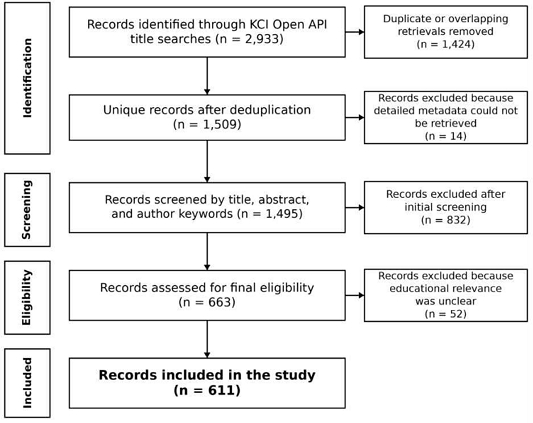
Literature identification and screening processNote. Of the 611 included records, 602 were used for author-keyword analysis (9 lacked author keywords) and 604 for BERTopic analysis (7 lacked sufficient text). These analytical subsets were selected independently. Twelve digital-twin-related candidates were separately examined through full-text review.
디지털트윈 관련 후보 문헌은 최종 분석 대상 중 제목, 초록 또는 저자키워드에 디지털트윈·디지털 섀도 관련 용어가 포함된 문헌과 디지털트윈 검색식으로 수집된 문헌의 합집합으로 구성하였다. 후보 문헌의 추출과 기술적 분류는 BERTopic 결과와 독립적으로 수행하였다. 중복 제거 결과 12편이 확인되었으며, 이 중 11편은 BERTopic 분석에 포함되었다. 나머지 1편은 텍스트 정보가 부족하여 BERTopic 분석에서만 제외하고 원문 분류에는 포함하였다.
3-2 데이터 전처리 및 분석 절차
최종 선정된 611편에서 제목, 초록, 저자키워드, 출판연도, 저자, 수록지명 및 DOI를 추출하였다. 저자키워드가 확인된 602편을 키워드 분석에 활용하고, 키워드가 없는 9편은 해당 분석에서만 제외하였다. 메타데이터가 원문과 일치하지 않은 1편은 KCI 서지정보와 원문을 대조하여 정정하였다.
키워드 전처리에서는 대소문자, 띄어쓰기, 단수·복수, 하이픈 및 한·영 동의어를 통일하고 불필요한 특수문자를 제거하였다. education, learning, student(s)와 이에 대응하는 한국어 표현은 단독 키워드일 때만 제외하고, nursing education이나 nursing students와 같은 복합 키워드는 유지하였다. 동일 문헌에서 같은 정규화 키워드가 반복된 경우에는 1회로 계산하였다. 주요 원 키워드의 빈도는 4-2절에, 키워드 대응관계와 정규화 후 빈도는 표 7에 제시하였다.
교과·전공 분야는 교육대상, 중심 학습목표 및 학습활동을 기준으로 문헌별 하나의 대표 분야를 부여하였다. 복수 분야에 해당할 수 있는 경우에는 적용 기술보다 중심 학습목표를 우선하였다. 예를 들어 로봇·센서를 활용하더라도 과학 개념과 탐구가 중심이면 과학, 로봇의 프로그래밍·제어·조작이 중심이면 로봇·로보틱스, 프로그래밍·AI·데이터·시스템 모델링이 중심이면 컴퓨터·정보로 분류하였다. 적용 기술은 시뮬레이션, 가상·원격실험, 로봇·센서, 피지컬·체화형 AI, CPS·스마트제조 및 디지털트윈 등으로 별도 분류하고 복수 코딩을 허용하였다. 따라서 분야별 문헌 수는 상호 배타적이지만 적용 기술은 중복될 수 있다. 분야 분류 기준은 표 8에 제시하였다.
포함·제외 판정과 대표 분야 분류는 2명의 분석자가 동일한 코드북에 따라 독립적으로 수행하였다. 분석자 간 일치도는 Cohen’s κ로 산출하였으며, 포함·제외 판정은 κ=.91, 대표 분야 분류는 κ=.87로 나타났다. 불일치 문헌은 제목, 초록, 저자키워드 및 원문을 교차 검토하여 합의하였다. 적용 기술의 복수 코딩과 토픽명도 두 분석자의 검토와 합의를 거쳐 확정하였다.
연도별 비교는 완전한 연간 자료가 확보된 2020~2025년을 기준으로 하고, 2026년 자료는 6월까지의 부분 연도로 구분하였다. 동일 문헌에 제시된 키워드 쌍을 동시출현 관계로 정의하고, 같은 쌍이 반복된 경우에는 1회로 계산하였다. 전체 네트워크에는 동시출현 빈도 2회 이상인 관계를 포함하였으며, 시각화에는 빈도 상위 20개 키워드 중 동시출현 빈도 5회 이상인 관계를 제시하였다. 노드 크기와 엣지 두께는 각각 문헌 빈도와 동시출현 빈도에 비례하도록 설정하였다. 검색 설계의 영향을 점검하기 위해 검색어군을 직접 나타내는 시드 용어를 제외한 보조 분석도 수행하였다.
BERTopic 분석에는 제목, 초록 및 저자키워드 정보가 충분한 604편을 활용하였다. 분석 텍스트는 국·영문 제목, 초록 및 저자키워드를 결합하되 수록지명, 학문분류 및 사전 코딩한 분야·기술 정보는 제외하였다. 문서 임베딩에는 paraphrase-multilingual-MiniLM-L12-v2를 사용하고[20], UMAP과 HDBSCAN을 적용하였다[21],[22]. UMAP은 n_neighbors=15, n_components=5, min_dist=0.0, metric=cosine, random_state=42로, HDBSCAN은 min_cluster_size=15, min_samples=5, metric=euclidean, cluster_selection_method=eom으로 설정하였다. 토픽 수는 사전에 지정하지 않았으며, min_df=2와 1~2그램을 적용한 c-TF-IDF 대표어를 토픽 표현에 활용하였다. 세부 설정은 표 6에 제시하였다.
토픽은 문헌 수, c-TF-IDF 대표어 및 대표 문헌의 제목·초록을 종합하여 교육대상, 적용 기술 및 학습활동을 기준으로 명명하였다. 기능어와 일반적인 연구 서술어는 대표어에서 제외하였다. 기준모형에서 도출된 5개 원 군집은 병합·분할하거나 문헌을 재배치하지 않았으며, 잡음으로 분류된 15편도 다른 토픽에 재배정하지 않고 별도 범주로 유지하였다. 원 군집과 최종 토픽의 대응, 명명 근거 및 대표 문헌은 표 9에 제시하였다.
파라미터 변화에 따른 결과의 민감도는 UMAP의 n_neighbors를 10과 30으로, HDBSCAN의 min_cluster_size를 10과 20으로 변경한 비교모형을 통해 검토하였다. 조건별 토픽 수, 잡음 비율, NPMI, 토픽 다양도 및 실루엣 계수를 비교하고, 기준모형과 각 비교모형 간 문헌별 군집 일치도를 ARI와 NMI로 산출하였다. 민감도 분석 결과는 표 10에 제시하였다.
디지털트윈 관련 후보 문헌 12편은 물리 시스템과 대응하는 디지털 모델의 존재, 자동 데이터 연계 여부 및 데이터 흐름의 방향을 기준으로 디지털 모델, 디지털 섀도 및 디지털트윈으로 분류하였다. 해당 조건을 충족하지 못한 문헌은 시뮬레이션·가상 시각화 또는 개념·설계 제안으로 구분하였다. 실시간성, 학습자 피드백 및 교육성과 검증 여부는 교육적 활용을 설명하는 보조 항목으로 기록하되 기술 유형의 판정 기준으로는 사용하지 않았다. 최종 분류는 두 분석자의 원문 검토와 합의를 통해 확정하였다.
Ⅳ. 연구결과
4-1 분석 대상 문헌의 연도별 변화 양상
최종 선정된 KCI 수록 국내 학술문헌 611편의 연도별 분포를 분석하였다. 연도 간 변화는 완전한 연간 자료가 확보된 2020~2025년을 기준으로 비교하였으며, 2026년 자료는 6월까지의 부분 연도 자료로 구분하였다.
분석 결과, 2020년 80편, 2021년 78편, 2022년 88편, 2023년 83편으로 비교적 유사한 수준을 유지하였다. 이후 2024년에는 105편으로 전년보다 26.5% 증가하였고, 2025년에는 119편으로 다시 13.3% 증가하였다. 2026년에는 6월까지 58편이 확인되었으나, 부분 연도 자료이므로 이전 연도와 직접 비교하지 않았다.
이러한 결과는 국내 시뮬레이션 기반 및 실제–가상 연계 교육 연구가 2020년 이후 지속적으로 발표되었으며, 특히 2024년과 2025년에 양적으로 확대되었음을 보여준다. 다만 문헌 수의 변화만으로 특정 기술의 확산이나 교육적 수요 증가를 단정하기는 어려우므로, 해당 기간 연구 발표가 증가한 것으로 제한하여 해석하였다.
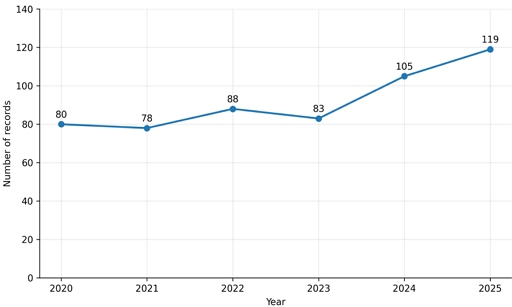
Annual distribution of analyzed records, 2020-2025Note. The 58 records published from January through June 2026 were included in the total of 611 records but excluded from the full-year trend comparison. Data were retrieved on July 2, 2026.
4-2 핵심 저자키워드 및 동시출현 네트워크 구조
저자키워드가 확인된 602편을 대상으로 문헌 빈도와 동시출현 관계를 분석하였다. 정규화 전 주요 원표기의 빈도는 Simulation 113편, 시뮬레이션 111편, 간호대학생 76편, Simulation training 65편, Nursing 52편, 시뮬레이션 교육 50편, Nursing students 49편, 가상현실 40편이었으며, 임상수행능력과 Simulation Training은 각각 33편이었다. Education 49편과 Students 39편도 확인되었으나, 단독으로 사용된 일반 맥락어이므로 최종 분석에서 제외하였다.
정규화 전에는 동일한 개념이 언어, 대소문자, 단수·복수 및 표기 방식에 따라 분산되어 있었다. 예를 들어 간호 학습자 관련 키워드는 간호대학생, 간호학생, Nursing students 및 Nursing Students 등으로 나뉘어 나타났다. 이를 통합하고 동일 문헌에서 한 번만 계산한 결과, simulation이 151편(25.1%)으로 가장 많았고 simulation-based education/training 145편(24.1%), nursing students 130편(21.6%), nursing 58편(9.6%), virtual reality 57편(9.5%) 순이었다. 이어 clinical competence/performance 51편(8.5%), problem-solving ability 43편(7.1%), self-efficacy 38편(6.3%), nursing education 35편(5.8%), patient safety 28편(4.7%)으로 나타났다. 정규화된 주요 키워드 빈도는 그림 3에, 키워드 대응관계와 정규화 후 빈도는 부록 표 7에 제시하였다.
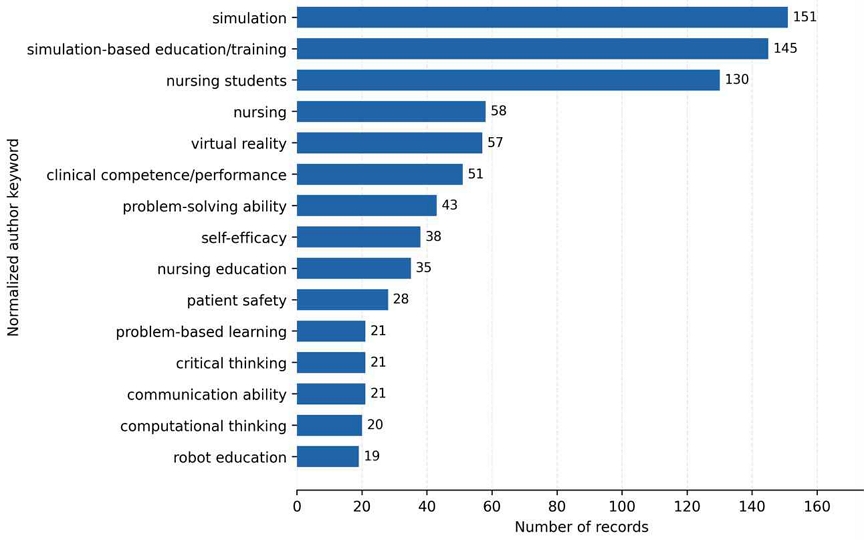
Document frequency of normalized author keywordsNote. Keywords were counted once per document after normalization. Standalone general terms such as education, learning, and student(s) were excluded, whereas compound keywords were retained.
검색 시드 용어의 영향을 점검한 보조 분석에서는 nursing students 130편, nursing 58편, virtual reality 57편, clinical competence/performance 51편, problem-solving ability 43편, self-efficacy 38편 순으로 나타났다. 시드 용어를 제외한 후에도 간호교육, 임상역량 및 학습성과 관련 개념이 주요하게 유지되었다.
주요 동시출현 관계는 그림 4와 같다. nursing students–simulation이 63회로 가장 많았고, nursing students–simulation-based education/training 46회, nursing–simulation 25회, clinical competence/performance–simulation 22회 순이었다. clinical competence/performance–nursing students, clinical competence/performance–simulation-based education/training 및 nursing–simulation-based education/training은 각각 21회였다. 네트워크에서 simulation과 simulation-based education/training은 간호학생, 임상역량 및 가상현실 관련 키워드와 다수의 연결을 형성하였다. 이는 국내 관련 연구가 간호학생의 임상역량과 학습성과를 다룬 시뮬레이션 교육을 중심으로 형성되었음을 보여준다.
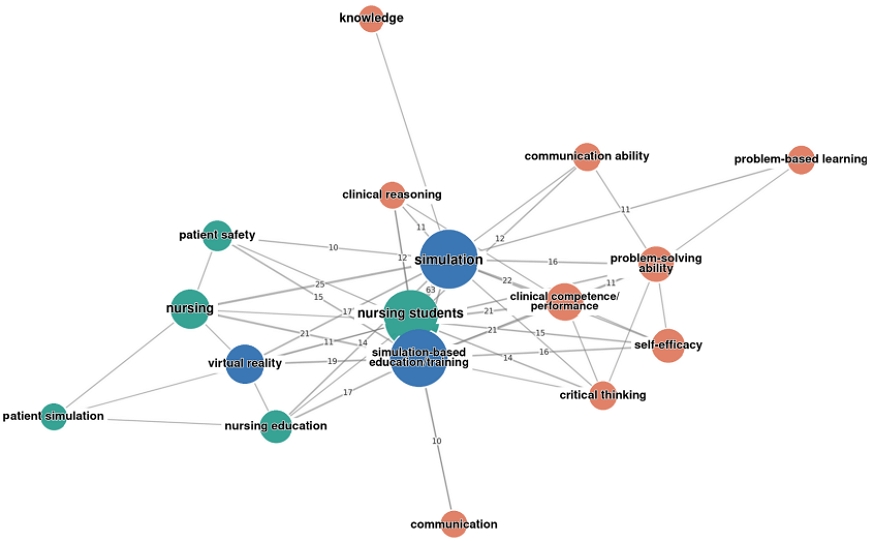
Co-occurrence network among the 20 most frequent normalized author keywordsNote. The network displays connected keywords among the 20 most frequent normalized author keywords; isolated keywords are omitted. Only keyword pairs appearing together in at least five documents are shown. Node size represents document frequency, edge width represents co-occurrence frequency, and edge labels indicate co-occurrence counts.
한편 digital twin은 11편으로 키워드 분석대상 602편의 1.8%를 차지했으며, 빈도 순위는 29위였다. 이는 관련 저자키워드가 포함된 문헌 수일 뿐, 기술적 기준을 충족한 디지털트윈 교육 연구의 수는 아니다. RQ4에서는 BERTopic과 독립적으로 추출한 후보 문헌 12편을 원문 검토하여 분류하였으므로, 저자키워드 빈도와 기술적 판정 결과를 구분하여 해석하였다.
4-3 교과·전공 분야별 활용 양상
최종 분석대상 611편은 교육대상, 중심 학습목표 및 학습활동에 따라 하나의 대표 교과·전공 분야로 분류하였다. 적용 기술은 분야와 별도로 복수 코딩하였으므로 분야별 문헌 수는 상호 배타적이지만, 적용 기술은 중복될 수 있다. 분야별 분포와 주요 적용 기술 및 교육적 활용 특성은 표 3과 같다.
Distribution, technologies, and educational uses by field
의료·보건 분야가 357편(58.4%)으로 가장 많았고, 과학 분야가 135편(22.1%)으로 뒤를 이었다. 두 분야는 총 492편으로 전체의 80.5%를 차지하였다. 로봇·로보틱스는 57편(9.3%), 컴퓨터·정보는 29편(4.7%)으로, 상위 네 분야가 총 578편(94.6%)을 차지하였다. 나머지 분야는 총 33편(5.4%)으로 연구 축적이 상대적으로 제한적이었다.
의료·보건 분야에서는 고충실도 시뮬레이션과 가상현실을 활용한 임상실습, 임상판단 및 수행평가가 주로 나타났다. 과학 분야에서는 가상실험과 개념 시각화, 로봇·센서 기반 탐구활동이 활용되었다. 로봇·로보틱스 분야는 로봇제어, 프로그래밍, 조작 및 문제해결 활동을, 컴퓨터·정보 분야는 인공지능, 데이터 시스템 및 가상환경을 활용한 프로그래밍과 모델링 활동을 중심으로 구성되었다. 공학·제조·직업교육에서는 CPS, 스마트팩토리, 공정 시뮬레이션 및 장비 기반 훈련이 확인되었으나 문헌 수는 적었다.
이러한 분포는 반복 실습과 안전 확보의 필요성이 큰 분야를 중심으로 시뮬레이션 기반 교육 연구가 축적되었을 가능성을 시사한다. 특히 의료·보건 분야의 높은 비중은 간호학생, 임상역량 및 환자안전 관련 키워드가 주요하게 나타난 4-2절의 결과와도 일관된다. 다만 혁신확산이론과 TPACK의 구성요소를 문헌별 변수로 직접 코딩하지 않았으므로, 분야별 차이를 기술 수용이나 기술–교과–교수학습 통합 수준의 결과로 단정하지 않았다.
4-4 BERTopic 기반 토픽 구조
제목, 초록 및 저자키워드 정보가 충분한 604편을 대상으로 BERTopic 분석을 수행하였다. 기준모형에서 HDBSCAN은 5개의 원 군집과 15편의 잡음 문헌을 산출하였다. 실제 산출된 원 군집의 문헌 수는 모두 min_cluster_size=15 이상이었다. 군집의 병합·분할이나 문헌 재배치는 수행하지 않았으며, 잡음 문헌 15편(2.5%)도 다른 토픽에 강제로 할당하지 않고 별도 범주로 유지하였다. 각 군집은 c-TF-IDF 대표어와 대표 문헌의 제목·초록을 종합하여 명명하였다. 원 군집과 최종 토픽의 대응, 토픽 명명 근거 및 대표 문헌은 부록 표 9에 제시하였다.
T0 ‘간호 임상역량 중심 시뮬레이션 교육’은 217편(35.9%)으로 가장 많았고, T1 ‘로봇·인공지능 기반 융합교육’은 161편(26.7%)이었다. T2 ‘가상현실 및 실제–가상 연계 실습’은 123편(20.4%), T3 ‘응급·재난 대응 시뮬레이션 훈련’은 52편(8.6%), T4 ‘디브리핑·성찰 중심 시뮬레이션 교육’은 36편(6.0%)으로 나타났다. 이는 국내 관련 연구가 간호·임상 시뮬레이션과 로봇·인공지능 교육을 중심으로 구성되며, 가상현실 및 실제–가상 연계 실습도 주요 의미축을 형성하고 있음을 보여준다.
Distribution of topics identified by BERTopic
BERTopic 분석에 포함된 디지털트윈 관련 후보 문헌 11편 중 10편은 T2, 1편은 T1에 포함되었다. 이 11편은 별도의 소규모 군집이 아니라 전체 분석자료에 포함된 후보 문헌의 부분집합이다. BERTopic 결과는 후보 문헌의 의미적 위치를 파악하기 위한 보조자료로 활용하였으며, 기술 유형은 물리 시스템과 디지털 모델의 존재 및 자동 데이터 연계 방향을 기준으로 4-6절에서 별도로 판정하였다.
민감도 분석에서는 파라미터 설정에 따라 토픽 수가 4~5개, 잡음 문헌이 0~15편으로 나타났다. 기준모형과 비교모형 간 일치도는 ARI .78~1.00, NMI .82~1.00이었으며, 실루엣 계수는 .57~.65였다. 상위 의미구조는 대체로 유지되었으나 세부 토픽 구성과 문헌 귀속에는 변동이 확인되었다. 따라서 결과는 반복적으로 나타난 상위 의미구조를 중심으로 탐색적으로 해석하였다. NPMI와 토픽 다양도를 포함한 전체 민감도 분석 결과는 부록 표 10에 제시하였다.
4-5 주요 토픽별 교육적 활용 특징과 연구 공백
BERTopic 분석 결과, T0은 ‘간호 임상역량 중심 시뮬레이션 교육’, T1은 ‘로봇·인공지능 기반 융합교육’, T2는 ‘가상 시뮬레이션 및 실제–가상 연계 실습’, T3은 ‘응급·재난 대응 시뮬레이션 훈련’, T4는 ‘디브리핑·성찰 중심 시뮬레이션 교육’으로 해석되었다. 가장 큰 두 토픽인 T0과 T1은 총 378편으로 BERTopic 분석대상 604편의 62.6%를 차지하였다.
교과·전공별로는 의료·보건과 과학 분야가 492편으로 전체 611편의 80.5%를 차지하였으며, 로봇·로보틱스와 컴퓨터·정보를 포함한 상위 네 분야의 비중은 94.6%였다. 반면 수학, 공학, 예체능, 제조, 기계, 직업교육, 건축·도시 및 기타 분야는 총 33편(5.4%)에 그쳤다. 이는 관련 연구가 의료·보건, 과학, 로봇·로보틱스 및 컴퓨터·정보 분야에 집중되어 있으며, 그 밖의 분야에서는 연구 축적이 상대적으로 제한적임을 보여준다.
디지털트윈 관련 후보 문헌도 독립된 토픽을 형성하지 않았다. BERTopic 분석에 포함된 후보 문헌 11편 중 10편은 T2, 1편은 T1에 포함되었다. 원문검토 후보 문헌 12편 가운데 엄격한 기술적 기준을 충족한 디지털트윈 연구는 2편으로, 전체 분석대상 611편의 약 0.3%였다. 이는 디지털트윈 교육이 독립적인 연구영역으로 충분히 축적되기보다 가상실습, 로봇 및 실제–가상 연계 교육의 일부로 출현하고 있음을 보여준다.
Full-text classification of 12 digital-twin-related candidate studies
다만 이러한 결과는 문헌 수와 토픽 분포에 근거한 연구 축적의 차이를 의미한다. 본 연구에서는 혁신확산이론과 TPACK의 구성요소를 문헌별 변수로 직접 측정하지 않았으므로, 이를 기술 수용이나 기술–교과–교수학습 통합 수준의 차이로 단정하지 않았다.
4-6 디지털트윈 관련 후보 문헌의 세부 분석
전체 분석대상에서 제목, 초록, 저자키워드의 관련 용어와 디지털트윈 검색식 유입 여부를 종합하여 후보 문헌 12편을 추출하였다. 이 중 11편은 BERTopic 분석에 포함되었고, 텍스트 정보가 부족한 1편은 토픽모델링에서만 제외하였다. BERTopic 결과는 후보 문헌의 의미적 분포를 확인하는 보조자료로 활용하였으며, 후보 선정과 기술 유형 판정에는 사용하지 않았다.
기술 유형은 표 1에 따라 물리 시스템과 디지털 모델의 존재 및 자동 데이터 연계 방향을 기준으로 판정하였다. 자동 연계가 없는 경우는 디지털 모델, 물리 시스템의 데이터가 디지털 모델에 단방향으로 반영되는 경우는 디지털 섀도, 양방향 자동 연계가 구현된 경우는 디지털트윈으로 분류하였다. 물리 시스템이 없는 연구는 시뮬레이션·가상 시각화로, 실제 구현이 확인되지 않은 연구는 개념·설계 제안으로 구분하였다. 실시간성, 학습자 피드백 및 교육성과는 교육적 활용을 설명하는 보조 항목으로 분석하였다.
후보 문헌은 2020년 1편, 2021년 3편, 2023년 2편, 2024년 3편, 2025년 3편이었으며, 2022년과 2026년 6월까지는 확인되지 않았다. 교육 맥락은 직업·산업교육 5편, 과학·화학안전교육 2편, 스마트팩토리·제조교육 2편, 군 교육 2편 및 XR 협력학습 1편으로, 주로 장비·공정·안전·훈련을 다루는 실습 분야에 집중되었다.
재분류 결과, 디지털 모델은 5편(41.7%), 디지털 섀도는 1편(8.3%), 디지털트윈은 2편(16.7%), 시뮬레이션·가상 시각화는 1편(8.3%), 개념·설계 제안은 3편(25.0%)이었다. 엄격한 디지털트윈 연구 2편은 전체 분석대상의 약 0.3%에 해당하였다.
학습자 관련 변인을 분석한 연구는 4편(33.3%)이었으나, 디지털트윈으로 판정된 2편은 시스템 또는 플랫폼의 기능 검증에 초점을 두어 교육성과를 정량적으로 검증하지 않았다. 따라서 양방향 자동 데이터 연계와 학습자 교육성과 검증을 모두 갖춘 연구는 확인되지 않았다.
Ⅴ. 결론 및 논의
본 연구는 국내 시뮬레이션 기반 및 실제–가상 연계 교육 연구의 교과·전공별 동향과 디지털트윈 교육의 출현 양상을 분석하였다. KCI Open API의 출판기간을 2020년 1월부터 2026년 6월까지로 설정하고, 2026년 7월 2일 자료를 수집하였다. 최종 선정된 국내 학술문헌 611편의 연도별·분야별 분포와 저자키워드 네트워크를 분석하고, 텍스트 정보가 충분한 604편에 BERTopic을 적용하였다. 또한 디지털트윈 관련 후보 문헌 12편의 원문을 검토하여 기술적 구현 수준과 교육적 활용 특성을 분석하였다.
문헌 수는 2020~2023년에는 유사한 수준을 유지하다가 2024년 105편, 2025년 119편으로 증가하였다. 2026년에는 6월까지 58편이 확인되었으나 부분 연도 자료이므로 이전 연도와 직접 비교하지 않았다. 저자키워드 분석에서는 simulation, simulation-based education/training 및 nursing students가 높은 빈도를 보였으며, 검색 시드 용어를 제외한 분석에서도 nursing students, clinical competence/performance, problem-solving ability 및 self-efficacy가 주요 키워드로 나타났다. 이는 국내 관련 연구가 간호학생의 임상역량, 문제해결 및 학습성과를 중심으로 축적되어 왔음을 보여준다.
교과·전공별로는 의료·보건 357편(58.4%)과 과학 135편(22.1%)이 전체의 80.5%를 차지하였다. 로봇·로보틱스와 컴퓨터·정보를 포함한 상위 네 분야의 비중은 94.6%였으며, 수학, 공학, 제조, 기계, 직업교육 및 건축·도시 등 기타 분야는 33편(5.4%)에 그쳤다. 의료·보건 분야에서는 반복 가능한 임상훈련과 수행평가가, 과학 분야에서는 가상실험과 개념 시각화 및 로봇·센서 기반 탐구활동이 주로 나타났다. 이러한 편중은 실습의 안전성·접근성과 반복훈련의 이점에 따른 결과일 가능성이 있으나, 본 연구에서 기술 수용 요인을 직접 측정하지 않았으므로 해석적 가능성으로 한정한다.
BERTopic 기준모형에서는 5개 토픽과 15편의 잡음 문헌(2.5%)이 도출되었다. 토픽은 간호 임상역량 중심 시뮬레이션 교육 217편(35.9%), 로봇·인공지능 기반 융합교육 161편(26.7%), 가상 시뮬레이션 및 실제–가상 연계 실습 123편(20.4%), 응급·재난 대응 시뮬레이션 훈련 52편(8.6%), 디브리핑·성찰 중심 시뮬레이션 교육 36편(6.0%)으로 해석되었다. 상위 두 토픽은 전체의 62.6%를 차지하였다. 민감도 분석에서 토픽 수는 4~5개, 잡음 문헌 비율은 0~2.5%였으며, 기준모형과 비교모형 간 일치도는 ARI .78~1.00, NMI .82~1.00으로 나타났다. 따라서 상위 의미구조는 대체로 유지되었으나 세부 토픽 구성과 문헌 귀속은 탐색적으로 해석할 필요가 있다.
디지털트윈 관련 후보 문헌 12편 중 텍스트 정보가 충분한 11편은 BERTopic에서 T2에 10편, T1에 1편이 분포하여 독립적인 토픽을 형성하지 않았다. 원문 판정 결과 디지털 모델은 5편(41.7%), 디지털 섀도는 1편(8.3%), 디지털트윈은 2편(16.7%), 시뮬레이션·가상 시각화는 1편(8.3%), 개념·설계 제안은 3편(25.0%)이었다. 엄격한 기술 기준을 충족한 디지털트윈 연구는 전체 611편의 약 0.3%에 불과하였다. 후보 문헌 중 학습자 관련 변인을 분석한 연구는 4편(33.3%)이었으나, 디지털트윈으로 판정된 2편은 시스템 또는 플랫폼 기능 검증에 초점을 두어 교육성과를 정량적으로 검증하지 않았다.
이 결과는 국내 디지털트윈 교육 연구가 독립적인 연구영역으로 충분히 축적되기보다 가상실습, 로봇, 스마트제조 및 실제–가상 연계 교육의 일부로 출현하는 초기 단계임을 보여준다. 또한 디지털트윈의 기술적 구현과 교육적 통합은 구분될 필요가 있다. 양방향 데이터 연계가 구현되었더라도 이를 교과내용, 학습활동, 피드백 및 평가와 연결하는 설계가 이루어져야 교육적 활용으로 확장될 수 있다. 다만 혁신확산이론과 TPACK은 본 연구에서 직접 검증한 변수가 아니므로 결과 해석을 위한 보조적 관점으로만 활용하였다.
본 연구의 의의는 시뮬레이션 기반 및 실제–가상 연계 교육 연구의 연도별 변화, 분야별 분포, 키워드 네트워크와 토픽 구조를 종합적으로 제시하고, 인접 기술 연구를 모두 디지털트윈 교육으로 간주하지 않았다는 데 있다. 특히 물리 시스템과 디지털 모델의 존재, 자동 데이터 연계 여부 및 데이터 흐름의 방향을 기준으로 후보 문헌을 재분류하여 기술적 구현 수준과 교육적 활용 수준을 구분하였다.
본 연구에는 다음과 같은 한계가 있다. 첫째, KCI 수록 국내 학술문헌만을 대상으로 하였으므로 국제 연구와 KCI 미수록 국내 문헌을 포함하지 못하였다. 둘째, KCI Open API의 논문명 필드 중심 검색으로 인해 관련 용어가 제목에 나타나지 않은 문헌이 누락되었을 가능성이 있다. 셋째, 2026년 자료는 6월까지의 부분 연도 자료이며, 저자키워드는 611편 중 602편에서만 확인되었다. 넷째, 제목·초록·저자키워드 중심의 분석은 개별 연구의 교수학습 과정과 교육성과를 충분히 포착하는 데 한계가 있다. 다섯째, 검색 시드 용어의 영향과 BERTopic의 파라미터 설정 및 토픽 명명 과정에서 연구자의 해석적 판단을 완전히 배제하기 어렵다. 이러한 한계는 후속 연구에서 보완할 필요가 있다.
Ⅵ. 제 언
본 연구 결과를 바탕으로 다음과 같은 후속 연구 방향을 제안한다.
첫째, 디지털트윈 교육 연구에서는 물리 시스템과 디지털 모델의 존재 여부, 자동 데이터 연계 방향, 데이터 갱신 주기 및 물리 시스템에 대한 제어 여부를 명확히 보고해야 한다. 이를 바탕으로 디지털 모델, 디지털 섀도 및 디지털트윈을 구분하고, 양방향 자동 데이터 연계의 실제 구현 여부를 제시할 필요가 있다.
둘째, 의료·보건과 과학 분야를 넘어 수학, 공학, 제조, 기계 및 직업교육으로 적용 범위를 확대해야 한다. 소규모 시험환경과 모듈형 장비를 활용하여 구축 부담을 낮추고, 수학적 모델링, 시스템 제어, 공정 데이터 해석 및 문제해결 활동을 학습목표와 연결할 필요가 있다. 이 과정에서 기술지식, 교과내용지식 및 교수학습지식을 통합하는 TPACK 기반 수업 설계가 요구된다.
셋째, 실제–가상 연계 환경에서 생성되는 학습데이터와 교육성과를 함께 검증해야 한다. 학습자의 조작 이력, 센서 데이터, 오류 수정 과정, 피드백 이용 및 과업 수행 결과를 수집하고, 개념 이해, 모델링 능력, 시스템 사고, 장비 조작 및 데이터 기반 의사결정 능력을 측정할 필요가 있다. 또한 비교집단이나 사전·사후 설계를 활용하여 교육효과와 실제 과업으로의 전이를 검증해야 한다.
넷째, 국제 데이터베이스를 활용한 비교연구와 분석자료의 공개를 통해 연구의 범위와 재현성을 강화해야 한다. OpenAlex, Scopus 및 Web of Science 등을 활용하여 국가별 적용 분야, 토픽 구조, 기술 구현 수준 및 교육성과 검증 방식을 비교할 수 있다. 아울러 검색식, 수집·중복 제거·제외 절차, 키워드 정규화 기준, 문서별 토픽 할당 결과, 대표 문헌, 잡음 문헌, 분석 파라미터, 민감도 분석 결과 및 분류 코드북을 공개할 필요가 있다.
Acknowledgments
본 연구는 과학기술정보통신부 및 정보통신기획평가원의 메타버스 융합대학원의 연구(RS-2022-00156318)와, 문화체육관광부 및 한국콘텐츠진흥원의 문화기술 연구개발사업(RS-2023-00219237)으로 수행된 연구로서, 관계부처에 감사드립니다.
References
-
T. De Jong and W. R. Van Joolingen, “Scientific Discovery Learning with Computer Simulations of Conceptual Domains,” Review of Educational Research, Vol. 68, No. 2, pp. 179-201, 1998.
[https://doi.org/10.3102/00346543068002179]

-
N. Rutten, W. R. van Joolingen, and J. T. van der Veen, “The Learning Effects of Computer Simulations in Science Education,” Computers & Education, Vol. 58, No. 1, pp. 136-153, 2012.
[https://doi.org/10.1016/j.compedu.2011.07.017]
-
M. Grieves and J. Vickers, Digital Twin: Mitigating Unpredictable, Undesirable Emergent Behavior in Complex Systems, in Transdisciplinary Perspectives on Complex Systems: New Findings and Approaches, Cham: Springer, pp. 85-113, 2017.
[https://doi.org/10.1007/978-3-319-38756-7_4]
-
W. Kritzinger, M. Karner, G. Traar, J. Henjes, and W. Sihn, “Digital Twin in Manufacturing: A Categorical Literature Review and Classification,” IFAC-PapersOnLine, Vol. 51, No. 11, pp. 1016-1022, 2018.
[https://doi.org/10.1016/j.ifacol.2018.08.474]
-
S. H. Kim and Y. S. Ham, “A Meta-Analysis of the Effect of Simulation Based Education: Korean Nurses and Nursing Students,” The Journal of Korean Academic Society of Nursing Education, Vol. 21, No. 3, pp. 308-319, 2015.
[https://doi.org/10.5977/jkasne.2015.21.3.308]
-
C. S. Park, “Simulation Nursing Education Research Topics Trends Using Text Network Analysis,” Journal of East-West Nursing Research, Vol. 26, No. 2, pp. 118-129, 2020.
[https://doi.org/10.14370/jewnr.2020.26.2.118]
-
H. Lee, “Development of Smart Factory-Based Technology Education Platform Linking CPPS and VR,” Journal of Practical Engineering Education, Vol. 13, No. 3, pp. 483-490, 2021.
[https://doi.org/10.14702/JPEE.2021.483]
-
O.-S. Kweon, S.-G. Kim, I.-W. Kim, U.-J. Lee, and D.-J. Kim, “Development of Digital Twin System for Smart Factory Education,” Journal of Venture Innovation, Vol. 6, No. 1, pp. 59-73, 2023.
[https://doi.org/10.22788/6.1.4]
-
N. Donthu, S. Kumar, D. Mukherjee, N. Pandey, and W. M. Lim, “How to Conduct a Bibliometric Analysis: An Overview and Guidelines,” Journal of Business Research, Vol. 133, pp. 285-296, 2021.
[https://doi.org/10.1016/j.jbusres.2021.04.070]
-
M. Grootendorst, “BERTopic: Neural Topic Modeling with a Class-Based TF-IDF Procedure,” arXiv:2203.05794, , 2022.
[https://doi.org/10.48550/arXiv.2203.05794]
-
M. A. Hazrat, N. M. S. Hassan, A. A. Chowdhury, M. G. Rasul, and B. A. Taylor, “Developing a Skilled Workforce for Future Industry Demand: The Potential of Digital Twin-Based Teaching and Learning Practices in Engineering Education,” Sustainability, Vol. 15, No. 23, 16433, 2023.
[https://doi.org/10.3390/su152316433]
- Y.-Z. Lin, A. H. J. Alhamadah, M. W. Redondo, K. H. Patel, S. Ghimire, B. S. Latibari, ... and P. Satam, “Transforming Engineering Education Using Generative AI and Digital Twin Technologies,” arXiv:2411.14433v1, , 2024.
-
J. Ma and J. V. Nickerson, “Hands-On, Simulated, and Remote Laboratories: A Comparative Literature Review,” ACM Computing Surveys, Vol. 38, No. 3, 7, 2006.
[https://doi.org/10.1145/1132960.1132961]
-
F. Ouyang and W. Xu, “The Effects of Educational Robotics in STEM Education: A Multilevel Meta-Analysis,” International Journal of STEM Education, Vol. 11, 7, 2024.
[https://doi.org/10.1186/s40594-024-00469-4]
-
National Academies of Sciences, Engineering, and Medicine, A 21st Century Cyber-Physical Systems Education, The National Academies Press, Washington, DC, Consensus Study Report, 2016.
[https://doi.org/10.17226/23686]
- E. M. Rogers, Diffusion of Innovations, 5th ed. New York, NY: Free Press, 2003.
-
P. Mishra and M. J. Koehler, “Technological Pedagogical Content Knowledge: A Framework for Teacher Knowledge,” Teachers College Record, Vol. 108, No. 6, pp. 1017-1054, 2006.
[https://doi.org/10.1177/016146810610800610]
- M. J. Koehler and P. Mishra, “What Is Technological Pedagogical Content Knowledge?,” Contemporary Issues in Technology and Teacher Education, Vol. 9, No. 1, pp. 60-70, 2009.
-
J. Voogt, P. Fisser, N. Pareja Roblin, J. Tondeur, and J. van Braak, “Technological Pedagogical Content Knowledge—A Review of the Literature,” Journal of Computer Assisted Learning, Vol. 29, No. 2, pp. 109-121, 2013.
[https://doi.org/10.1111/j.1365-2729.2012.00487.x]
-
N. Reimers and I. Gurevych, “Sentence-BERT: Sentence Embeddings Using Siamese BERT-Networks,” in Proceedings of the 2019 Conference on Empirical Methods in Natural Language Processing and the 9th International Joint Conference on Natural Language Processing, Hong Kong, China, pp. 3982-3992, 2019.
[https://doi.org/10.18653/v1/D19-1410]
-
L. McInnes, J. Healy, and J. Melville, “UMAP: Uniform Manifold Approximation and Projection for Dimension Reduction,” arXiv:1802.03426, , 2018.
[https://doi.org/10.48550/arXiv.1802.03426]
-
R. J. G. B. Campello, D. Moulavi, and J. Sander, “Density-Based Clustering Based on Hierarchical Density Estimates,” in Proceedings of the 17th Pacific-Asia Conference on Advances in Knowledge Discovery and Data Mining, Gold Coast, Australia, pp. 160-172, 2013.
[https://doi.org/10.1007/978-3-642-37456-2_14]
-
Y. Park, Y. Lee, S. Yoo, Y. Yu, G. Jo, and T. Kim, “A Study on the Development of Digital Twin-Based Magnetic Particle Inspection Job Training Contents,” Journal of Energy Engineering, Vol. 34, No. 4, pp. 83-93, 2025.
[https://doi.org/10.5855/ENERGY.2025.34.4.083]
-
J.-W. Woo and S.-J. Shin, “Development of Digital Twin-Based Semiconductor Chip Sorting Simulator and Analysis of Its Educational Effectiveness,” Journal of Industrial Technology Research, Vol. 30, No. 3, pp. 101-114, 2025.
[https://doi.org/10.29279/jitr.k.2025.30.3.101]
-
S. Ki, K. Kim, D. Han, J. Ryu, and H. Kang, “The Effects of Digital Twin-Based Extended Reality Simulations on Task Load, Academic Self-Efficacy, and Learning Achievement,” The Korean Journal of Educational Methodology Studies, Vol. 37, No. 3, pp. 297-322, 2025.
[https://doi.org/10.17927/tkjems.2025.37.3.297]
-
S.-J. Cho, “A Study on the Application of Military Mental Power Education with Digital Twin Technology,” Journal of Spiritual & Mental Force Enhancement, No. 78, pp. 3-28, 2024.
[https://doi.org/10.23054/jsmfe.2024..78.001]
-
J.-H. Byeon, “Development of the Model for Construction in Science Inquiry Class Using Digital Twin Technology,” Brain, Digital, & Learning, Vol. 14, No. 3, pp. 305-324, 2024.
[https://doi.org/10.31216/BDL.20240018]
-
S.-B. Lee, Y. K. Jung, J. Yoo, B. Jang, Y.-S. Jung, and J.-K. Min, “A Study on the Utilization of Digital Twin Training Equipment Based on EduTech for Vocational Training,” Journal of Practical Engineering Education, Vol. 16, No. 5, pp. 709-724, 2024.
[https://doi.org/10.14702/JPEE.2024.709]
-
E. Yang and J. Ryu, “The Effects of Avatar Interaction by Digital Twin on the Attention and Social Presence in the Extended Reality-Based Learning Environment,” Journal of Educational Technology, Vol. 39, No. 1, pp. 251-274, 2023.
[https://doi.org/10.17232/KSET.39.1.251]
-
K. Shin, H.-J. Choi, and S. Park, “Developing a Digital Twin and Extended Reality-Based Future Integrated Combat Training Platform Under 5G,” Journal of Digital Contents Society, Vol. 22, No. 4, pp. 727-735, 2021.
[https://doi.org/10.9728/dcs.2021.22.4.727]
- S. Kim and S. Hong, “A Learning Method Using Blockchain and Digital Twin for Practical Classes in Specialized High Schools: Focusing on a DENSO Six-Axis Robot,” in Proceedings of the 2021 Fall Conference of the Korea Institute of Information and Communication Engineering, pp. 511-513, 2021.
-
S.-H. Lee and B.-S. Jung, “Development of Electric Vehicle Maintenance Education Ability Using Digital Twin Technology and VR,” International Journal of Advanced Culture Technology, Vol. 8, No. 2, pp. 58-67, 2020.
[https://doi.org/10.17703/IJACT.2020.8.2.58]
Appendix
부 록
BERTopic modeling parameters
Normalization rules and document frequencies of major author keywords
Criteria for classifying subject and disciplinary fields
Topic mapping, naming basis, and representative documents
BERTopic parameter sensitivity analysis
Full KCI search queries and query-level retrieval counts
저자소개

2024년:한국기술교육대학교 IT융합과학경영산업대학원 (공학석사–AI융합교육학과)
2026년:서강대학교 가상융합전문대학원 박사과정 수료
2025년~현 재: 이엑스솔루션 수석연구원
2025년~현 재: 한국기술교육대학교 IT융합과학경영산업대학원 AI융합교육학과 겸임교수
※관심분야:인공지능, 피지컬AI, 가상융합, 디지털트윈 등

1989년:서강대학교 대학원 (문학석사-신문방송학)
1998년:Temple University (Ph.D.-Telecommunication)
2021년~현 재: 서강대학교 커뮤니케이션센터 소장
2021년~현 재: 서강대학교 메타버스전문대학원 원장
2022년~현 재: 국제메타버스학회(IMA) 회장
2024년~현 재: 서강대학교 지식융합미디어대학 학장
※관심분야:ICT 정책 및 산업, 가상융합, 인공지능 등