
Korea Digital Contents Society
[ Article ]
Journal of Digital Contents Society - Vol. 27, No. 6, pp.1457-1476
ISSN: 1598-2009 (Print) 2287-738X (Online)
Print publication date 30 Jun 2026
Received 30 Mar 2026 Revised 29 Apr 2026 Accepted 29 May 2026
DOI: https://doi.org/10.9728/dcs.2026.27.6.1457

모바일 RPG 게임 사용성 평가를 위한 하위 장르 기반 휴리스틱 평가 프레임워크 개발

정다연1 ; 임세진2 ; 신혜련3, *
1명지대학교 대학원 디지털콘텐츠디자인학과 석사 졸업
2명지대학교 대학원 디지털콘텐츠디자인학과 석사과정
3명지대학교 대학원 디지털콘텐츠디자인학과 교수
Development of a Subgenre-Based Usability Heuristic Evaluation Framework for Mobile Role-Playing Games
Da-Yeon Jeong1 ; Se-Jin Lim2 ; Hye-Ryeon Shin3, *
1Master's Graduate, Department of Digital Contents Design, Graduate School, Myongji University, Seoul 03674, Korea
2Master's Student, Department of Digital Contents Design, Graduate School, Myongji University, Seoul 03674, Korea
3Professor, Department of Digital Contents Design, Graduate School, Myongji University, Seoul 03674, Korea

Correspondence to: *Hye-Ryeon Shin E-mail: magnolia@mju.ac.kr

Copyright ⓒ 2026 The Digital Contents Society
This is an Open Access article distributed under the terms of the Creative Commons Attribution Non-CommercialLicense(http://creativecommons.org/licenses/by-nc/3.0/) which permits unrestricted non-commercial use, distribution, and reproduction in any medium, provided the original work is properly cited.

초록

모바일 게임 시장 경쟁 심화로 사용자 경험이 몰입과 수익의 핵심 요소가 되었으나, 기존 사용성 휴리스틱은 모바일 RPG(Role Playing Game) 특유의 상호작용을 충분히 반영하지 못한다. 본 연구는 이를 보완하고자 RPG 5개 대표 하위 장르를 대상으로 특화 사용성 휴리스틱 평가 프레임워크를 개발하였다. 최근 5년간 평균 일간 활성 사용자 수 상위 30개 게임을 선정해 (1) 장르별 시스템 정의, (2) 델파이 조사를 통한 검증, (3) 평가 항목 도출, (4) 휴리스틱 구조화의 4단계로 수행하였다. 그 결과 4개 범주, 19개 휴리스틱, 602개 평가 항목을 도출하였다. Nielsen 휴리스틱과의 비교에서 평가자 만족도가 평균 0.68점 높고 효과 크기는 중간 수준(Hedges' g=0.71)이었으나, 통계적 유의성은 확보되지 않았다(p=.295). n=10의 탐색적 예비 연구로, 표본 확대 및 실사용자 검증이 후속 과제로 남는다.

Abstract

As the competition for developing mobile games intensifies, the user experience increasingly drives engagement and revenues. However, existing usability heuristics inadequately represent the interactions unique to mobile role-playing games (RPGs). This study developed an RPG-specific usability heuristic evaluation framework for five sub-genres. The top 30 titles ranked by the five-year average of daily active users were subjected to a four-stage procedure: (1) defining the systems by genre, (2) validating the core systems using Delphi, (3) deriving the evaluation items, and (4) structuring them into a heuristic framework. This yielded 602 evaluation items under 4 categories and 19 heuristics. Compared with Nielsen's heuristics, the mean evaluator satisfaction was 0.68 points higher with a medium effect size (Hedges' g=0.71), but significance was not reached (p=0.295). Being an exploratory pilot (n=10), this study leaves the sample expansion and end-user validation to future work.

Keywords:

Mobile Games, Heuristics, Usability Evaluation, UX, RPG Subgenres

키워드:

모바일 게임, 휴리스틱, 사용성 평가, RPG 하위 장르

Ⅰ. 서 론

한국의 게임 산업은 크게 성장해 왔으며, 게임은 국내 콘텐츠 수출 수익의 64%를 차지하고 있다[1]. 게임 시장 내 경쟁이 심화됨에 따라, 사용성 개선이 이용자 유지와 매출 증대를 위한 핵심 전략으로 인식되고 있다. 선행 연구에 따르면 효과적인 게임 인터페이스 설계와 사용성은 사용자 만족도, 구매 의도, In-app 광고 참여에 긍정적인 영향을 미치는 것으로 나타났다[2]-[7].

그럼에도 불구하고 많은 중소규모 게임 개발사는 체계적인 사용성 평가를 수행할 자원이나 내부 전문성을 보유하지 못하고 있다. 이러한 경우 비교적 적은 비용으로 사용성 문제를 식별할 수 있는 방법으로 알려진 휴리스틱 평가[8]를 활용한다. 하지만 가장 널리 사용되는 Nielsen의 10가지 사용성 휴리스틱[9]은 일반 소프트웨어를 평가하는 방법으로, 게임 특유의 상호작용 패턴을 충분히 반영하기에는 한계가 있다.

이러한 한계를 보완하기 위해 Federoff[10], Desurvire 등의 HEP(Heuristics for Evaluating Playability)[11], Desurvire와 Wiberg의 PLAY[12] 등 게임에 특화된 휴리스틱 연구가 진행되었다. 그러나 이들은 대부분 PC 및 콘솔 환경을 전제하여, 모바일 환경의 터치 인터랙션, 짧은 세션, 자동화 기능, In-app 결제 UI(User Interface)와 같은 특성과 게임 장르별 사용성을 구체화하지 못했다.

이에 본 연구는 모바일 RPG(Role Playing Game)에 특화된 사용성 휴리스틱 평가 프레임워크를 개발하는 것을 목적으로 한다. Hassenzahl과 Tractinsky[13]의 연구에 따르면 사용자 경험은 유용성, 사용 용이성과 같은 실용적 품질(pragmatic quality)과 매력성, 자극성과 같은 쾌락적 품질(hedonic quality)의 두 독립적 차원으로 구성되는데, 본 연구가 다루는 범위는 전자에 한정된다. Nielsen은 사용성을 학습 용이성, 효율성, 기억 용이성, 오류, 만족도의 5개 구성 요소로 구체화하였는데[14], 본 연구의 평가 항목은 이러한 사용성 구성 요소 가운데 인터페이스의 명료성, 학습 용이성, 오류 예방, 피드백 등 평가자가 점검 가능한 기준에 중점을 둔다. 이는 넓은 의미의 사용자 경험(UX; User Experience) 전체가 아니라 인터페이스 평가에 해당하는 영역이다. 쾌락적 품질에 해당하는 게임의 매력성, 재미, 정서적 경험 차원의 평가는 본 연구의 직접적 범위에 포함되지 않으며, 별도의 방법론을 통해 다루어져야 한다.

연구 대상으로는 한국 모바일 게임 시장에서 높은 성과를 보이는 5개 하위 장르, 즉 CCG(Collectible Card Game), SRPG(Strategy RPG), IDLE RPG, ARPG(Action RPG), MMORPG(Massively Multiplayer Online RPG)를 선정하였다. 각 하위 장르의 대표 게임은 최근 5년간의 평균 일간 활성 사용자 수(DAU; Daily Active User)를 기준으로 채택하여, 지속적인 인기와 이용자 참여를 유지한 타이틀을 분석 대상으로 삼았다. 사용자가 유사한 제품에서 축적한 경험이 새로운 제품의 사용성 인식에 영향을 미치므로[15], DAU가 높은 게임을 분석하는 것은 해당 장르 플레이어에게 이미 친숙한 인터페이스와 상호작용 패턴을 파악하는 데 유용한 표본 추출 기준이 될 수 있다.

이후 본 논문은 다음과 같이 구성된다. Ⅱ장에서는 기존 사용성 휴리스틱과 게임 휴리스틱 연구를 검토하고 본 연구의 위치를 설정한다. Ⅲ장에서는 연구 대상 선정, 게임 시스템 분석, 델파이 조사 설계, 평가 항목 도출 절차를 상세히 기술한다. Ⅳ장에서는 도출된 핵심 시스템과 평가 프레임워크를 제시하며, Ⅴ장에서는 프레임워크의 사례 검증 절차를 제시한다. Ⅵ장에서는 결과를 학술적, 이론적, 실무적 관점에서 논의하고, Ⅶ장에서 결론을 제시한다.


Ⅱ. 선행 연구 검토

2-1 해외 선행 연구

Federoff[10]는 게임 디자인 문헌을 검토하고 한 PC 게임 개발사의 개발자들을 인터뷰하여 휴리스틱을 도출하였다. 휴리스틱은 게임 인터페이스, 게임 메커닉, 게임플레이의 세 영역으로 분류하였고, 이는 ‘게임에는 일반 소프트웨어와는 다른 별도의 휴리스틱이 필요하다’는 문제 의식을 처음으로 체계화한 작업이었다. Desurvire 등[11]은 Federoff의 작업을 보완하여 HEP(Heuristics for Evaluating Playability)를 제안하였다. 이들은 게임 디자인 문헌과 기존 휴리스틱을 종합하여 게임 플레이, 게임 스토리, 게임 메커닉, 게임 사용성의 4가지 범주로 재구성하였다. 또한, HEP를 활용한 평가 결과를 동일 게임에 대한 사용자 테스트 결과와 비교하여, HEP가 초기 디자인 단계에서는 유용하지만 후기 사용성 문제 발견에는 한계가 있음을 확인하였다. Desurvire와 Wiberg[12]는 HEP를 산업 현장의 피드백을 반영해 PLAY 휴리스틱으로 개정하였고, 신규 플레이어의 접근성과 학습 곡선을 강조하였다.

이후 2010년대 중반부터는 도메인 특화 휴리스틱의 체계적 개발 방법론과 검증 절차에 대한 논의가 활발해졌다. Hermawati와 Lawson[16]은 70편의 도메인 특화 휴리스틱 연구를 체계적으로 검토하여, 기존 연구의 대부분이 휴리스틱 제안 이후의 검증 노력이 부족하고 검증 방법의 엄밀성이 결여되어 있다는 문제를 지적하였다. 이러한 문제의식을 바탕으로 Jiménez 등[17]은 PROMETHEUS라는 도메인 특화 휴리스틱 개발 방법론을 제안하여, 문헌 검토, 실험적 연구, 전문가 검증을 거치는 체계적인 8단계 절차를 정립하였다. 최근에는 Aker 등[18]이 스마트폰 게임에 특화된 144개의 휴리스틱(SmGH)을 6개 범주로 개발하고, 기존 모바일 게임 휴리스틱 4종과의 비교를 진행하였다. 이를 통해 각 연구에서 제안된 휴리스틱 간 공통 항목이 적어 표준화된 평가 기준이 부재함을 확인하였다.

이러한 연구들은 게임 휴리스틱의 이론적 토대를 확립하였다는 점에서 의의가 크지만, 본 연구의 관점에서 다음과 같은 한계가 확인된다. 첫째, Federoff[10], HEP[11], PLAY[12] 등 초기 연구들은 대부분 PC, 콘솔 환경을 전제하여 모바일 환경의 터치 인터랙션, 짧은 세션, 자동화 기능과 같은 특성이 반영되지 않는다. 둘째, 기존 휴리스틱은 ‘게임’을 단일 범주로 다루어 게임 장르별 시스템적 특성을 평가하기에는 다소 추상적이다. SmGH[18]는 스마트폰 플랫폼을 다루며 모바일 게임에 특화된 휴리스틱의 필요성을 실증하였으나, 여전히 범장르적 접근에 머물렀다. 셋째, 항목 도출 과정에서 전문가 합의 검증이나 내용타당도지수(CVI; Content Validity Index)와 같은 정량적 검증 절차가 충분히 적용되지 않아, 평가 항목을 정량적으로 입증한 사례가 부족하다. 넷째, PROMETHEUS[17]와 같은 범용 프레임워크는 체계적인 절차를 제공하지만, 게임 장르별 고유한 특성을 반영한 시스템을 분석하고 이를 평가 문항으로 구현하기 위한 구체적 방법은 제시하지 않는다. 따라서 게임과 같은 복합 인터랙션 도메인에 적용하기 위해서는 장르별 특성을 반영한 설계가 필요하다.

2-2 국내 선행 연구

국내에서는 김도경[3]이 모바일 RPG UI(User Interface)를 분석하여 화면 레이아웃의 특성을 정리하였으며, 박일권[4], 김시정과 조도은[5], 부영과 구자준[6] 등은 모바일 앱 및 게임 인터페이스의 사용자 경험 차원을 다양한 관점에서 분석하였다. 김정현[19]은 스마트폰 기반의 모바일 게임의 특성을 반영하여 모바일 게임 인터페이스를 위한 3가지 원칙을 제안하였다.

이러한 연구들은 모바일 게임 사용성 연구의 토대를 제공하였다는 점에서 의의가 있으나, 대부분 특정 인터페이스 요소(레이아웃, 색상, 아이콘 등)에 대한 사례 분석에 집중되어 있으며, 평가자가 즉시 사용할 수 있는 항목 단위의 체크리스트나 휴리스틱으로는 발전하지 못하였다. 또한, 모바일 RPG와 같이 특정 장르의 시스템적 특성을 반영한 평가 프레임워크는 매우 제한적이다. RPG는 자동 전투, 캐릭터 뽑기, 스탯 강화와 같은 RPG 특화 시스템을 갖고 있으며, 여러 시스템이 연결된 구조이므로, 이를 평가하려면 시스템 단위의 휴리스틱이 요구된다.

2-3 본 연구의 위치

위에서 정리한 선행 연구의 한계점에 대해, 본 연구는 다음과 같은 보완을 시도한다.

첫째, 모바일 RPG 30개 타이틀의 직접 플레이 분석을 통해 모바일 환경 특유의 상호작용을 반영한다.

둘째, 게임을 단일 범주가 아닌 5개 RPG 하위 장르(CCG, SRPG, IDLE, ARPG, MMORPG)로 세분화하고, 장르별 핵심 시스템 단위로 평가 항목을 모듈화한다.

셋째, 18인 패널의 3차 델파이 조사와 CVI·수렴도·합의도 지표를 통해 항목의 내용 타당성을 정량적으로 검증한다.

넷째, 분석 표본에 포함되지 않은 게임을 대상으로 한 비교 검증을 통해 프레임워크의 1차 효용성을 탐색적으로 확인한다.


Ⅲ. 연구 방법

3-1 연구 대상

게임 장르 전반에 걸친 폭넓은 사용성 특성을 발견하기 위해, 단순히 매출이나 다운로드 순위에만 의존하지 않고 다양한 하위 장르의 대표적인 모바일 RPG 타이틀을 선정하였다. 표본 추출 기준은 다음과 같다.

첫째, 최근 5년간의 평균 DAU를 1차 선정 기준으로 채택하여, 지속적인 인기와 이용자 참여를 보인 게임을 대상으로 하였다. 장기 DAU를 선정 기준으로 삼으면 출시 직후 일시적인 마케팅 효과와 같은 단기 편향을 피할 수 있으며, 오랜 기간 동안 이용자의 재방문과 잔존율을 유지한 게임을 구분할 수 있다는 장점이 있다. 다만 DAU는 브랜드 인지도, 콘텐츠 업데이트 주기, IP(Intellectual Property) 영향력 등 사용성 외 요인이 복합적으로 영향을 미치므로, 사용성의 우수성을 직접적으로 입증하는 지표는 아니다. 따라서 본 연구는 DAU를 사용자가 지속적으로 상호작용하는 인터페이스를 관찰할 수 있는 표본 선정 기준으로 사용하였으며, DAU가 높은 게임이 사용성이 우수한 게임이라는 인과적 가정을 두지 않았다.

둘째, 분석 시점에서 한국에서 운영 중이며, 출시 후 1년 이상 서비스 중인 타이틀로 한정하였다. 이는 연구진이 직접 플레이하면서 게임별 시스템과 인터페이스를 관찰하기 위한 필수 조건이며, 출시 직후의 미완성 콘텐츠나 초기 버그가 안정화된 상태에서 평가가 가능하도록 하였다.

셋째, 장르 편향을 방지하기 위해 5개 하위 장르에서 각각 6개씩 선정하였다. 데이터 추출은 글로벌 모바일 앱 데이터 분석 플랫폼 data.ai[20]를 활용하였으며, 최종적으로 30개 게임이 선정되었다. 장르별 목록은 표 1과 같다.

Games selected by genre

3-2 연구 방법

본 연구는 크게 4단계로 수행되었다.

1단계에서는 30개 게임의 직접 플레이 분석을 통해 코어(core) 시스템과 메타(meta) 시스템을 추출하고 분류 체계 초안을 도출하였다. RPG 특화 시스템 요소에 대한 선행 연구가 부족하기 때문에, 본 연구에서는 선정된 30개 RPG 타이틀을 직접 플레이하며 다음의 분석 기준을 적용하여 시스템 요소를 추출하였다.

첫째, 게임의 ‘시스템’을 분석 단위로 정의하였다. 선행 연구에 따르면 게임 장르는 게임이 제공하는 규칙 구조와 상호작용 방식에 의해 구분되며[21], 게임 안에서 상호 간의 특정한 규칙이 게임의 시스템이 되고, 각각의 시스템들이 추구하는 방향성이 모여 장르를 결정짓게 된다[22]. 이에 따라 시스템은 단일 화면이나 메뉴가 아니라, ‘사용자가 특정 목표를 추구하며, 정해진 규칙에 따라 행동하고, 그 결과를 피드백으로 받는 하나의 상호작용 구조’로 식별하였다.

둘째, 각 게임에서 식별된 시스템은 코어와 메타로 분류하였다. 코어 시스템은 전투 메커니즘과 같이 해당 장르가 성립하기 위해 필수적인 게임 플레이 기능이 해당되며, 메타 시스템은 보상, 사회적 상호작용처럼 코어 플레이를 풍부하게 만드는 지원 기능이 해당된다.

셋째, 각 게임당 최소 3시간 이상의 플레이 분석을 수행하면서 시스템 명칭, 시스템 유형(코어/메타), 인터랙션 방식, 인터페이스 캡처 등을 기록하였다. 모든 진행은 1차로 연구진들이 독립적으로 수행한 후, 불일치 항목은 합의 회의를 통해 조정하였다. 해당 결과는 1차 델파이 조사의 기초 자료로 활용하였다.

2단계에서는 델파이 조사를 통해 각 RPG 하위 장르의 주요 시스템 요소에 대한 전문가 합의를 도출하였다. 델파이 조사는 익명성, 반복적 피드백, 통계적 집계를 통해 전문가들의 의견을 수렴하는 합의 도출 기법으로, 평가 도구 도출 연구에서 널리 활용되어 왔다[23]. 일반적으로 델파이 연구에서는 10~15명 정도의 전문가 패널로도 충분한 합의 도출이 가능하다고 알려져 있으나[24], 본 연구는 보다 높은 안정성과 다양한 관점 확보를 위해 18명의 전문가를 모집하였다. 패널은 게임 기획, 개발, 디자인, 프로젝트 매니저 경력 10년 이상의 시니어 전문가 12명과, 5년 이상의 경력을 가진 미드레벨 전문가 6명으로 구성되었으며, 모두 현재 모바일 게임 산업에 종사하며 최신 시장 환경과 RPG 타이틀에 익숙한 실무자였다. 단일 회사 및 단일 직무에 패널이 집중되지 않도록 모집 단계에서 회사, 경력, 직무를 분산시켰다.

델파이 조사는 총 3차에 걸쳐 진행되었으며, 패널 응답률은 100%였다. 델파이 과정에서 발생할 수 있는 편향을 통제하기 위해 패널 간 응답이 노출되지 않도록 모든 설문은 1:1 온라인 설문으로 진행되었으며, 각 차수의 집계 결과만 다음 차수에서 익명으로 공유되었다. 2차, 3차 조사에서는 1차 응답의 평균값과 자신의 응답값을 함께 제시함으로써, 자신의 의견을 재고하면서도 다수 의견에 동조하지 않도록 안내하였다. 또한, 모든 항목은 중립적 서술형으로 작성하였으며, 연구진의 사전 가설을 노출하지 않았다.

1차 조사에서는 사례 분석을 통해 도출한 모바일 RPG 시스템 요소 초안을 전문가들이 검토하였다. 각 범주와 항목에 대해 동의/비동의를 표시하고, 개방형 의견을 통해 추가·삭제·수정 제안을 할 수 있도록 하였다. 동의율은 유효 응답자 중 동의 응답자의 비율로, 델파이 조사의 일반적인 동의율 중앙값인 75%를 기준으로[25] 전문가 패널 18명 중 75%(14명) 이상이 동의한 항목을 채택하였다. 50~75% 범위의 항목은 개방형 의견을 반영하여 수정 후 유지 여부를 결정하였고, 50% 미만인 항목은 삭제를 검토하였다. 이후 동의율 산출 및 질적 코딩으로 분류 체계를 정교화하였다.

2차 조사에서는 수정된 목록을 기반으로, 전문가들에게 각 RPG 하위 장르(CCG, SRPG, IDLE, ARPG, MMORPG)에서 가장 핵심적인 시스템 요소를 1위부터 5위까지 순위화하도록 요청하고 그 이유를 서술하게 하였다. 또한 중요하다고 판단되는 추가 시스템도 자유롭게 제안할 수 있도록 하였다. 본 연구에서는 가중평균 점수 산출 후 순위를 계산하여 장르별 상위 핵심 시스템을 도출하였고, 필요시 광범위한 범주를 보다 구체적인 시스템 요소 수준으로 정교화하였다.

3차 조사에서는 각 장르별 핵심 시스템 항목의 검증과 합의 도출에 초점을 맞추었다. 전문가들은 각 항목이 해당 장르의 핵심 시스템으로 포함되는 것에 대한 동의 수준을 평가하였다. 내용 타당도는 CVI를 통해 정량화하였다. 각 항목의 CVI는 높은 관련성 평가를 부여한 전문가 비율로 계산하였으며, 4점 척도 중 1점 또는 2점은 0으로, 3점 또는 4점은 1로 환산한 뒤 총점을 응답자 수로 나누어 산출하였다[26]. 일반적인 기준에 따라 CVI가 0.5 미만인 항목은 제거를 검토하였고, 0.78 이상인 항목은 높은 타당성을 가진 것으로 판단하였다[27]. 또한 패널의 수렴도와 합의도도 측정하였으며, 수렴도 0.5 미만은 허용 가능한 응답 일치 수준, 합의도 0.75 초과는 강한 합의로 해석하였다[28]. 이러한 지표를 바탕으로 기준에 미달한 항목은 삭제 또는 수정하였다.

3단계에서는 검증된 핵심 시스템 요소를, 특정 게임이 그 요소를 좋은 사용성으로 구현하고 있는지를 판단할 수 있는 구체적인 평가 항목으로 전환하였다. 이를 위해 30개 게임을 다시 플레이하며 각 핵심 시스템과 관련된 화면을 캡처하고 분석하였다. 이 과정에서 3,700개 이상의 사용성 관찰 결과(스크린샷, 관찰 내용)를 기록하였고, 이를 정제하여 모바일 RPG에 적합한 602개의 사용성 평가 항목으로 정리하였다. 정제 과정에서는 연구진 3인이 각자 독립적으로 사용성 관찰 결과를 검토하여, 정제 기준에 따라 수정 필요 항목을 분류하였다. 이후 회의를 통해 전원이 ‘유지’로 분류한 항목은 그대로 채택하고, 1인 이상이 ‘통합, 삭제, 수정’으로 분류한 항목은 논의를 거쳐 3인 모두 동의한 방향으로 최종 합의하였다. 정제 기준으로는 (1) 중복 제거(동일한 점검 의도를 가진 항목을 가장 명확하고 일반화 가능한 항목 1개로 통합), (2) 점검 가능성 (‘예/아니오’로 명확히 응답할 수 있는 항목으로 재기술 또는 삭제), (3) 핵심 시스템과의 연결 (핵심 시스템과 연결될 수 있도록 재배치 또는 삭제), (4) 사용성 영역 한정 (매력성, 재미 등 사용성 외 차원의 평가 항목은 본 연구 범위에서 제외), (5) 장르 공통 적용성 (다수 장르에 공통 적용되는 항목은 1개로 통합)을 활용하였다.

정리된 항목들은 시스템별로 모듈화하여 구성하였고, 평가자는 자신이 평가하려는 게임에 해당하는 모듈만 선택적으로 활용할 수 있도록 하였다.

4단계에서는 평가 항목을 보다 효율적으로 활용할 수 있도록, Nielsen의 10가지 사용성 휴리스틱을 참조하여 군집화하였다. 군집화를 위해 우선 각 평가 항목을 Nielsen의 10개 원칙 중 가장 관련성 높은 원칙에 1차로 대응시켰다. 여기서 Nielsen 원칙을 그대로 적용하기 어려운 게임 특화 항목은 별도 휴리스틱 후보로 분리하였다. 그다음, affinity diagram 기법[29]을 적용하여 유사한 휴리스틱들을 4개의 상위 범주(정보 제공/피드백, 오류 예방, 학습 및 이해 용이성, 업계 표준 일관성)로 군집화하였다.


Ⅳ. 연구 결과

4-1 게임 플레이 및 시스템 분석 결과

선정된 30개 게임에 대한 전수 조사를 통해, 하위 장르 내 및 장르 간 공통적으로 나타나는 코어 시스템 요소와 메타 시스템 요소를 식별하였다. 초기 분석 결과 약 60개의 개별 시스템 요소가 도출되었으며, 이를 10개의 카테고리로 구성하였다. 이러한 카테고리와 세부 항목은 다음 단계인 전문가 평가를 위한 참고 자료로 활용되었다. 표 2는 사례 연구를 통해 도출한 주요 시스템 항목 초안을 보여준다. 이 초안 분류 체계는 전문가 패널이 검토 대상 시스템의 범위를 쉽게 이해하고 누락 또는 불필요한 요소에 대해 구체적인 피드백을 제공하는 데 도움을 주었다.

Draft of key system items for mobile RPG games

4-2 델파이 조사 결과

1차 델파이 조사에서는 전문가들이 표 2의 10개 카테고리와 60개 시스템 항목을 검토하였다. 각 카테고리와 항목에 대한 동의 여부를 확인하고, 개방형 의견을 통해 수정 또는 추가 제안을 할 수 있도록 하였다. 그 결과, 모바일 RPG 장르를 보다 정확히 반영할 수 있도록 분류 체계를 정교화하였다. 여러 카테고리가 조정되었고 1개의 신규 카테고리가 추가되어, 최종적으로 11개 카테고리, 92개 시스템 요소로 확장되었다. 전문가들은 다양한 PvP(Player versus Player) 콘텐츠 유형을 구분할 필요성을 제안했고, 일부 하위 장르에서는 ‘미션/퀘스트’와 같은 메타 시스템 요소가 누락되어 있다고 지적하였다.

2차 조사에서는 각 하위 장르에서 어떤 시스템 요소가 가장 핵심적인지를 식별하는 데 초점을 맞추었다. 전문가들은 각 하위 장르별 상위 5개 핵심 시스템을 중요도 순으로 제시하고 그 근거를 설명하였다. 이를 가중평균 점수로 계산한 결과, 장르별로 뚜렷한 패턴이 나타났다. CCG에서는 캐릭터 뽑기와 카드/스킬 조합 조작이 가장 높은 순위를 차지하였다. SRPG에서는 턴제 전투와 위치/진형/편성이 핵심 요소로 나타났다. IDLE에서는 캐릭터 레벨업, 자동 전투, 방치 시스템이 핵심으로 도출되었고, ARPG에서는 수동 전투, 실시간 전투, 캐릭터 클래스가 두드러졌다. MMORPG에서는 길드 전용 콘텐츠와 필드 사냥이 높은 순위를 차지하였다. 전문가들은 이 과정에서 추가 시스템을 제안하였고, 다수의 동의를 얻은 항목은 최종 목록에 포함하였다.

3차 델파이 조사에서는 2차 조사 결과를 바탕으로 정리된 장르별 핵심 시스템 목록을 전문가들에게 다시 제시하고, 각 항목이 해당 장르의 핵심 요소로 적절한지 4점 척도로 검증하도록 하였다. 연구 방법에서 설명한 CVI와 수렴도, 합의도 지표를 활용하여 각 항목의 수용성을 평가하였다. 평가 결과는 표 3과 같다.

Content validity verification of core system items by mobile RPG genre

평가 결과 대부분의 항목은 기준을 충족하였으나, ARPG 장르에서는 ‘스킬 트리’와 ‘캐릭터 뽑기’ 두 항목이 경계선 수준의 점수를 받았다. 이에 따라 ‘캐릭터 뽑기’는 ARPG 핵심 목록에서 제거하였고, ‘스킬 트리’는 ARPG의 스킬 성장 방식 전반을 보다 넓게 포괄할 수 있도록 ‘스킬 강화’로 수정하였다. 이러한 조정을 제외하면, 전문가 패널은 각 하위 장르를 정의하는 핵심 시스템에 대해 강한 합의(CVI 0.78 초과, 합의도 75% 초과)에 도달하였다.

표 4는 3차 조사 이후 확정된 장르별 핵심 시스템 요소이며, 시스템 요소들은 중요도 순서대로 기재하였다. 이러한 핵심 시스템 목록은 각 하위 장르의 공통점과 차별적 특성을 동시에 보여준다. 많은 요소가 여러 장르에서 공통적으로 나타나지만, 중요도나 구현 방식은 다를 수 있다.

Final list of core systems by genre after the 3rd Delphi round

4-3 평가 프레임워크 개발 결과

검증된 핵심 시스템을 바탕으로, 본 연구는 각 사용성 요소별로 실제 활용 가능한 체크리스트 형태의 모바일 RPG 사용성 평가 프레임워크를 개발하였다. 표 4에서 확정된 각 핵심 시스템 요소에 대해, 게임이 따라야 할 최적의 사용성 규칙을 도출하였다. 이를 위해 연구진은 30개 게임을 다시 플레이하며, 각 시스템이 인터페이스와 상호작용에서 어떻게 구현되는지에 대한 구체적인 스크린샷과 관찰 내용을 수집하였다. 이 과정에서 수백 개의 후보 가이드라인이 도출되었으며, 장르별로는 CCG 817개, SRPG 751개, IDLE 644개, ARPG 932개, MMORPG 644개의 초기 항목을 정리하였다. 이후 중복되거나 유사한 내용을 통합·정제하여, 최종적으로 602개의 사용성 평가 항목으로 정리하였다.

각 항목은 평가 시 ‘예/아니오’로 응답할 수 있는 질문 형태로 구성되며, 게임의 특정 사용성 측면을 점검하도록 설계되었다. 또한 항목들은 모듈화되어 있어, 평가자는 해당 게임의 장르 및 시스템에 맞는 부분만 선택적으로 활용할 수 있다. 순수 CCG라면 CCG 관련 모듈에 집중할 수 있고, ARPG/MMORPG 하이브리드 게임이라면 두 장르에 해당하는 모듈을 결합해 사용할 수 있다. 도출된 형가 항목은 표 5와 같다.

Usability evaluation by core system for mobile RPG

그림 1그림 2는 평가 항목과 활용 방식을 일부 보여준다. 그림 1은 CCG의 사용성 규칙 예시를 제시하며, 캐릭터 뽑기나 스킬 사용과 같은 핵심 시스템이 사용성 기준에 따라 어떻게 점검되는지를 보여준다. 그림 2는 CCG용 사용성 평가 체크리스트 일부를 보여주며, 각 항목이 시스템 요소와 연결되고 평가자가 예/아니오 방식으로 응답하는 구조를 나타낸다. 이 항목들은 프레임워크가 얼마나 구체적이고 세밀한 수준에서 사용성을 다루는지를 보여준다.
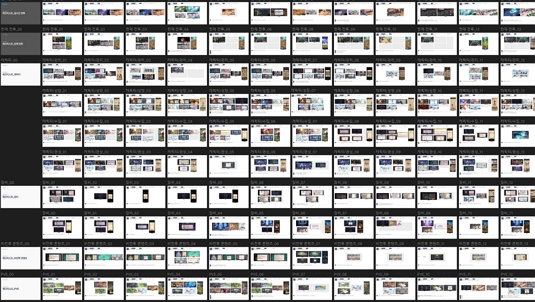
Fig. 1.

Example usability evaluation items for CCG, with screenshots illustrating key systems (character gacha, skill usage) and corresponding evaluation items*Korean text is retained in the figure because the primary intended audience of this study is Korean readers, and the figure presents screenshots of the Korean version of the game interface.
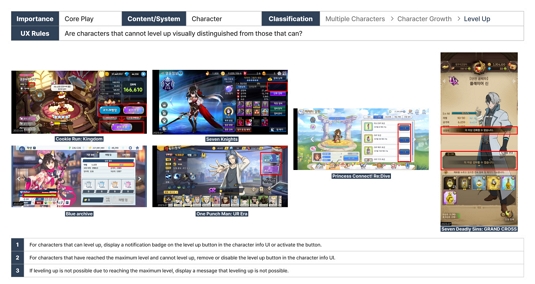
Fig. 2.

Detailed view of the usability evaluation framework for CCGs, showing each item linked to a system element and evaluated with a Yes/No response*Korean text is retained in the figure because the primary intended audience of this study is Korean readers, and the figure presents screenshots of the Korean version of the game interface.

4-4 휴리스틱 개발

모바일 RPG 게임 사용성 평가 항목의 단순성과 보편성을 높이기 위해, Nielsen의 10가지 사용성 휴리스틱을 참조 프레임으로 활용하여 총 4개 범주와 19개 휴리스틱을 도출하였다. 각 휴리스틱은 다수의 평가 항목을 포괄하며, 평가자는 휴리스틱 단위에서 게임의 사용성 수준을 빠르게 점검할 수 있다. 자세한 내용은 표 6과 같다.

Mobile RPG game usability heuristics


Ⅴ. 사례 검증

5-1 검증 설계

본 연구에서 제안한 휴리스틱이 게임 사용성 평가에 적용될 수 있는 가능성을 검증하기 위해, 관련 분야의 전문가를 대상으로 만족도 평가를 진행하였다. 이는 도구의 사용 편의성, 적합성, 유용성에 대한 평가자의 주관적 판단을 반영한다. 즉 실제로 더 정확한 사용성 문제를 발견하는 능력과는 개념적으로 구분된다. 본 검증은 평가자 만족도에 초점을 맞추며, 진단 유효성의 직접적 검증은 후속 연구의 과제로 남긴다.

비교 대상은 Nielsen의 사용성 휴리스틱[9]을 채택하였다. 게임 특화 휴리스틱의 경우 PC, 콘솔 환경을 전제로 하여 모바일 환경 자체가 또 다른 변수가 되어 본 프레임워크의 효용성과 모바일 적합성을 분리해 확인하기 어렵기 때문에, 도메인과 무관하게 점검 가능하면서 산업에서 가장 널리 사용되는 Nielsen의 휴리스틱을 비교 기준으로 채택하였다.

검증의 객관성을 확보하기 위해, 본 연구의 표본 30개 게임에 포함되지 않은 별도의 게임을 검증 대상으로 선정하고자 하였다. 그 결과 data.ai[20]를 통해 2026년 4월 25일 시점 최근 3개월 DAU 상위 5개 게임 중 1종인 ‘메이플 키우기’를 선정하였다. 메이플 키우기는 IDLE RPG 계열의 시스템과 수동 전투 및 캐릭터 수집 및 강화 시스템을 함께 갖추고 있어, 본 연구가 정의한 다수의 핵심 시스템이 평가 대상으로 포함될 수 있다는 점도 고려되었다.

검증에는 게임 및 서비스 UX 분야 경험을 보유한 평가자 10명이 참여하였다. 직무, 경력, 게임 이해도를 고려하여 두 개 그룹에 5명씩 균등하게 배분되도록 해 참여자의 특성이 휴리스틱 평가에 미치는 영향을 최소화하였다. 그룹A는 본 연구가 개발한 모바일 RPG 사용성 휴리스틱을 사용하고, 그룹B는 Nielsen의 일반 사용성 휴리스틱을 사용하여 동일 게임을 평가하였다. 그룹당 평가자 수는 휴리스틱 평가에 3~5명의 평가자를 권장하는 Nielsen과 Landauer의 근거를 참고하여 설정하였다[30].

5-2 검증 방법

검증 방법은 두 개 그룹을 대상으로 2단계로 구성하였다.

1단계에서는 평가자들을 대상으로 ‘메이플 키우기’를 직접 플레이하며, 게임 플레이 중 발견한 문제를 휴리스틱에 기반해 설명하고 해당하는 휴리스틱 번호를 기록하도록 하였다. 평가자들은 공통적으로 튜토리얼이 완료되어 핵심 시스템이 개방된 이후인 3 챕터를 기준으로 30분 이상 플레이하도록 하였다.

2단계에서는 휴리스틱에 대한 만족도 설문을 진행하였다. 휴리스틱 평가 완료 후 사용한 휴리스틱에 대한 10문항의 리커트 5점 척도 설문과 휴리스틱 사용 의견 주관식 1문항으로 구성하였다. 평가 문항은 표 7과 같다.

Heuristic evaluation items

검증은 비모수 통계기법을 적용해 10명 규모의 소수 인원을 대상으로 진행하였다. 두 독립 그룹의 만족도 평균 차이를 비교하기 위해 Mann-Whitney U 검정[31]을 적용하였다. 이 검정은 두 표본의 점수를 통합하여 순위로 변환한 뒤, 그룹별 순위 합의 차이로 두 분포의 동일성을 검정하는 방식으로, 표본의 크기가 작은 경우 검정 통계량이 분포간 차이를 충분히 반영하지 못할 수 있으므로, 유의확률 p와 함께 효과 크기를 산출하여 두 휴리스틱 간 차이의 실질적 크기를 함께 확인하였다. 효과 크기 산출에는 Hedges’ g[32]를 사용하였는데, Hedges’ g는 Cohen’s d에 보정 계수 J를 곱하여, 표본 크기가 20 미만일 때 d가 효과 크기를 과대 추정하는 편향을 교정하는 통계량이다. 효과 크기 해석은 g ≥ 0.8을 큰 효과, g ≥ 0.5를 중간 효과, g ≥ 0.2를 작은 효과로 보는 기준을 따랐다.

분석 단위는 만족도 설문 10개 문항의 평균 점수로 설정하였고, 문항별 평균값은 그룹 간 차이를 확인하기 위한 보조 기술 통계로 제시하였다. 또한 만족도 설문의 내적 일관성을 확인하기 위해 Cronbach's α를 산출하였다.

만족도 설문의 주관식 답변은 사전 분류 체계없이 응답 자료를 반복적으로 검토하여 의미 단위를 추출하고, 유사한 키워드를 묶어 주제를 도출하였다.

5-3 검증 결과

Cronbach's α 산출 결과, 전체 참여자 α = 0.924, A그룹 Cronbach's α = 0.843, B 그룹 Cronbach's α = 0.947로 양호한 수준의 내적 일관성을 보여 10개 설문 문항이 평가 도구 만족도를 일관되게 측정하고 있음을 확인했다.

설문에 대한 기술통계분석 결과, 전체 평균과 세부 문항의 평균 점수에서 A그룹이 B그룹보다 높은 평균을 보였다. Mann-Whitney U 양측 검정 결과 U=18.0, p= .295로 두 그룹 간 차이가 통계적으로 유의한 수준에 도달하지 않았으나, 이는 소규모 표본의 검정력 한계에 기인한 것으로 해석된다. 효과 크기 Hedges' g = 0.71은 중간 수준에 해당하였으며, 이는 두 휴리스틱 간에 실질적인 차이가 존재함을 시사한다. 다만, 그룹당 n=5의 소규모 표본에서 Hedges' g의 95% 신뢰구간은 (–0.57, 1.98)이며, 0을 포함하고 있어 효과 크기를 추정하는데 불확실성이 크다는 한계가 있다. 효과 크기는 분포 간 차이의 추정치일 뿐이며, 통계적 유의성이 확보되지 않은 상태에서 휴리스틱의 우월성은 단정할 수는 없다.

문항별로 살펴보면, 모든 문항에서 A 그룹이 B 그룹보다 높은 평균 점수를 보였으며, 특히 도구의 효용성과 적합성을 묻는 Q3과 Q9에서 큰 차이를 보였다.

Means by heuristic evaluation items

주관식 응답을 분석한 결과, Nielsen 휴리스틱을 사용한 B그룹 참여자들이 제공된 휴리스틱의 게임 적용 한계를 공통적으로 지적하였다. 구체적으로는 “기본적으로 일반 서비스/플랫폼 위주의 휴리스틱이라 게임에 적용하기 애매한 부분이 있으며, 오류·실수 방지에 치중되어 게임에 특화된 평가가 어려웠다.”, “게임에서만 사용되는 사용성 항목이 있을 것 같은데, 일반 서비스 앱을 평가하는 항목과 비슷해 보여 완벽하게 들어맞는 항목을 찾기 어려웠다.” 등의 응답이 제시되었다. 반면 A 그룹은 일부 휴리스틱 항목의 표현 모호성이나 의미 중첩에 대한 개선 의견을 제시하였으나, 적용 가능성 자체에 이의를 제기한 사례는 없었다.

5-4 검증 결론

본 검증의 정량 분석 결과 A그룹의 만족도 평균이 B그룹보다 0.68점 높게 나타났으며, 효과 크기 Hedges’ g=0.71로 중간 수준의 차이를 보였다. 본 결과는 소규모 탐색적 검증으로서 모바일 RPG 게임 사용성 휴리스틱이 기존 휴리스틱에 비해 게임 평가자에게 실질적 도움을 제공할 가능성을 탐색적으로 보여준다. 다만, 본 검증은 n=10의 소규모 탐색적 연구이며 신뢰구간이 넓어(-0.57, 1.98) 효과 크기 추정이 불확실하다. 또한, IDLE 장르 게임 1종을 대상으로 수행되어, 일반화를 위해서는 표본 규모와 장르 다양성을 확보한 후속 검증이 필요하다.


Ⅵ. 논 의

6-1 학술적·이론적 기여

본 연구의 학술적·이론적 기여는 다음 네 가지이다.

첫째, 기존 게임 휴리스틱 연구가 ‘게임’을 단일 범주로 다루어 추상적 수준에 머물러 있었던데 반해, 본 연구는 모바일 RPG를 구성하는 시스템 단위의 구체적인 평가 프레임워크를 제시함으로써 장르 특화 휴리스틱의 학술적 공백을 메웠다. 특히 2차 델파이 조사에서 나타난 장르별 핵심 시스템의 차이는 각 하위 장르의 고유한 설계 철학을 반영한다. CCG에서 캐릭터 뽑기와 카드/스킬 조합 조작이 최상위로 도출된 것은 해당 장르에서 뽑기 메커닉과 덱 전략이 중심적이라는 점을 보여주며, SRPG에서 턴제 전투와 위치/진형/편성이 핵심으로 나타난 것은 전술적 플레이 특성과 일치한다. IDLE에서 자동 전투와 방치 시스템이 핵심으로 도출된 것은 최소 조작으로 성장을 체험하는 장르적 본질을 반영하고, ARPG에서 수동 전투와 실시간 전투가 두드러진 것은 조작 숙련도가 핵심 재미 요소임을 나타낸다. MMORPG에서 길드 전용 콘텐츠와 필드 사냥이 높은 순위를 차지한 것은 사회적 요소와 오픈월드적 특성이 강조되는 장르 특성과 부합한다. 이러한 결과는 RPG를 단일 범주로 다루는 기존 접근이 아닌, 하위 장르별 시스템 분석이 필요함을 실증적으로 뒷받침한다.

둘째, Hassenzahl과 Tractinsky[13]는 사용자 경험을 실용적 품질과 쾌락적 품질의 두 독립적 차원으로 구분하였다. 본 연구가 사용성 영역만으로 602개 항목을 도출할 수 있었다는 결과는, 게임 맥락에서도 사용성이 그 자체로 충분한 분석 단위가 될 수 있음을 시사한다.

셋째, 본 연구의 19개 휴리스틱은 Nielsen의 9개 원칙과 매칭되어, 일반 사용성 원칙이 게임 도메인에서 어떻게 재맥락화될 수 있는지를 보여주는 구체적 사례를 제공한다. 특히 ‘심미적이고 미니멀한 디자인’ 원칙이 게임 시각 표현 관행과 충돌한다는 발견은 일반 사용성 이론을 게임 영역에 적용하는 것에 대한 이론적 시사점을 제공한다.

넷째, ‘대표 게임 플레이 분석 > 델파이 조사 > 정량적 검증 > 모듈형 구조화’의 절차는 다른 모바일 게임 장르에서도 동일하게 적용 가능한 방법론으로, 향후 장르별 사용성 휴리스틱 라이브러리 구축의 기반이 될 수 있다. 특히 PROMETHEUS[17]등과 달리 직접 플레이 분석이 필수적인 게임 도메인에 맞추어 핵심 시스템을 먼저 식별하고 각 시스템별로 사용성 항목을 모듈화함으로써 장르의 구조적 복잡성에 대응하는 평가 구조를 구현하였다. 이는 ‘모바일, RPG 하위 장르, 시스템 단위 모듈화, 정량적 검증’을 동시에 구현한 사례로서 차별성을 가진다.

6-3 실무적 함의

실무적 측면에서, 본 연구가 개발한 사용성 평가 프레임워크는 게임 개발자, 디자이너, QA(Quality Assurance) 팀이 즉시 활용할 수 있는 유용한 자원이다. 이 프레임워크는 전담 UX 연구자가 없는 팀이라도 게임의 인터페이스와 상호작용을 점검할 수 있도록 체크리스트 형태의 가이드라인을 제공한다. 이는 광범위한 사용자 테스트나 사용성 컨설팅을 수행하기 어려운 중소규모 개발사에 특히 유용하다. 또한 모듈형 구조 덕분에 프로젝트의 특성에 맞게 필요한 항목만 선택적으로 적용할 수 있어, 평가 과정의 효율성을 높이고 부담을 줄일 수 있다. 개발팀은 이 프레임워크를 활용해 사용성 문제를 초기 단계에서 발견할 수 있으며, 예를 들어 튜토리얼이 복잡한 시스템을 충분히 설명하지 못하거나 중요한 스탯 강화 피드백이 누락된 경우 등을 빠르게 파악할 수 있다. 더 나아가 본 프레임워크는 디자이너, 개발자, 프로젝트 매니저가 공통의 휴리스틱 기준을 바탕으로 사용성 개선 사항을 구체적으로 논의할 수 있도록 함으로써 조직 내 커뮤니케이션을 촉진하는 효과도 기대할 수 있다.

6-4 한계

본 연구는 여러 기여에도 불구하고 다음과 같은 한계를 가진다.

첫째, 본 연구는 사용성 영역에 초점을 맞추었다. 게임 경험을 구성하는 또 다른 핵심 축인 매력성, 재미, 정서적 경험은 본 프레임워크의 평가 범위에 포함되지 않는다. 따라서 본 프레임워크는 ‘이 게임이 사용하기 쉬운가’에 대한 답을 제공할 수 있으나, ‘이 게임이 매력적인가’에 대한 답은 제공하지 못하므로 종합적 게임 경험 평가를 위해서는 본 프레임워크와 매력성 평가 도구가 결합되어야 한다.

둘째, 분석 대상으로 선정된 30개의 게임은 DAU 기준으로 선정되었다. DAU는 지속적 인기와 이용자 참여의 객관적 지표이나, 이 게임들이 사용성 측면에서 모범 사례인지 여부는 별도의 인과 검증 없이는 단정할 수 없다. 본 연구는 이러한 한계를 인식하고, DAU를 ‘사용성 우수 지표’가 아닌 ‘풍부한 인터랙션 패턴 관찰을 위한 표본’으로만 사용하였다.

셋째, 분석 대상 게임과 전문가 패널 모두 한국 시장과 한국 실무자에 한정되었다. 따라서 도출된 사용성 휴리스틱과 우선순위는 한국 시장에서 일반적인 문화적 선호나 디자인 관행을 반영할 수 있으며, 글로벌 이용자층 전체에 완전히 일반화되기 어려울 수 있다. 다른 지역의 플레이어 집단을 타깃으로 하는 게임은 다른 사용성 요소를 중시할 가능성이 있다.

넷째, 본 연구는 인기 있는 RPG 하위 장르 5종(CCG, SRPG, IDLE, ARPG, MMORPG)에 집중하였으며, 퍼즐, FPS(First-Person Shooter) 등 다른 장르나 보다 세분화된 RPG 하위 장르는 다루지 않았다. 따라서 본 휴리스틱 프레임워크는 모바일 RPG에 특화된 성격을 갖고 있으며, 다른 장르에 적용하려면 추가적인 수정이 필요할 수 있다.

다섯째, ‘핵심 시스템’ 식별은 델파이 방법을 통한 전문가 합의에 의존하였기 때문에, 선정된 전문가 집단에 따른 편향 가능성을 내포한다. 다른 전문가 집단이나 더 큰 규모의 패널을 구성했다면 다른 요소가 강조되었을 수도 있으며, 향후 게임 디자인 트렌드 변화에 따라 ‘핵심’의 정의 역시 달라질 수 있다. 즉, 본 프레임워크는 연구 시점의 합의를 반영한 결과로서, 게임 산업이 변화함에 따라 주기적 업데이트가 필요하다.

여섯째, Ⅴ장의 사례 검증은 n = 10의 소규모 탐색적 연구이며, IDLE 장르 게임 1종(메이플 키우기)만을 대상으로 수행되었다. 효과 크기(Hedges' g = 0.71)를 통해 실질적 차이의 가능성은 확인하였으나, 그룹당 n=5에서의 Hedges’g 추정치는 95% 신뢰구간이 넓어(–0.57, 1.98) 효과 크기의 정밀도가 제한적이며, 본 검증이 측정한 종속변수는 평가자 만족도로서 프레임워크의 진단 유효성과는 구분된다. 이 또한 평가자가 모두 UX 관련 전문 평가자였기 때문에, 본 도구가 식별한 사용성 문제와 실제 일반 유저가 경험하는 문제 간의 일치도는 본 검증으로 확인되지 않는다. 따라서 본 프레임워크의 일반화를 위해서는 표본 규모와 장르 확대, 일반 유저를 대상으로 한 사용자 테스트 결과와의 일치도 비교가 후속 연구에서 수행되어야 한다.

6-5 향후 연구 방향

본 연구를 바탕으로 몇 가지 후속 연구 방향을 제안할 수 있다.

첫째, 6-3절에서 제기한 한계들을 각각 직접적인 후속 연구로 이어진다. 구체적으로, 본 프레임워크가 발견한 사용성 문제와 실제 플레이어가 경험하는 문제 간의 일치도를 사용자 테스트로 비교하여 프레임워크의 진단 유효성을 검증하고, 본 연구가 다루지 못한 매력성, 재미, 정서적 경험 차원의 평가 프레임워크를 별도로 개발하여 본 사용성 프레임워크와 결합한 종합적 게임 평가 체계로 확장하며, 본 프레임워크를 북미, 유럽, 일본 등 다른 지역과 FPS, 퍼즐, MOBA(Multiplayer Online Battle Arena)등 다른 장르로 본 방법론을 확대 적용하는 연구가 필요하다.

둘째, 모바일 게임의 빠른 발전을 고려할 때, 본 프레임워크 역시 지속적인 업데이트가 필요하다. AR(Augmented Reality) 기능, 새로운 과금 UX 등 새로운 상호작용 패턴이 등장함에 따라, 이를 평가 항목에 반영하는 후속 연구가 지속되어야 한다. 주기적으로 개정되는 ‘살아있는 휴리스틱 프레임워크’가 된다면 산업 변화 속에서도 유효성을 유지할 수 있을 것이다.

셋째, 실제 개발 현장에서 이 프레임워크의 효과를 검증하는 것이다. 개발팀이 본 사용성 평가 프레임워크를 실제 제작 과정이나 출시 후 점검에 활용하는 사례 연구 또는 현장 실험을 수행하고, 사용성 관련 불만 감소, 리텐션 개선, 디자인 개선 속도 향상 등의 결과를 측정한다면, 프레임워크의 효과성에 대한 실증적 근거를 한층 강화할 수 있다.


Ⅶ. 결 론

본 연구는 모바일 RPG의 핵심 게임 시스템을 정의하고 이를 사용성 휴리스틱으로 전환함으로써, 모바일 RPG에 특화된 사용성 평가 프레임워크를 개발하였다. 5개의 주요 모바일 RPG 하위 장르에 걸쳐 핵심 게임 플레이 요소를 식별하고, 18인 전문가 패널의 3차 델파이 검증과 CVI, 수렴도, 합의도 지표를 통해 내용 타당성을 확보한 결과, 4개 범주와 19개 휴리스틱 아래 602개의 사용성 평가 항목으로 구성된 포괄적 프레임워크를 도출하였다. 이를 통해 본 연구는 게임 분야에서 부족했던 장르 특화 사용성 평가 프레임워크의 학술적, 실무적 공백을 보완하였다. 본 평가 프레임워크의 활용은 모바일 RPG에서 보다 직관적인 인터페이스, 매끄러운 학습 곡선, 전반적인 사용성 만족도 향상으로 이어질 것으로 기대된다. 모바일 게임 산업이 계속 진화함에 따라, 본 연구가 지속적인 사용성 연구의 기반이 되고, 새롭게 등장하는 장르와 플레이어 기대에 부응하는 평가 방법의 고도화를 촉진하기를 기대한다.

Acknowledgments

본 연구는 Qroad 지원에 의하여 이루어진 연구로서, 도움주신 분들께 감사드립니다. 또한 연구자로 참여해 주신 오세준, 윤정섭님께도 감사드립니다.

References

  • Korea Creative Content Agency. 2023 Semi-Annual Content Industry Trend Analysis Report [Internet]. Available: https://www.kocca.kr/kocca/bbs/view/B0158949/2006345.do?searchCnd=&searchWrd=&cateTp1=&cateTp2=&useYn=&menuNo=204157&categorys=0&subcate=0&cateCode=&type=&instNo=0&questionTp=&ufSetting=&recovery=&option1=&option2=&year=&morePage=&qtp=&domainId=&sortCode=&pageIndex=1#, .
  • H. M. Sim, Y. J. Son, C. K. Yoo, S. S. Jeon, and W. Lee, “User Interface Evaluation Method for Mobile Contents Using Eye Tracking,” Journal of Computer Games and Contents, Vol. 27, No. 3, pp. 219-225, 2014. [https://doi.org/10.22819/kscg.2014.27.3.025]
  • D.-K. Kim, “A Study of UI in Mobile Game RPG,” in Proceedings of the Korean Society of Computer Information Conference, pp. 311-314, 2016. https://koreascience.kr/article/CFKO201623070249928.page
  • I. K. Park, “A Study on the User Experience by Types of the UI Design of Mobile Weather Application,” The Journal of Communication Design, Vol. 54, pp. 7-22, 2016.
  • S.-J. Kim and D.-E. Cho, “Technology Trends for UX/UI of Smart Contents,” Review of Korea Contents Association, Vol. 14, No. 1, pp. 29-33, 2016. [https://doi.org/10.20924/CCTHBL.2016.14.1.029]
  • Y. Fu and J. J. Koo, “Effect of the Layout Characteristics of the Mobile Game Interface on User's Purchase Intention,” Journal of Basic Design & Art, Vol. 22, No. 2, pp.187-202, 2021. [https://doi.org/10.47294/KSBDA.22.2.14]
  • Igaworks. All About Mobile App Advertising Revenue, Desperately Needed for Survival [Internet]. Available: https://www.igaworksblog.com/post/insight-%EC%83%9D%EC%A1%B4%EC%9D%84-%EC%9C%84%ED%95%B4-%EA%B0%84%EC%A0%88%ED%9E%88-%EB%B0%94%EB%9D%BC%EB%B4%A4%EB%8D%98-%EB%AA%A8%EB%B0%94%EC%9D%BC-%EC%95%B1-%EA%B4%91%EA%B3%A0-%EC%88%98%EC%9D%B5%ED%99%94%EC%9D%98-%EB%AA%A8%EB%93%A0-%EA%B2%83, .
  • J. Nielsen, Heuristic Evaluation, in Usability Inspection Methods, New York, NY: John Wiley & Sons, pp. 25-62, 1994.
  • J. Nielsen and R. Molich, “Heuristic Evaluation of User Interfaces,” in Proceedings of the SIGCHI Conference on Human Factors in Computing Systems, Seattle: WA, pp. 249-256, 1990. [https://doi.org/10.1145/97243.97281]
  • M. A. Federoff, Heuristics and Usability Guidelines for the Creation and Evaluation of Fun in Video Games, Master’s Thesis, Indiana University, Bloomington, IN, 2002.
  • H. Desurvire, M. Caplan, and J. A. Toth, “Using Heuristics to Evaluate the Playability of Games,” in CHI '04 Extended Abstracts on Human Factors in Computing Systems, Vienna, Austria, pp. 1509-1512, 2004. [https://doi.org/10.1145/985921.986102]
  • H. Desurvire and C. Wiberg, “Game Usability Heuristics (PLAY) for Evaluating and Designing Better Games: The Next Iteration,” in Proceedings of the 3rd International Conference on Online Communities and Social Computing, San Diego: CA, pp. 557-566, 2009. [https://doi.org/10.1007/978-3-642-02774-1_60]
  • M. Hassenzahl and N. Tractinsky, “User Experience — A Research Agenda,” Behaviour & Information Technology, Vol. 25, No. 2, pp. 91-97, 2006. [https://doi.org/10.1080/01449290500330331]
  • J. Nielsen, Usability Engineering, San Diego, CA: Academic Press, 1993. [https://doi.org/10.1016/B978-0-08-052029-2.50007-3]
  • D. H. Shin, Humanitas Technology, Seoul: Communication Books, 2013.
  • S. Hermawati and G. Lawson, “Establishing Usability Heuristics for Heuristics Evaluation in a Specific Domain: Is There a Consensus?,” Applied Ergonomics, Vol. 56, pp. 34-51, 2016. [https://doi.org/10.1016/j.apergo.2015.11.016]
  • C. Jiménez, H. Allende Cid, and I. Figueroa, “PROMETHEUS: Procedural Methodology for Developing Heuristics of Usability,” IEEE Latin America Transactions, Vol. 15, No. 3, pp. 541-549, 2017. [https://doi.org/10.1109/TLA.2017.7867606]
  • R. S. Iyer, C. Ndulue, S. Meier, and R. Orji, “Smartphone Games Heuristics (SmGH) – Towards a Standard Set of Platform-Centric Heuristic for Smartphone Games Evaluation,” International Journal of Human-Computer Interaction, Vol. 41, No. 8, pp. 5057-5078, 2024. [https://doi.org/10.1080/10447318.2024.2356911]
  • J. H. Kim, “Smartphone Game Interface Design Guideline,” Telecommunications Review, Vol. 23, No. 2, pp. 183-192, 2013.
  • Data.ai. Top Apps [Internet]. Available: https://www.data.ai, .
  • S. H. Lee and M. S. Kwon, “Classifying Digital Game Genres,” Journal of Korea Game Society, Vol. 8, No. 3, pp. 3-14, 2008. https://www.kci.go.kr/kciportal/landing/article.kci?arti_id=ART001269968
  • K. B. Lee and Y. J. Kim, “Analysis of Factors That Influence Users’ Preference for MOBA Game Genre: Focusing on the Game Systems of League of Legends,” The Journal of Global Cultural Contents, No. 47, pp. 107-124, 2021. [https://doi.org/10.32611/jgcc.2021.5.47.107]
  • J. S. Lee, The Delphi Method, Seoul: Kyoyook Kwahaksa, 2001.
  • H. M. Yang, Comparative Study of the Effectiveness Among Group Techniques for Decision-Making: Interacting Group, Brainstorming, Nominal Group, and Delphi Technique, Ph.D. Dissertation, Sungkyunkwan University Graduate School, Seoul, 1991.
  • I. R. Diamond, R. C. Grant, B. M. Feldman, P. B. Pencharz, S. C. Ling, A. M. Moore, and P. W. Wales, “Defining Consensus: A Systematic Review Recommends Methodologic Criteria for Reporting of Delphi Studies,” Journal of Clinical Epidemiology, Vol. 67, No. 4, pp. 401-409, April 2014. [https://doi.org/10.1016/j.jclinepi.2013.12.002]
  • D. M. Rubio, M. Berg-Weger, S. S. Tebb, E. S. Lee, and S. Rauch, “Objectifying Content Validity: Conducting a Content Validity Study in Social Work Research,” Social Work Research, Vol. 27, No. 2, pp. 94-104, June 2003. [https://doi.org/10.1093/swr/27.2.94]
  • J. S. Grant and L. L. Davis, “Selection and Use of Content Experts for Instrument Development,” Research in Nursing & Health, Vol. 20, No. 3, pp. 269-274, June 1997. <269::AID-NUR9>3.0.CO;2-G [https://doi.org/10.1002/(SICI)1098-240X(199706)20:3]
  • Y. J. Kang, Understanding and Application of Delphi Techniques, Employment Development Institute, Seongnam, Research Report Series 08-20, pp. 1-17, 2008.
  • A. Lucero, “Using Affinity Diagrams to Evaluate Interactive Prototypes,” in Proceedings of the 15th IFIP TC 13 International Conference on Human-Computer Interaction – INTERACT 2015, Bamberg, Germany, pp. 231-248, 2015. [https://doi.org/10.1007/978-3-319-22668-2_19]
  • Nielsen Norman Group. How Many Test Users in a Usability Study? [Internet]. Available: https://www.nngroup.com/articles/how-many-test-users/, .
  • H. B. Mann and D. R. Whitney, “On a Test of Whether One of Two Random Variables Is Stochastically Larger Than the Other,” Annals of Mathematical Statistics, Vol. 18, No. 1, pp. 50-60, 1947. [https://doi.org/10.1214/aoms/1177730491]
  • L. V. Hedges, “Distribution Theory for Glass's Estimator of Effect Size and Related Estimators,” Journal of Educational Statistics, Vol. 6, No. 2, pp. 107-128, 1981. [https://doi.org/10.3102/10769986006002107]

저자소개

정다연(Da-Yeon Jeong)

2021년:명지대학교 디지털콘텐츠디자인학과 (공학사)

2025년:명지대학교 대학원 디지털콘텐츠디자인학 (디지털콘텐츠디자인학 석사)

※관심분야:게임/서비스 UX, 서비스 기획, 비즈니스 설계, 유저 리서치, 사용자 데이터 분석 등

임세진(Se-Jin Lim)

2023년:명지대학교 디지털콘텐츠디자인학과 (공학사)

2025년~현 재: 명지대학교 대학원 디지털콘텐츠디자인학 석사과정

※관심분야:게임 콘텐츠, 게임 서비스, 게임 BM, 사용자 데이터 분석 등

신혜련(Hye-Ryeon Shin)

2005년:명지대학교 산업디자인학과 (미술학사)

2007년:명지대학교 산업디자인학 (미술학석사)

2007년~2009년: 넥슨 모바일(현 넥슨코리아)

2009년~2011년, 2015년~2018년: 네시삼십삼분

2012년~2013년: CJ E&M 게임사업부분(현 넷마블)

2013년~2014년: 바른손 E&A

2018년~현 재: 명지대학교 디지털콘텐츠디자인학과 부교수

※관심분야:게임 콘텐츠, 게임 서비스, 게임BM, 모바일 UX, 사용자 데이터 분석 등

Fig. 1.

Fig. 1.
Example usability evaluation items for CCG, with screenshots illustrating key systems (character gacha, skill usage) and corresponding evaluation items*Korean text is retained in the figure because the primary intended audience of this study is Korean readers, and the figure presents screenshots of the Korean version of the game interface.

Fig. 2.

Fig. 2.
Detailed view of the usability evaluation framework for CCGs, showing each item linked to a system element and evaluated with a Yes/No response*Korean text is retained in the figure because the primary intended audience of this study is Korean readers, and the figure presents screenshots of the Korean version of the game interface.

Table 1.

Games selected by genre

Genre Game Title
CCG Cookie Run: Kingdom
The Seven Deadly Sins: Grand Cross
Blue Archive
Seven Knights
One Punch Man: The Strongest
Princess Connect! Re:Dive
SRPG Alchemy Stars
Langrisser
Brave Nine
Arcana Tactics
The Walking Dead: No Man's Land
Final Fantasy Brave Exvius War Of The Visions
IDLE AFK Arena
Figure Story
One Punch Man: 英雄之路
Legend of Slime: Idle RPG
Perfect Arena
Tap Defenders
ARPG Guardian Tales
Dungeon & Fighter Mobile
MARVEL Future Fight
Honkai Impact 3
THE KING OF FIGHTERS ALLSTAR
Punishing: Gray Raven
MMORPG Ni no Kuni: Cross Worlds
The Kingdom of the Winds: Yeon
MapleStory M
Black Desert
Lineage M
Odin Valhalla Rising

Table 2.

Draft of key system items for mobile RPG games

Categories key system items
Character Collection Character Gacha, Character Class Selection, Character Synthesis
Character Growth Character Level Up (Hunting), Character Promotion/Transcendence, Character Strengthening, Collection System, Character Stat Enhancement, Socket Expansion
Equipment/ItemCollection Equipment Crafting, Equipment Gacha, Field Drop Equipment Acquisition, Equipment Unique Options, Equipment Synthesis, Peer-to-Peer Trading, Auction House
Equipment Growth Equipment Enhancement (with potential for destruction), Equipment Enhancement (Promotion, Transcendence), Equipment Option Strengthening, Equipment Option Assignment
Gameplay Systems PvE Dungeon, Small Party Play, PvP (Tournaments/Ranking Matches), PvP (Player Killing), RvR (Conquest/Siege), Asynchronous Raid/Defense System, Village Prosperity through Construction Crafting, Idle System, Raids
Combat Style Auto Battle, Fully Manual Operation, Limited Manual Operation of Skills, Real-time Combat, Turn-based Combat, Targeting, Non-targeting, Multiple Character Control, Single Character Control, Character Placement
Additional Systems Skins/Costumes, Character Customization, Affinity System, Chatting (Text/Voice), Story Progression, Avatar Stats, Achievements, Compendium (Information Collection Content), Profile Customization, Personal Housing
Gameplay Progression Progression through Preceding Stages, Open Field Exploration
Guild Guild Store, Guild Trading, Guild Buffs/Debuffs
Skills Skill Gacha, Skill Purchase, Skill book Field Farming, Skill Combination, Skill Tree, Skill Strengthening

Table 3.

Content validity verification of core system items by mobile RPG genre

Genre Core System Mean SD Consensus Convergence CVI
CCG Character Gacha 3.889 0.458 1.000 0.000 0.944
Card/Skill Combination Operation 3.889 0.314 1.000 0.000 1.000
Active/Passive Skills 4.000 0.000 1.000 0.000 1.000
Compendium 4.000 0.000 1.000 0.000 1.000
Skins/Costumes 4.000 0.000 1.000 0.000 1.000
PvP (Tournaments/Ranking Matches) 4.000 0.000 1.000 0.000 1.000
Character Classes 3.667 0.816 1.000 0.000 0.889
Equipment/Item Gacha 3.667 0.745 1.000 0.000 0.833
Character Level Up 3.667 0.745 1.000 0.000 0.833
Packages 3.889 0.314 1.000 0.000 1.000
SRPG Turn-based Combat 4.000 0.000 1.000 0.000 1.000
Position/Formation/Lineup 3.889 0.458 1.000 0.000 0.944
Character Classes 4.000 0.000 1.000 0.000 1.000
Character Level Up 4.000 0.000 1.000 0.000 1.000
Active/Passive Skills 4.000 0.000 1.000 0.000 1.000
Character Gacha 3.944 0.229 1.000 0.000 1.000
PvE Dungeon 3.611 0.891 1.000 0.000 0.833
Field/Dungeon Drop Equipment 3.889 0.458 1.000 0.000 0.944
Missions/Quests 3.889 0.458 1.000 0.000 0.944
Equipment Enhancement 3.667 0.943 1.000 0.000 0.889
IDLE Character Level Up 4.000 0.000 1.000 0.000 1.000
Auto Battle 3.778 0.629 1.000 0.000 0.889
Idle System 3.889 0.458 1.000 0.000 0.944
Character Gacha 4.000 0.000 1.000 0.000 1.000
Field/Dungeon Drop Items 3.833 0.500 1.000 0.000 0.944
Equipment Enhancement 3.944 0.229 1.000 0.000 1.000
Packages 3.778 0.629 1.000 0.000 0.889
Missions/Quests 4.000 0.000 1.000 0.000 1.000
Achievements/Challenges 3.889 0.458 1.000 0.000 0.944
Skill Enhancement 3.889 0.458 1.000 0.000 0.944
Equipment/Item Crafting 3.889 0.458 1.000 0.000 0.944
ARPG Manual Combat 3.889 0.458 1.000 0.000 0.944
Real-time Combat 4.000 0.000 1.000 0.000 1.000
Character Classes 3.889 0.458 1.000 0.000 0.944
Character Level Up 4.000 0.000 1.000 0.000 1.000
Skill Enhancement 3.556 0.831 1.000 0.000 0.778
Equipment Enhancement 3.944 0.229 1.000 0.000 1.000
Character Gacha 3.500 0.957 1.000 0.000 0.778
PvE Dungeon 3.556 0.896 1.000 0.000 0.833
Field/Dungeon Drop Equipment 3.833 0.687 1.000 0.000 0.944
Character Customizing 3.778 0.629 1.000 0.000 0.889
Missions/Quests 4.000 0.000 1.000 0.000 1.000
Guild Exclusive Content 3.722 0.803 1.000 0.000 0.889
MMORPG Character Classes 3.667 0.745 1.000 0.000 0.833
Character Level Up 4.000 0.000 1.000 0.000 1.000
PvE Dungeon 3.500 0.764 0.750 0.500 0.833
Real-time Combat 3.889 0.314 1.000 0.000 1.000
Field/Dungeon Drop Items 3.889 0.458 1.000 0.000 0.944
Text Chat 3.944 0.229 1.000 0.000 1.000
Guild Exclusive Content 3.944 0.229 1.000 0.000 1.000
Missions/Quests 3.889 0.458 1.000 0.000 0.944
Character Customizing 4.000 0.000 1.000 0.000 1.000
Character Stat Enhancement 3.944 0.229 1.000 0.000 1.000
Field Hunting 3.944 0.229 1.000 0.000 1.000
Auto Battle 3.500 0.764 0.750 0.500 0.833

Table 4.

Final list of core systems by genre after the 3rd Delphi round

Genre Core System Items
CCG Character Gacha, Card/Skill Combination Operation, Active/Passive Skills, Compendium (Information Collection Content), Skins/Costumes, PvP (Tournaments/Ranking Matches), Character Classes, Equipment/Item Gacha, Character Level Up, Packages
SRPG Turn-based Combat, Position/Formation/Lineup, Character Classes, Character Level Up, Active/Passive Skills, Character Gacha, PvE Dungeon, Field/Dungeon Drop Equipment, Missions/Quests, Equipment Enhancement
IDLE Character Level Up, Auto Battle, Idle System, Character Gacha, Field/Dungeon Drop Items, Equipment Enhancement, Packages, Missions/Quests, Achievements/Challenges, Skill Enhancement, Equipment/Item Crafting
ARPG Manual Combat, Real-time Combat, Character Classes, Character Level Up, Skill Enhancement, Equipment Enhancement, PvE Dungeon, Field/Dungeon Drop Equipment, Character Customizing, Missions/Quests, Guild Exclusive Content
MMORPG Character Classes, Character Level Up, PvE Dungeon, Real-time Combat, Field/Dungeon Drop Items, Text Chat, Guild Exclusive Content, Missions/Quests, Character Customizing, Character Stat Enhancement, Field Hunting, Auto Battle

Table 5.

Usability evaluation by core system for mobile RPG

System Usability Evaluation
Character Level Up 1) Is the result of the level up recognized through the level-up animation?, 2) Is the increase in experience points noticeable when experience is gained?, 3) If leveling up is not possible due to unmet conditions, is the reason for this clearly recognized?, 4) When enhancement materials are clicked, is the increase in experience points noticeable?, 5) Upon leveling up, is the increase in attributes noticeable?, 6) Is the consumption of resources used for leveling up, as well as the current inventory of these resources, recognized?, 7) Can players easily distinguish between characters who cannot level up and those who can?, 8) When the conditions for leveling up are met, is this recognized?, 9) Is there a convenience feature provided that simplifies the leveling up process?
Character Stat Enhancement 1) When the conditions for stat enhancement are satisfied, is this recognized?, 2) Is there a convenience feature provided that simplifies the stat enhancement process?, 3) Is the increase in stats that will result from the enhancement recognized?, 4) Is the consumption of resources used for enhancing stats, along with the current inventory, recognized?, 5) Is the result of the stat enhancement recognized through the enhancement animation?, 6) If enhancement is not possible due to unmet conditions, is the reason for this clearly recognized?
Character Classes 1) Is the information required for class selection recognized?, 2) Is the character's class information recognized?, 3) Is there a feature provided to prevent starting the game with an unwanted class?
Promotion/Transcendence 1) Is the increase in stats recognized during promotion/transcendence?, 2) Is the consumption of resources used for promotion/transcendence, along with the current inventory, recognized?, 3) Is the result of promotion/transcendence recognized through the promotion/transcendence animation?, 4) If promotion/transcendence is not possible due to unmet conditions, is the reason for this clearly recognized?, 5) When the conditions for promotion/transcendence are met, is this recognized?
Character Customizing 1) Are the selected customizing options recognized?, 2) Is the UI used for customizing convenient to operate?, 3) Is there a feature provided to prevent starting the game with an unwanted appearance?, 4) Is a convenience feature provided to facilitate easy decisions in customizing?
Real-time Combat 1) Is it clear which character the status UI corresponds to?, 2) Are the individual status UIs for characters distinguishable?, 3) Is a change in a character's status metrics noticeable?, 4) Is the status UI appropriately emphasized according to importance/hierarchy?, 5) During combat, are the character status UI and level UI distinguishable?, 6) Is the character's attribute information noticeable?, 7) Is the character's affiliation information noticeable?, 8) Are the enemy's status UI and the player character's status UI distinguishable?, 9) Is it clear which enemy the status UI corresponds to?, 10) Is a change in the enemy's status metrics noticeable?, 11) Are the boss status UI and the regular enemy status UI distinguishable?, 12) Is the enemy's attribute information noticeable?, 13) When a character acquires a buff/debuff, is this noticeable?, 14) Is the information about buffs/debuffs applied to the character noticeable?, 15) Is the end point of a character's buff/debuff effects noticeable?, 16) Are the representations of buffs/debuffs on enemies and player characters consistently provided?, 17) When an enemy acquires a buff/debuff, is this noticeable?, 18) Is the information about buffs/debuffs applied to the enemy noticeable?, 19) Is the end point of an enemy's buff/debuff effects noticeable?, 20) Are the grades and characteristics of active buffs visually distinguishable?, 21) When viewing information on active buffs/debuffs, is there no inconvenience from an operational perspective?, 22) Is the attack UI convenient to operate?, 23) When using an attack, is the active attack UI noticeable?, 24)If the target is out of range, is a feature provided to easily attack?, 25)If the target is out of range, is it noticeable that an attack cannot be made?, 26)Is the currently attacking character noticeable?, 27)If an attack effect is not applied to a character, is this noticeable?, 28)Is the currently attacking enemy noticeable?, 29)If an attack effect is not applied to an enemy, is this noticeable?, 30)Is an enemy preparing a strong attack distinguishable from those who are not?, 31)Is the remaining time until an enemy uses an attack noticeable?, 32)Is the range affected by an enemy's attack distinguishable from unaffected areas?, 33)Are attack animations distinguishable based on the type of attack effect, such as critical hits?, 34)Is the dodge/defense UI convenient to operate?, 35) Is the effect due to defense noticeable?, 36) If an attack is dodged, is the effect of the dodge noticeable?, 37) If a hit is dodged by chance, is this noticeable?, 38) When hit, is whether the hit and the applied effect noticeable?, 39) When a character dies, is the fact of death noticeable?, 40) When an enemy dies, is the fact of death noticeable?, 41) Through skill animations, is the information about the skill being used noticeable?, 42) Is the skill UI convenient to operate? , 43) During combat, is a feature provided to check detailed information about skills?, 44) Is the currently available skill noticeable?, 45) Is the currently used skill noticeable?, 46) After using a skill, is the remaining time until the skill can be used again noticeable?, 47) Is the status and change of the skill use cost noticeable?, 48) If a skill can be used multiple times, is the number of available uses noticeable?, 49) Are the player's character and other players' characters distinguishable?, 50) Is it convenient to recognize the location of characters during combat?, 51) Is a targeted enemy distinguishable from non-targeted ones?, 52) Are similar functions in the combat system UI recognizable?, 53) Is the pause screen distinguishable from the combat screen?, 54) Is a button provided in the pause popup to return to combat?, 55) Is a device provided to prevent quitting combat?, 56) Is it noticeable when entering combat?, 57) Is a boss fight visually distinguishable from regular combat situations?, 58) Is the remaining or elapsed time of the combat noticeable?, 59) When combat is nearing its end, is this noticeable?, 60) After failing a boss fight, is the button for re-entry noticeable?, 61) Is the wave information in combat noticeable?, 62) Is the UI for combat convenience features (speed battle, automatic battle, etc.) noticeable?, 63) Is the application of combat convenience features (speed battle, automatic battle, etc.) noticeable?, 64)Is the tag UI convenient to operate?, 65)Is it clear which character the tag UI corresponds to?, 66)If it is advantageous to switch characters, is the tag UI of the advantageous character easy to recognize?, 67)Is the quick slot UI distinguishable from the action-oriented operation UI (attack, skill, etc.)?, 68)For items registered in the quick slot, is the inventory quantity noticeable?, 69)Is it noticeable that items can be registered in an empty quick slot?, 70)After using an item registered in the quick slot, is the remaining time until it can be used again noticeable?, 71)If more than one quick slot is provided, is it noticeable that other quick slots exist besides the currently used one?, 72)If more than one quick slot is provided, are the currently used and unused quick slots distinguishable?, 73)Is the movement UI convenient to operate?, 74)Is the direction in which the character is moving noticeable?, 75)Is a feature provided to change the control options or position of the control UI?, 76)Is the currently registered mount/pet noticeable?, 77)Is the currently applied viewpoint option noticeable?, 78)Is the currently applied PK disposition setting noticeable?, 79)When the combo count changes, is this noticeable?, 80)If there are surviving enemy troops, is this noticeable?, 81)If movement is necessary for progression, is this noticeable?, 82)Is the UI for enemy and ally characters distinctly recognizable?
Turn-based Combat 1)Is it clear which character the status UI corresponds to?, 2)Are individual character status UIs distinguishable?, 3)Is a change in a character's status metrics noticeable?, 4)Is the character's status UI emphasized according to importance/hierarchy?, 5)During combat, are character status UIs and level UIs distinguishable?, 6)Is the character's attribute information noticeable?, 7)Is the character's affiliation information noticeable?, 8)Are enemy status UIs and player character status UIs distinguishable?, 9)Is it clear which enemy the status UI corresponds to?, 10)Is a change in the enemy's status metrics noticeable?, 11)Are boss status UIs and regular enemy status UIs distinguishable?, 12)Is the enemy's attribute information noticeable?, 13)When a character acquires buffs/debuffs, is this noticeable?, 14)Is information about buffs/debuffs applied to a character noticeable?, 15)Is the endpoint of a character's buff/debuff effects noticeable?, 16)Are the representations of buffs/debuffs on enemies and player characters consistently provided?, 17)When an enemy acquires buffs/debuffs, is this noticeable?, 18)Is information about buffs/debuffs applied to an enemy noticeable?, 19)Is the endpoint of an enemy's buff/debuff effects noticeable?, 20)Are the grades and characteristics of active buffs visually distinguishable?, 21)When viewing information on active buffs/debuffs, is there no inconvenience from an operational perspective?, 22)Is the currently attacking character noticeable?, 23)If an attack effect is not applied to a character, is this noticeable?, 24)Is the currently attacking enemy noticeable?, 25)If an attack effect is not applied to an enemy, is this noticeable?, 26)Is an enemy preparing a strong attack distinguishable from those who are not?, 27)Is the upcoming action pattern of an enemy noticeable?, 28)Are attack animations distinguishable based on the type of attack effect, such as critical hits?, 29)Is the effect due to defense noticeable?, 30)When hit, is the fact of being hit and the applied effect noticeable?, 31)When a character dies, is the fact of death noticeable?, 32)When an enemy dies, is the fact of death noticeable?, 33)Through skill animations, is information about the skill being used noticeable?, 34)Is the skill UI convenient to operate?, 35)During combat, is a feature provided to check detailed information about skills?, 36)Is the currently available skill noticeable?, 37)Is the currently used skill noticeable?, 38)After using a skill, is the remaining time until the skill can be used again noticeable?, 39)Is the status and change of the skill use cost noticeable?, 40)If a skill can be used multiple times, is the number of available uses noticeable?, 41)When selecting a skill usage point, is the expected effect noticeable?, 42)Are similar functions in the combat system UI recognizable?, 43)Is the pause screen distinguishable from the combat screen?, 44)Is a button provided in the pause popup to return to combat?, 45)Is a device provided to prevent quitting combat?, 46)Is it noticeable when entering combat?, 47)Is a boss fight visually distinguishable from regular combat situations?, 48)Is the remaining or elapsed time of the combat noticeable?, 49)When combat is nearing its end, is this noticeable?, 50)After failing a boss fight, is the button for re-entry noticeable?, 51)Is the wave information in combat noticeable?, 52)Is the UI for combat convenience features (speed battle, automatic battle, etc.) noticeable?, 53)Is the application of combat convenience features (speed battle, automatic battle, etc.) noticeable?, 54)Are the attack turns of enemies and characters noticeable?, 55)Are characters that can act in the current turn distinguishable from those that cannot?, 56)Are enemies that can act in the current turn distinguishable from those that cannot?, 57)Is the turn end UI easy to perceive?, 58)Is the turn end UI convenient to operate?, 59)Is the combat clear objective easy to perceive during combat?, 60)Are the ally and enemy character combinations distinguishable?, 61)Is the attribute synergy of the arranged characters noticeable?, 62)Is the range in which an enemy can move visually distinguishable from where movement is not possible?, 63)Is the position to which an enemy has moved noticeable?
Auto Battle 1)Is the UI for convenience features such as speed battle and auto battle noticeable?, 2)Is the application status of convenience features like speed battle and auto battle clear?, 3)Is the auto battle settings UI convenient to operate?, 4)Is the UI for setting skills to auto-use easy to operate?, 5)Are skills under auto-use distinguishable from those not under auto-use?, 6)During auto movement, is the destination noticeable?, 7)During auto movement, is the remaining distance to the destination clear?, 8)During auto combat, is there a feature to allow manual intervention according to player intent?, 9)Is the on and off status of the auto-use feature for quick slots noticeable?, 10)Are quick slots under auto-use distinguishable from those not under auto-use?, 11)Is the current auto-attack setting noticeable?, 12)Is the condition for auto-using items clear?, 13)Are the current auto-use options noticeable?
Manual Combat 1)Is the UI for manual targeting convenient to operate?, 2)Is the attack UI easy to operate?, 3)When an attack is used, is the attack UI being used noticeable?, 4)If the attack target is out of range, is a feature provided to attack easily?, 5)If the attack target is out of range, is it clear that the attack cannot be executed?, 6)Is the evade/defense UI convenient to operate?, 7)Is it clear which character corresponds to a given tag UI?, 8)Is the tag UI easy to operate?, 9)If a switch to a more advantageous character is possible, is the tag UI for the advantageous character easy to recognize?, 10)Is the quick slot UI distinguishable from the action-type control UI (attack, skill, etc.)?, 11)For items registered in the quick slot, is the inventory quantity noticeable?, 12)Is it clear that items can be registered in an empty quick slot?, 13)After using an item from the quick slot, is the remaining time until it can be reused clear?, 14)When multiple quick slots are provided, is it clear that there are quick slots other than the one currently in use?, 15)When multiple quick slots are provided, are the currently used and unused quick slots distinguishable?, 16)Is the movement UI easy to operate?, 17)Is the direction in which the character is moving clear?, 18)Is a feature provided to change the control options or position of the control UI?
Card/Skill Combination Operation 1)Are the card/skill combination statuses of allies and enemies distinguishable?, 2)Is the synergy of the attributes of the combined cards/skills noticeable?, 3)Is information about the combined cards/skills clear?, 4)Are selectable cards/skills noticeable?, 5)Are selected and unselected cards/skills distinguishable?, 6)If there are combination limits, are these clear?, 7)Is the operation for combinations convenient?, 8)Is a convenience feature provided to undo combinations?, 9)Is a feature provided to prevent errors in deleting combinations due to initialization?
Skill Enhancement 1)Are skills that have reached the maximum enhancement level distinguishable from those that can still be enhanced?, 2)Are the skill stats that will increase with enhancement known beforehand?, 3)When enhancing a skill, are the increased stats noticeable?, 4)For skill enhancement materials, is the amount consumed and the current inventory clear?, 5)Through skill enhancement animations, are the results of skill enhancements noticeable?, 6)When conditions for skill enhancement are met, is this clear?, 7)If conditions are not met and skill enhancement is not possible, is the reason clear?, 8)Are skills that cannot be enhanced distinguishable from those that can?, 9)Is a convenience feature provided for easy skill enhancement?, 10)When enhancing multiple skills simultaneously, is the increase in stats clear?
Active/Passive Skills 1)Is the skill UI easy to operate?, 2)During combat, is a feature provided to check detailed information about skills?, 3)Is the currently used skill clear?, 4)Are the currently available skills noticeable?, 5)After using a skill, is the remaining time until the skill can be used again clear?, 6)Is the status and change of the skill use cost clear?, 7)If a skill can be used multiple times, is the number of available uses clear?, 8)Is it easy to recognize when a skill is ready to use again after a cooldown?, 9)When selecting a skill usage point, is the expected effect clear?
Field Hunting 1)Are the resources and items obtainable in the field clear?, 2)Is information about enemies that appear in each field clear?, 3)Is the recommended combat power for the field noticeable?, 4)Are the types and quantities of resources obtained clear?, 5)Are the items obtained noticeable?, 6)Is the UI for setting auto hunting in the field noticeable?, 7)Is the application status of the field auto hunting settings clear?, 8)Is the UI for setting auto hunting in the field convenient to operate?
PvP 1)Is the win/loss status of PK records distinguishable?, 2)Are details about occurred PKs noticeable?, 3)Is the reset time for PK records provided?, 4)Is character information for top players in PK ranking noticeable?, 5)Is information about the scoring criteria that determines the PK ranking provided?, 6)Is the reset time for PK ranking noticeable?, 7)Is information about buffs/debuffs related to PK ranking noticeable?, 8)Is it clear whether PK is allowed in certain areas?, 9)Is the character's PK tendency score noticeable? ,10)Is information about buffs/debuffs based on PK tendency score noticeable?, 11)Are situations of attacking other players distinguishable from attacking regular enemies?, 12)Are situations of killing other players distinguishable from killing regular enemies?, 13)When PKed, is information about the player who committed the PK noticeable?, 14)Is the name of the current arena season noticeable?, 15)Is the remaining time until the reset of the current arena season noticeable?, 16)Are the limitations for the arena noticeable?, 17)Is the attack deck setup button noticeable?, 18)Is the defense deck setup button noticeable?, 19)Is information about ranking changes based on previous battle results noticeable? , 20)Is the complete player ranking list in the arena noticeable?, 21)Is information about other players in the total ranking noticeable?, 22)Is the feature to view the total ranking list noticeable?, 23)Is one's own ranking in the total ranking list noticeable?, 24)Are one's current arena points noticeable?, 25)Is information about point changes based on battle results noticeable?, 26)Is it noticeable when points do not change regardless of the battle outcome?, 27)Are the points of other players in the ranking list noticeable?, 28)Are the points of all players in the current arena ranking noticeable?, 29)Is the current tier stage noticeable?, 30)Are tier stages and names provided using common terminology from other games?, 31)When changing tiers, is the tier change information noticeable through an animation?, 32)Is information about rewards obtainable upon tier advancement provided?, 33) When obtaining tier advancement rewards, is the information about the acquired rewards noticeable through an animation?, 34) Are win rates for attack and defense distinguishable?, 35) Are score changes based on arena attack/defense results noticeable?, 36)Are records of battles conducted in arena attack/defense noticeable?, 37)Is information about the opposing player in battles conducted in arena attack/defense noticeable?, 38)Are conditions for obtaining rewards noticeable?, 39)Are daily/weekly rewards obtainable based on arena performance noticeable?, 40)When obtaining rewards, is the information about the acquired rewards noticeable through an animation?, 41)Is information about rewards obtained due to the season end based on arena performance noticeable?, 42)Are battle-related settings registered by the player (character lineup, equipment setting, etc.) noticeable?, 43)When accumulated rewards are obtained, is information about the acquired rewards noticeable?, 44)Is it noticeable when there are obtainable rewards?, 45)Is the record of battles conducted with the set defense deck provided?, 46)Is information about the opposing player in battles conducted defensively provided?, 47)Is basic information related to arena battles for selecting an opponent noticeable?, 48)Is the total combat power information of the opponent noticeable?, 49)Is information about the opponent's combat performance noticeable?, 50)Is information about the growth of characters in the opponent's deck noticeable?, 51)If a refresh feature has a cooldown, is the remaining time until cooldown refresh noticeable?, 52)When using the refresh feature, if resources are consumed, are the type and amount of consumed resources noticeable?, 53)Is the resource consumed for entry noticeable when entering?, 54)Are the maximum resource holding capacity and current entry resource holding amount noticeable?, 55)If holding fewer entry resources than the maximum, is the remaining time until resource recharge noticeable?, 56)If there is a daily limit on purchasing arena entry resources, is this noticeable in advance?, 57)Is the period during which arena entry resources are recharged (reset) noticeable?, 58)Is it noticeable if gameplay is not possible due to insufficient resources in the arena?, 59)If gameplay is not possible due to a lack of resources in the arena, is information provided that entry resources must be purchased?, 60)Is navigating to the entry resource purchase page noticeable?, 61)Is the feature to modify battle-related settings (character lineup, equipment setting, etc.) provided?, 62)Is the button to exit the battle (move to the main screen, retry, etc.) noticeable?, 63)Is information about rewards obtainable through battle victory noticeable in advance?, 64)When a battle is won, is this noticeable?, 65)Is information about rewards obtained through battle victory noticeable?, 66)When a battle is lost, is this noticeable?, 67)Are changes in arena performance based on battle results noticeable?, 68)Is information about the character lineup used in the battle noticeable?, 69)In the damage tally screen, are the total damage and each character's contribution to the damage noticeable?, 70)In the battle result screen, is the button to exit the battle (move to the main screen, retry, etc.) noticeable for its function?, 71)Is a growth guide provided in the battle defeat screen?, 72)Is the feature to navigate from the arena content to the arena shop provided?, 73)Is the list of products purchasable with arena coins provided?, 74)Are the display rules in the arena shop consistent with those in other shops?, 75)Is the method for obtaining arena coins in the arena shop noticeable?
PvE Dungeon 1)Are the conditions required to obtain rewards recognizable?, 2)Is the reset time for dungeon rewards noticeable?, 3)When entrance to a dungeon is not possible due to unmet conditions, is this recognized?, 4)Are the resources obtainable in the dungeon noticeable?, 5)Is information about enemies appearing in each dungeon available?, 6)Is the recommended combat power for the current dungeon and the player’s combat power recognizable?, 7)Are the resource amounts needed for dungeon entry and the current holdings noticeable?, 8)When dungeon entry counts (dungeon entry resources) are depleted, is a reset (shortcut to store) feature provided?, 9)Is the reset (regeneration) time for dungeon entry counts (dungeon entry resources) noticeable?, 10)Is the maximum number of entries for the dungeon and the current remaining count recognizable?, 11)After entering a dungeon, is the remaining time noticeable?, 12)Are dungeons that need to be cleared distinguishable from those already cleared? , 13)Is the current dungeon distinguishable from dungeons not located?, 14)Are the conditions for applying formation bonuses noticeable?, 15)When formation bonuses are applied to the current lineup, is this application noticeable?, 16)Is character and combat power information of top players in the ranking provided?, 17)Is the player’s achieved rank in the ranking noticeable?, 18)Are the conditions for receiving ranking achievement rewards recognizable?, 19)When ranking achievement rewards are obtainable, is this availability noticeable?, 20)Is the settlement time of the current raid noticeable?, 21)Is the season reset time of the current raid noticeable?, 22)If death penalty recovery is possible, is this pre-noticeable?, 23)When progressing with death penalty recovery, are the types and amounts of resources obtainable noticeable?, 24)Are the resources required for death penalty recovery noticeable?, 25)Are the current remaining counts and the maximum limits for death penalty recovery noticeable?, 26)Is the limit time for death penalty recovery noticeable?, 27)Is the maximum number of participants that can enter recognizable?, 28)Are the maximum and current numbers of party members noticeable?, 29)Is information about the current party members noticeable?, 30)Is the party leader distinguishable from regular party members?, 31)When the maximum number of party members is reached, is a feature provided for the party leader to notice this?, 32)Is party matching convenient?
Position/Formation/Lineup 1)Are the battle-related settings registered by the player (character lineup, equipment setting, etc.) noticeable?, 2)Is a feature provided to modify battle-related settings (character lineup, equipment setting, etc.)?, 3)When retrying, is a feature provided to redo the character lineup?, 4)Is a convenience feature provided to restore the lineup to its original state?, 5)Is a convenience feature provided for easy character lineup?, 6)During character lineup, are each character's details noticeable?, 7)Is the character lineup information of cleared battles noticeable?, 8)Are the conditions for applying lineup bonuses recognizable?, 9)When lineup bonuses are applied to the current lineup, is this application noticeable?, 10)Is the attack deck setup button noticeable?, 11)Is the defense deck setup button noticeable?, 12)In the lineup window, is the character currently being selected noticeable?, 13)Are the slots where characters can be placed and cannot be placed distinguishable?, 14)Are various sorting/filtering features provided considering the attributes and characteristics of characters?, 15)Is the character lineup information of defeated battles noticeable?, 16)Are the stats and roles of the lined-up characters noticeable?, 17) Is the in-game position (location) information of the lined-up characters noticeable?, 18) Is a feature provided to view detailed information about the lined-up characters?, 19) Is a feature provided to view lineup presets for different contents?, 20) When newly lining up characters already positioned in another unit, is this pre-noticeable?, 21) Is the total combat power of the currently lined-up characters provided?, 22) When the character composition changes, is the change in total combat power noticeable?, 23) Are multiple deck lineup presets distinguishable?, 24) Are the selected preset and unselected preset distinguishable?, 25) During lineup, are the selectable characters noticeable?, 26) Are the selected and unselected characters distinguishable?, 27) If lineup restriction conditions exist, are these noticeable?, 28) When proceeding with lineup changes, is it pre-noticeable that the currently configured lineup information will change?, 29) Are lined-up characters and unlined-up characters distinguishable?, 30) Is a convenience feature provided for easy movement of characters within the lineup?, 31) Is a convenience feature provided for easy exclusion/change within the lined-up characters?, 32) Is a feature provided to select deployment positions during character lineup?, 33) Are the character combination statuses of friendly and enemy characters each noticeable?, 34) Is the attribute synergy of the lined-up characters noticeable?
Equipment/Item Crafting 1) Are craftable items categorized and provided by category?, 2) Is the amount of crafting materials needed known?, 3) Is a convenience feature provided that allows for the crafting of multiple items at once?, 4) Is the amount of materials consumed for crafting known?, 5) When crafting, is the type of equipment to be obtained recognizable?, 6) When crafting, are the detailed specifications of the obtained equipment provided?, 7) Is the result of the crafting process recognized through the crafting animation?, 8) Is there a convenience feature provided that simplifies crafting based on the materials owned?
Equipment Enhancement 1) Is the amount of experience needed to reach the next level known?, 2) Is the increase in equipment experience from using resources recognizable?, 3) Is a convenience feature provided to simplify equipment leveling?, 4) When leveling up equipment, is the expected increase in stats recognizable?, 5) Is the amount of resources consumed as leveling materials and the current inventory known?, 6) Is the result of leveling up recognized through the leveling animation?, 7) When equipment enhancement fails, is this recognized?, 8) When leveling up multiple pieces of equipment, is the increase in stats known?, 9) If the equipment can be enhanced to the next tier, is this recognized beforehand?, 10) Are the amount of materials used for tier enhancement and the current inventory known?, 11) If there is a shortage of materials needed for tier enhancement, is the reason known?, 12) Is the result of tier enhancement recognized through the tier enhancement animation?, 13) Is a convenience feature provided that simplifies tier enhancement?, 14) If conditions are not met for batch enhancement, is the reason recognized?
Character Gacha 1) Is the 'Summon' button and its information provided in a consistent format regardless of the type of summon?, 2) Are different types of summons distinctly recognizable?, 3) Is the UI of the summon button easy to recognize?, 4) Is the button to access the summon probability information window noticeable?, 5) Is it clear which characters can be obtained through summoning?, 6) Is the cumulative number of summons required for a guaranteed character acquisition recognizable?, 7) If it is a limited-time summon, is the remaining period until the end of summoning noticeable?, 8) In the character summon probability, is the acquisition probability for each character clear?, 9) Are the summon probabilities by character grade recognizable?, 10) Are characters with increased acquisition probabilities easy to identify?, 11) Is the character selected for summoning noticeable?, 12) Are the summon buttons distinguishable between when summoning is possible and when it is not?, 13) Are the amount of resources used for summoning and the current inventory noticeable?, 14) Is the character obtained through summoning recognizable?, 15) If summoning cannot proceed due to a lack of necessary resources, is this recognized?, 16) Is the time remaining until the next free summon recognizable?, 17)Is there an animation that hints at the grade of the summoned character?, 18)Is there a convenience feature provided for summoning multiple characters at once?, 19)Is there a convenience feature provided to expedite the summoning animation?, 20)If summoning characters is possible from a screen other than the summon screen, is this recognized?, 21)If summoning of a different type is possible from the current screen, is this noticeable?, 22)Is there a convenience feature provided to simplify summoning based on the owned resources?, 23) If resources are insufficient for proceeding with a summon, are explanations provided about various ways to obtain resources?, 24) Is there a feature provided to prevent accidental summoning?
Equipment/Item Gacha 1) Is the 'Summon' button and its information provided in the same format regardless of the type of summon?, 2) Is the UI of the summon button easy to recognize?, 3) Is the button to move to the summon probability information window easy to recognize?, 4) Is it clear which equipment can be obtained through summoning?, 5) Is the cumulative number of summons required for a guaranteed equipment/item acquisition recognizable?, 6) Is the remaining period until the end of the summoning process noticeable?, 7) In the equipment summon probability, is the acquisition probability for each item clear?, 8) Are the summon probabilities by equipment grade recognizable?, 9) When summon probabilities are increased, is the increased probability of obtaining certain equipment easy to recognize?, 10) Are the summon buttons distinguishable between when summoning is possible and when it is not?, 11) Are the amount of resources used for summoning and the current inventory noticeable?, 12) Is the equipment obtained through summoning recognizable?, 13) If summoning cannot proceed due to a lack of necessary resources, is this pre-recognized?, 14) Is the time remaining until the next free summon recognizable?, 15)Is there an animation that hints at the grade of the summoned equipment?, 16)Is there a convenience feature provided for summoning multiple items at once?, 17) If resources are insufficient for equipment summoning, are explanations provided about various ways to obtain resources?, 18) Is there a convenience feature provided to expedite the summoning animation?, 19) If equipment summoning is possible from a screen other than the summon screen, is this recognized?, 20) If summoning of a different type is possible from the current screen, is this noticeable?, 21) Is there a convenience feature provided to simplify summoning based on the owned resources?
Field/Dungeon Item Drops 1) Is the pathway for items dropping recognizable?, 2) Is it noticeable when items have dropped?, 3) Are the grades of the dropped items recognizable?, 4) Are the types of the dropped items distinguishable?, 5) When items are acquired from drops, is the acquisition noticeable?, 6) In cases where multiple items are dropped, is this recognized?
Missions/Quests 1) Are objects where events (quest initiation, completion, etc.) occur distinguishable from ordinary objects?, 2) Is the progress of a quest recognizable?, 3) Are different types of quests distinguishable?, 4) Are similar types of quests recognizable among each other?, 5) Is the progress status of a quest noticeable?, 6) Is an ongoing quest recognizable?, 7) Are completed quests distinguishable from ongoing quests?, 8) Is the quest overlay provided in a way that facilitates the recognition of game progress?, 9) Is it convenient to travel to the quest progression area?, 10) Upon completing a quest, is it convenient to proceed to the next quest?, 11) Is it clear which page the UI transitions to when moving between different types of missions?, 12) If not all mission information is visible on one screen, is it noticeable that more mission information is available?, 13) Is the duration of mission progress recognizable?, 14)Are the conditions of the mission recognizable?, 15)When mission conditions are met, are the possible rewards recognizable?, 16) Is the overall progress of various types of missions recognizable?, 17) Is the progress for each mission recognizable?, 18) When all mission conditions are satisfied, is the reward collection UI easy to perceive?, 19) Are missions that have satisfied conditions but not yet collected rewards distinguishable from those that haven't?, 20) Is there a convenience feature provided for accessing content where mission progression is possible?, 21) Is there a convenience feature provided for easily collecting rewards for completed missions?, 22) When mission conditions are met, is it noticeable that rewards can be collected?, 23) Is the standard time for mission renewal recognizable?, 24) Is the time remaining until mission renewal noticeable?, 25) Is it recognizable when all missions are completed and no further progress can be made?, 26) Are the specific conditions required for each mission recognizable?, 27) When mission conditions are met, are obtainable rewards distinguishable from those that are not obtainable?, 28) Is the progress of overall achievements and individual achievements recognizable?, 29) Is the progress of achievements by type recognizable?, 30) When all achievement conditions are met, are the obtainable rewards recognizable?, 31) When achievement conditions are met, are obtainable rewards distinguishable from those that are not?, 32)Are the effects of stat bonuses obtained through achievements recognizable?
Text Chat 1) Is the chat UI designed to maintain game awareness?, 2) Is there a feature provided to hide or minimize the chat UI for better immersion?, 3) Is the current chat channel recognizable?, 4) When selecting a chat channel, is it distinguishable from other channels?, 5) Is the chat window for interaction distinguishable from general chat?
Skins/Costumes 1) Is information about the costume recognizable?, 2) Is the price of the costume recognizable?, 3) Is the availability period of the costume known?, 4) Are currently equipped costumes distinguishable from unequipped ones?, 5) Are owned costumes distinguishable from those not owned?, 6) Is information that indirectly identifies the costume recognizable?, 7) Is there a feature to closely inspect the costume’s appearance?, 8) Are the effects obtained from equipping the costume known?, 9) Is there a feature to try on (preview) the costume before purchasing?, 10) Are the methods for acquiring the costume recognizable?, 11) Is it known if the costume cannot be currently acquired?, 12) When selecting a costume, is the character displayed wearing the costume?, 13) If a costume cannot be obtained directly, are the methods for acquisition provided?, 14)Is an immediate purchase feature provided for costumes that can be directly bought?, 15)Are the name and concept of the selected costume provided?
Achievements (Challenges) 1) Is the progress of overall and individual achievements recognizable?, 2) Is the progress of achievements by type recognizable?, 3) When all conditions for achievements are met, are the obtainable rewards recognizable?, 4) When achievement conditions are satisfied, are obtainable rewards distinguishable from those that are not?, 5) Are the stat effects gained through achievements recognizable?
Compendium (Information Collection Content) 1) Is the entry UI for the compendium easy to understand which compendium it refers to?, 2) If not all compendiums are displayed on one screen, is it clear that more compendiums are available?, 3) Is the detailed information entry UI user-friendly for checking specific information?, 4) Is a sorting feature provided in the compendium list?, 5) Is a filtering feature provided to view only the desired group of compendiums?, 6) Is it noticeable when an item not listed in the compendium is obtained?, 7) Is the progress of collection for each type of compendium noticeable?, 8) Is the progress for registering an item in a list noticeable?, 9) Is it clear what rewards can be received through the collection of the compendium?, 10) When rewards are collected from the compendium, is it noticeable?, 11) When collection is complete and rewards are obtainable, is it distinguishable from when rewards cannot be obtained?, 12) Is the currently applied account enhancement effect noticeable?, 13) When an account enhancement effect is gained, is it clear how much the enhancement has increased?, 14) Are owned items distinguishable from unowned items?, 15) Is the necessary enhancement stage for registering an item in the compendium noticeable?, 16) Is it possible to indirectly perceive information about the equipment?, 17) Is detailed information about the equipment’s stats provided?, 18) Is the provided image of the equipment easy to recognize?, 19) Is it clear how the equipment can be obtained?, 20) Is it noticeable if the equipment cannot currently be acquired?, 21) Are different chapters and stages of the story distinguishable?, 22) Is the progress of collected stories for each story category noticeable?, 23) Are stories that cannot be viewed distinguishable from those that can be?, 24) Is the amount of story text convenient to read?, 25) Is the font size of the story text easy to read?, 26) Are the title and summary of the story synopsis clear and indicative of the story content?, 27) Are owned characters distinguishable from those not owned?, 28) Is basic information and icons that can reveal the character’s traits noticeable?, 29) Are the character’s detailed story and battle-related stats information distinguishable?, 30) Is there a function available to discern detailed stats of the character?, 31) Are the position and size of the character’s image convenient for understanding the content?
Package 1) Is the available Battle Pass recognized?, 2) Are purchasable and non-purchasable Battle Passes distinguishable?, 3) Is the list of items obtainable through the Battle Pass recognized?, 4) Is the price of the Battle Pass known?, 5) Is the duration of the Battle Pass recognized?, 6) Are the core rewards of the Battle Pass distinguishable from regular rewards?, 7) Is the progress of the Battle Pass recognized?, 8) Are rewards obtainable based on the progress of the Battle Pass recognized?, 9) Are rewards from the paid Battle Pass distinguishable from those of the free Battle Pass?, 10) Is the criterion for increasing Battle Pass progress recognized?, 11) When purchasing Battle Pass progress is possible, is this recognized?, 12) Are purchasable limited-time packages recognized?, 13) Are purchasable and non-purchasable limited-time packages distinguishable?, 14) Is the list of items obtainable through the limited-time package recognized?, 15) Is the price of the limited-time package known?, 16) Is the available period for the limited-time package recognized?, 17) For limited-time packages with a purchase limit, are the limit and current number of purchases recognized?, 18) Are purchasable general packages recognized?, 19) Are purchasable and non-purchasable general packages distinguishable?, 20) Is the list of items obtainable through the general package recognized?, 21) Is the price of the general package known?, 22) For general packages with a purchase limit, are the limit and current number of purchases recognized?, 23) Are purchasable event packages recognized?, 24) Are purchasable and non-purchasable event packages distinguishable?, 25) Is the information about the event package recognized?, 26) Is the list of items obtainable through the event package recognized?, 27) Is the price of the event package known?, 28) Is the available period for the event package recognized?, 29) Is the purchase benefit of the event package recognized?, 30) For event packages with a purchase limit, are the limit and current number of purchases recognized?
Idle System 1) Are conditions for increased idle reward efficiency recognized?, 2) Is the accumulated idle time since the last reward collection (reward time reset) recognized?, 3) Based on accumulated idle time, are current obtainable idle rewards recognized?, 4) Are times when idle rewards can be collected distinguishable from when they cannot?, 5) Is the currency earned per idle time known?, 6) Are conditions for increasing idle reward efficiency recognized?, 7) Is information about currency obtained through idle reward collection recognized?, 8) Is the expected value of rewards obtainable through fast idle progression provided?, 9) Is the currency consumption required for fast idle progression recognized?, 10) Are times when fast idle progression is possible distinguishable from when it is not?, 11) Is information about currency obtained through fast idle reward progression recognized?, 12) Is the daily limit for fast idle progressions known?, 13) Is the time remaining until the daily limit for fast idle progressions resets recognized?, 14) When the maximum limit of idle rewards is reached, is this recognized?, 15) When fast idle reward collection is possible, is this pre-recognized?, 16) Is the duration for which idle mode can be engaged recognized?, 17) When engaging idle mode, is it recognized that the app will close?
Guild Exclusive Content 1) In the supporters' formation screen, are heroes from the same guild recognized?, 2) In the supporters' formation screen, are the stats and skills of the heroes recognized?, 3) Is finding the desired hero on the supporters' formation screen convenient?, 4) When using a supporters' hero, are notifications and rewards provided to the friend?, 5) When a supporters' hero is used, is the reduction in usage count recognized?, 6) Is there a daily limit on the use of supporters' heroes recognized?, 7) On the ranking screen, is the ranking of the affiliated guild recognized?, 8) On the ranking screen, is an individual's ranking recognized?, 9) On the ranking screen, is information about raid ranking rewards recognized?, 10) Are ranking rewards according to rank distinguishable?, 11) Is information about the timing of reward distribution recognized?, 12) Is the feature to enter the guild store from the guild page provided?, 13) When touching guild currency, is it convenient to move to the acquisition source or guild content?, 14) In the guild store, are the icon and the quantity of guild currency recognized?

Table 6.

Mobile RPG game usability heuristics

Category Corresponding Nielsen Heuristics Heuristic Items
Information Provision/Feedback 1. Visibility of system status Elements on the screen are distinctly marked for identification.
The system's status and changes are displayed immediately.
Provide proactive information to predict the consequences of actions.
Provide appropriate feedback on user choices and consequences.
Indicate what actions can be taken next based on the current state of the system.
Shows the conditions required for the current system to complete.
Immediately indicate what new information needs to be verified.
Error Prevention 3. User control and freedom
5. Error prevention
9. Help users recognize, diagnose, and recover from errors
Clearly indicate why an action is not possible.
Provide features that prevent users from making unexpected mistakes.
Display the UI in a location that doesn't obscure or interfere with gameplay.
It should be intuitively clear which features can be manipulated and which cannot.
The shape of the UI is appropriate for viewing and manipulating information.
Ease of Learning/Understanding 7. Flexibility and efficiency of use
10. Help and documentation
Provide enough information, guides, and tutorials to understand the game.
Highly used features and important information should be prominent and easily accessible.
Provide convenience features that require repetitive player behavior.
Industry Standard Consistency 2. Match between the system and the real world
4. Consistency and standards
6. Recognition rather than recall
For general-purpose features, use familiar pictograms that players are familiar with.
UIs with general directionality in the form of illustrations should behave predictably.
For features that are typical/iconic of a particular genre, follow the practices used by games of the same genre.
Within the game, use the same principles and present similar features in similar ways.

Table 7.

Heuristic evaluation items

No. Content
Q1 The number and structure of items in this heuristic are appropriate for conducting usability evaluation. (5-point scale)
Q2 The items in this heuristic are written in a way that makes their meaning clear and understandable. (5-point scale)
Q3 This heuristic is easy enough to understand for people who do not have sufficient experience in usability evaluation. (5-point scale)
Q4 The items in this heuristic adequately reflect the usability elements required for gameplay. (5-point scale)
Q5 The items in this heuristic are connected to actual gameplay contexts. (5-point scale)
Q6 Using this heuristic, I was able to identify areas of the game that require usability improvement. (5-point scale)
Q7 This heuristic helped me identify usability problems that would otherwise be difficult to recognize. (5-point scale)
Q8 This heuristic helped me anticipate directions for usability improvement. (5-point scale)
Q9 This heuristic adequately reflects the overall characteristics of the RPG genre. (5-point scale)
Q10 I think this heuristic can also be applied to RPG games other than the evaluated game. (5-point scale)
Q11 Please freely describe any heuristic items that were difficult to understand or need improvement. (Open-ended)

Table 8.

Means by heuristic evaluation items

Item Mean
(Group A)
Mean
(Group B)
Difference
(A – B)
Q1 3.60 3.20 +0.40
Q2 3.80 3.60 +0.20
Q3 4.00 2.60 +1.40
Q4 3.80 3.20 +0.60
Q5 3.60 3.00 +0.60
Q6 4.40 3.80 +0.60
Q7 3.80 3.40 +0.40
Q8 3.80 3.40 +0.40
Q9 3.60 2.00 +1.60
Q10 3.40 2.80 +0.60
Overall Mean 3.78 3.10 +0.68