
VR-Based Training Game to Support the Practice of Forehand and Backhand Table Tennis Techniques Among Vietnamese University Students
Copyright ⓒ 2026 The Digital Contents Society
This is an Open Access article distributed under the terms of the Creative Commons Attribution Non-CommercialLicense(http://creativecommons.org/licenses/by-nc/3.0/) which permits unrestricted non-commercial use, distribution, and reproduction in any medium, provided the original work is properly cited.

Abstract
The integration of Virtual Reality (VR) technology into educational paradigms continues to narrow the divide between virtual and physical learning contexts. This paper presents a VR-based training game designed to support the practice of forehand and backhand table tennis techniques among Vietnamese university students. Diverging from standard VR simulations, the application incorporates role-playing game elements with precise racket trajectory parameters to guide accurate muscle memory, spatial coordination, and racket face orientation. The VR-based training game was implemented with 40 students enrolled in a university table tennis course. Classroom observations found high satisfaction with the application’s engagement, ease of use, and perceived realism. In-game practice metrics showed positive alignment with standard course skill assessments, suggesting potential for VR to support skill practice in this context. These observations suggest that VR-based training games may serve as a promising approach to support student motivation and technical practice in sports education.
초록
가상현실(Virtual Reality, VR) 기술의 교육 분야 적용은 가상 학습 환경과 실제 학습 환경 간의 격차를 지속적으로 줄여가고 있다. 본 연구는 베트남 대학생의 포핸드 및 백핸드 탁구 기술 연습을 지원하기 위한 VR 기반 훈련 게임을 제안한다. 기존의 일반적인 VR 시뮬레이션과 달리, 본 시스템은 정확한 근육 기억 형성, 공간 협응 능력, 그리고 라켓 면 방향 제어를 유도하기 위해 정밀한 라켓 궤적 매개변수와 롤플레잉 게임 요소를 통합하였다. 개발된 VR 기반 훈련 게임은 대학 탁구 수업에 참여한 40명의 학생을 대상으로 적용되었다. 수업 관찰 결과, 학습자의 몰입도, 사용 용이성, 그리고 현실감 측면에서 높은 만족도가 나타났다. 또한 게임 내 연습 지표는 정규 교과 과정의 기술 평가 결과와 긍정적인 연관성을 보였으며, 이는 VR 기반 훈련이 탁구 기술 연습을 지원하는 데 효과적으로 활용될 수 있음을 시사한다. 이러한 결과는 VR 기반 훈련 게임이 체육 교육 분야에서 학습자의 동기 유발과 기술 연습을 지원하는 효과적인 교육 방법으로 활용될 가능성이 있음을 보여준다.
Keywords:
VR-Based Training Games, Table Tennis Training, Forehand Technique, Backhand Technique, Spin Wheels키워드:
가상현실 기반 훈련 게임, 탁구 훈련, 포핸드 기술, 백핸드 기술, 스핀 휠Ⅰ. Introduction
Table tennis is a common subject taught in physical education programs at Vietnamese universities. At the same time, numerous studies have been carried out to examine different aspects of the sport, with the aim of supporting teaching practices and hands-on training for students. A study conducted at Saigon University indicated that while students possess basic knowledge of table tennis, their active engagement in practical training remains limited due to traditional teaching methods[1]. Similarly, research at Vietnam National University, Hanoi, proposed innovative teaching methods to support students in transitioning away from traditional passive learning approaches[2].
Leveraging the advantages of 3D technology over 2D, a digital tool has been developed to support the learning of table tennis techniques for students at Thai Nguyen University of Education[3]. However, the application of VR technology in table tennis training within Vietnamese higher education remains limited and has not yet been widely recognized or implemented across universities.
Table tennis serves as a vital component in enhancing physical fitness among university students in Vietnam. Despite its potential benefits, student engagement in the sport is notably low, influenced by several factors. These include suboptimal training environments, a shortage of adequate facilities and equipment, and a lack of diverse and dynamic pedagogical approaches that resonate with student interests and learning styles. Such limitations hinder the effective promotion of table tennis as a viable fitness activity within academic settings[1]. Therefore, research aimed at advancing teaching methods that support student engagement is crucial in the educational field.
Table tennis is a fast-paced sport that demands both physical strength and technical skill in each stroke executed by players[4]. In modern table tennis, mastering both forehand and backhand techniques is crucial. Typically, the backhand stroke generates less power than the forehand, as it relies primarily on the hips, forearm, and wrist for energy[5]. In contrast, the forehand stroke is generally more forceful, as it incorporates body flexion, shoulder rotation, and trunk movement[6]. Accordingly, researchers in [7] have shown that players often perform forehand strokes with greater proficiency than backhand strokes, making the forehand more suitable for aggressive play due to its extended range and higher power.
Previous research has shown that complex motor skills learned through VR training can effectively translate to real-world performance. Participants who trained with VR systems have demonstrated significant enhancements in both their technique and gameplay abilities[8],[9]. VR training has also been reported to outperform traditional methods in measures such as serve accuracy, stroke endurance, and overall skill ratings[10]. One of the outstanding benefits of VR is the ability to create engaging and gamified experiences, which boost learner motivation, satisfaction, and long-term interest in the training process[10]. These findings suggest that VR offers an exciting and potentially game-changing method for table tennis education and sports training. It may help address limitations associated with conventional methods, such as in-person coaching and video analysis. Previous studies[9]-[11] have also indicated that VR technology has the potential to support the acquisition of essential skills, including forehand and backhand techniques.
In addition, ball control is a key component in executing effective strokes. Therefore, this study incorporates the design and simulation of a virtual training model called “spin wheels”, inspired by the “Huieson Table Tennis Stroke Training” tool[12]. This model enables students to refine accuracy and precision by practicing with static targets rather than fast moving balls.
This study develops a VR-based training game application to support the development of muscle memory, which is critical for students’ quick reflexes and consistent technique. The system provides detailed visual guidance for right-handed university students practicing forehand and backhand table tennis techniques.
Ⅱ. Literature Review
The application of VR in sports training has gained significant popularity, particularly as research has demonstrated its advantages over traditional training methods. Studies have shown that complex motor skills acquired in VR environments can transfer effectively to real-world settings[8],[10]. Moreover, a notable strength of VR is its ability to simulate customizable environments and incorporate stimulating effects that boost user engagement and enjoyment during practice[13],[14].
Muscle memory is a crucial factor in skill development, enhancing reflexes, and boosting performance in sports[15]. Theoretically, this concept aligns with Fitts and Posner’s three-stage model of motor learning[16], which outlines the progression from the cognitive stage (understanding the mechanics), to the associative stage (refining movement through feedback), and finally to the autonomous stage (automatic execution). In table tennis, muscle memory is developed through consistent practice with correct posture and technique, particularly when players focus on replicating movements along a predefined trajectory model[17]. This approach has been effectively applied in VR-based training environments, where experiences closely simulate real-world practice[15].
The concept of gameplay naturally involves stimulation, engagement, and intrinsic motivation. This engagement can be explained by Self-Determination Theory (SDT)[18], which suggests that motivation is sustained when an activity satisfies the psychological needs for competence (feeling effective), autonomy (feeling in control), and relatedness (feeling connected). Previous studies have shown that players' motivation and engagement are positively influenced by psychological satisfaction and enjoyment[19]-[21]. In-game mechanics, such as varying levels of difficulty and point accumulation systems, play a significant role in stimulating the desire to engage and achieve success[22], effectively addressing the need for competence. Moreover, cognitive skills and self-regulation have been shown to play an important roles in promoting autonomous learning. Studies have confirmed that the use of game-based learning approaches as effective tools for promoting active and self-directed learning behaviors[23]-[25].
Existing approaches can be broadly categorized into three groups. One prominent direction involves VR-based systems that focus on creating immersive training environments combined with basic motion tracking and performance feedback[9]. While these systems improve engagement, they often lack detailed guidance on movement execution. Another school of thought focuses on some studies integrate wearable sensors or motion capture technologies to provide more precise kinematic feedback[8]. Despite the enhanced performance analysis offered by these systems, their complex setups often hinder usability. In contrast to these immersive environments, some traditional approaches emphasize foundational methods like shadow practice to build muscle memory, which provides a theoretical basis for modern AR and VR guidance but lacks the high-level immersion of fully digital systems[26].
As summarized in Table 1, most prior studies primarily provide general visual feedback or performance metrics, without explicitly representing motion trajectories in a way that is easily interpretable for learners. Furthermore, many studies focus on system implementation rather than examining the relationship between user experience and performance outcomes.

Comparison with related studies on VR-based sports training
Motivated by the lack of trajectory guidance in current VR tools, we developed a VR-based training system with explicit racket trajectory visualization. By directly visualizing stroke paths, the system aims to support students in understanding motion patterns more effectively. In addition, this study investigates the association between user experience and performance, contributing further insight into the role of engagement in VR-based training contexts.
Ⅲ. System Design
3-1 Game Workflow
Numerous flow frameworks have emerged from game-based training contexts. These frameworks suggest that students can opportunities presented by the challenges encountered during gameplay-based training[27]. When a task is perceived as too difficult or too easy, it can result in suboptimal learning experiences. Therefore, game-based tasks must be carefully designed to balance challenge and skill to maintain student engagement and foster a positive learning experience[28].
The role-playing game is categorized as a serious game, created specifically to teach table tennis techniques to students[29]. It is developed within an educational game design framework and consists of three levels, each providing different degrees of instructional support to assist students in shaping and developing their technical skills[30]. After each level, a challenge is introduced to ensure that players have thoroughly understood and correctly executed the techniques as demonstrated in the instructional visuals[30]. These challenges are carefully designed to balance technical difficulty and task complexity, thereby fostering students’ confidence and preventing discouragement or dropout during the learning process[31]. The overall workflow of the VR-based training games is illustrated in Fig. 1.
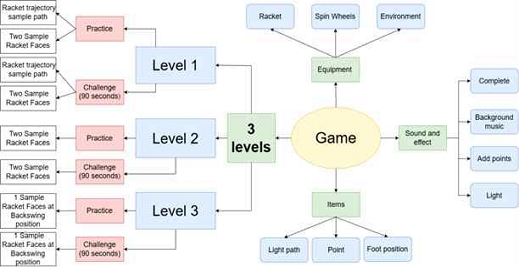
Overview of the workflow and components of the VR-based training games
- • Level 1: Full trajectory+racket models
- Challenge: ≥18/25 strokes accurate in ≤90s (72% threshold)
- • Level 2: Partial trajectory; speed focus
- Challenge: ≥18/25 strokes in ≤90s (increased precision)
- • Level 3: Backswing model only
- Challenge: ≥20/25 strokes in ≤90s (autonomous)
- Scoring: 1 point/stroke meeting 3 criteria (Racket trajectory path, Two Sample Racket Faces, follow through).
3-2 Game Structure and Progression
The VR-based training game consists of five sequential steps designed to guide students through the complete forehand and backhand training process, as illustrated in Fig. 2.
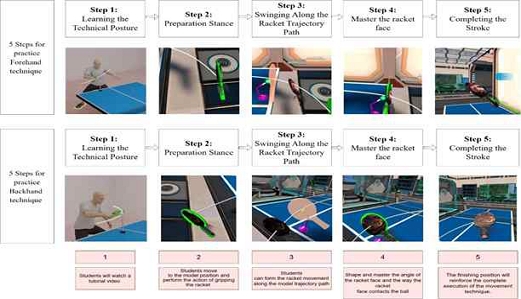
5 steps to guide students in correctly performing the forehand and backhand techniques
- • Posture Tutorial: Video demonstration of stance/coordination
- • Preparation: Controller based racket grip+ backswing alignment
- • Trajectory Practice: Guided swing path for muscle memory
- • Racket Face: Ball contact angle mastery via fixed model
- • Follow-through: Complete stroke completion for power/accuracy
3-3 Game Elements & Features
Game elements are essential components that support students’ object recognition and enrich their experiential perception during gameplay.
- • Points: All game scenarios utilize a common point accumulation system, which reflects the students’ performance and serves to stimulate enthusiasm and satisfaction, particularly when students achieve high scores. The goal-oriented nature of the point system encourages repeated participation and motivates students to return to practice sessions[32],[33].
- • Items: Points earned through gameplay can be used to purchase various virtual items, allowing students to customize their experience according to personal preferences, thereby supporting a greater sense of immersion[34]. Available items in the game include skins of rackets, the “spin wheel” tool, and table (As shown in Fig. 3).
- • Visual Support Tools: Visual simulation tools provide students with the ability to observe and follow proper techniques independently, without requiring direct instructor intervention[35]. These visual aids include the racket trajectory sample path, two reference racket positions at the backswing and contact points, and a virtual representation of the “spin wheels” tool.
- • Effects: Students can experience a sense of realistic interaction between the racket and ball, replicating real world tactile feedback[36]. Additionally, dynamic visual and audio effects, unrestricted by physical constraints, support enjoyment and motivation each time students correctly execute a technical movement[37],[38].
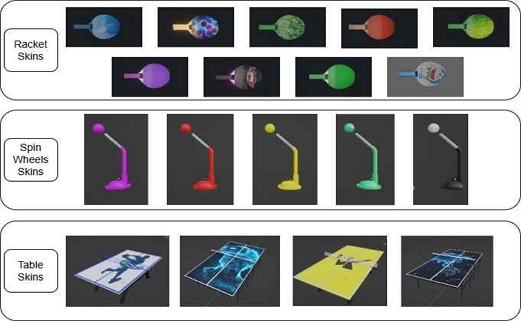
Skins of rackets, spin wheel, and table
Ⅳ. Game Development/Implementation
4-1 Interaction and Physics
The velocity is applied to the racket’s Rigidbody component only when its magnitude exceeds a predefined threshold (0.01m/s), preventing unwanted jitter from minor controller movements. To further support immersion, a swing sound is triggered when the controller’s velocity exceeds a swing threshold (15.0m/s). This is implemented in the PlaySwingSound method, which uses a SoundBuilder from the audio system to play a sound with randomized pitch at the racket’s position, simulating the auditory feedback of a real table tennis swing. A cooldown mechanism (0.5seconds) prevents repetitive sound playback during continuous swings, a more natural audio experience.
The haptic feedback is triggered upon collision between the racket and the ball, utilizing the Oculus controller’s vibration capabilities.
The collision detection is handled by Unity’s physics engine, with both the racket and ball assigned appropriate colliders (e.g., sphere or capsule colliders) to ensure accurate detection. The system is designed to be performance-efficient, as it leverages Unity’s built-in physics system without requiring additional computational overhead.
To evaluate the accuracy of the user’s stroke movement, six collider points were integrated as checkpoints. A successful execution is recorded only when the racket trajectory intersects all designated points in the correct sequence.
The colliders are used as the checkpoints for each part of the forehand and backhand techniques guideline, as shown in Fig. 4. We determine which kind of collider should be used in this situation. Ordinarily, the sphere collider is the most computationally efficient. Therefore, it was selected for this implementation to optimize performance.
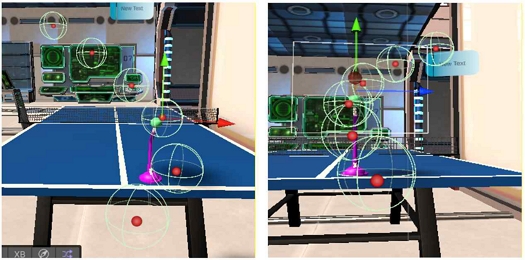
Colliders used for checking forehand (left) and backhand (right) techniques guidelines
4-2 Racket Trajectory Visualization and Simulation
This study utilizes the coordinate and angular data collected from users to simulate the forehand and backhand stroke movements in response to incoming balls, based on the research conducted in [39]. The kinematic simulation was developed using Blender, adhering to the joint coordinate system and human motion modeling standards established by the International Society of Biomechanics (ISB)[40]. Fig. 5 depicts the range of rotational motion across body segments and joints. The system precisely defines the coordinates of the critical backswing and contact points, subsequently deriving the follow-through trajectory in accordance with the kinematic simulation model proposed by [5]. The simulated trajectories are illustrated in Fig. 6 and Fig. 7.
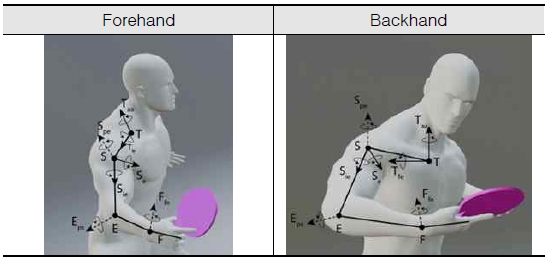
Rotational degrees of freedom of human body segments based on ISB joint coordinate system guidelines
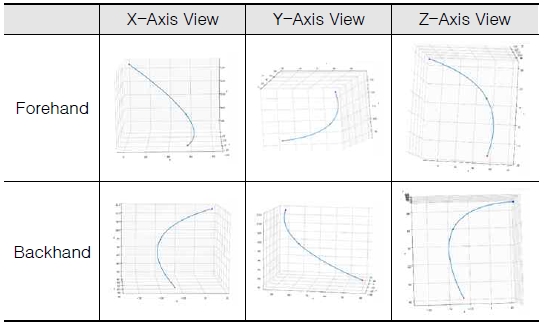
Trajectory in a three-dimensional coordinate system for forehand and backhand techniques
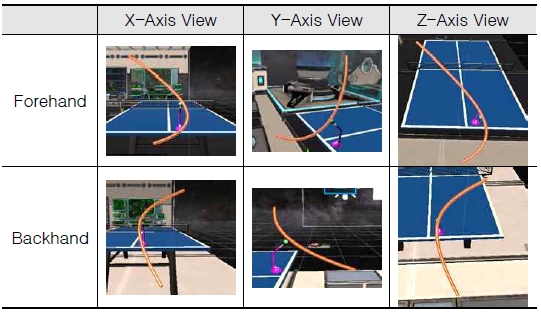
Racket trajectory sample path in the game, corresponding to each forehand and backhand technique
Table tennis is a high-speed sport. Therefore, students must minimize any unnecessary movements that could reduce their responsiveness during gameplay. This highlights the importance of the reference racket’s motion trajectory in supporting the development of proper techniques. The trajectory of the reference racket should provide a clear and comprehensive visual representation for students, illustrating a continuous curve that passes through the key phases: backswing, contact, and follow-through.
4-3 Specifications of the Two Sample Racket Faces
Table tennis technique is particularly characterized by its reliance on the racket face angle during the swing and, most critically, at the moment of ball contact. The shape parameters and coordinates of the sample racket at two key positions, backswing and contact, enable students to independently understand the required racket angles, and these are simulated using the 3D modelling tool Blender. The three-dimensional data necessary for these two racket models was referenced from the study in [39] (See Table 2).
Angular parameters of the sample racket for both forehand and backhand techniques at two key positions: Backswing and Contact
Based on the data analyzed and synthesized in Table 2, the Blender application is used to create two sample racket faces at two critical positions: backswing and contact. Fig. 8 illustrates examples of forehand and backhand racket angle simulation in the Blender tool.
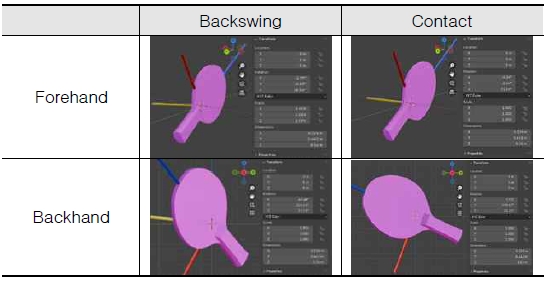
Illustration of the backswing and contact positions of the forehand and backhand techniques in blender
After the modeling process is completed, these models are transferred to the Unity tool, where they are integrated into the game environment to support visual guidance for students, as shown in Fig. 9.
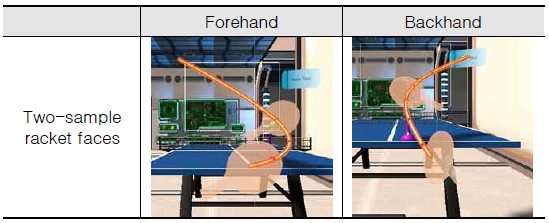
The images of the two sample racket surfaces at the backswing and contact positions, as displayed in the VR-based training game, correspond to the backhand technique on the right and the forehand technique on the left
Ⅴ. User Study
5-1 Implementation Procedure
The VR-based training game was introduced in a regular table tennis class with 40 students enrolled in the course. The VR activity was integrated as a learning module within the normal curriculum; Each student participated individually in the VR-based training game for approximately 45 minutes; after using the application, students completed the standard course skill assessment typically used in the class.
The implementation followed the game's instructional structure:
• VR Practice Session: Students completed all three instructional levels of the VR-based training game, practicing both forehand and backhand techniques as guided by the application's progression.
• Course Skill Assessment: Immediately after the VR session, students performed 10 forehand and 10 backhand strokes as part of the regular class evaluation. Performance scores were recorded as FH_R and BH_R (real-world technical ratings for forehand and backhand strokes) for classroom assessment purposes. The technical performance (FH_R and BH_R) was assessed through a skill test consisting of 10 controlled trials for each technique. A structured evaluation rubric was employed, where scores (1–5) were assigned based on the number of successful hits (accuracy) in conjunction with the quality of execution, including stance, contact point, and follow-through. Two experienced table tennis instructors independently evaluated the performances using a structured rubric. After the initial scoring, any discrepancies were discussed to reach a consensus, and the final score for each participant was determined accordingly. Although formal inter-rater reliability was not calculated, this process helped enhance scoring consistency.
5-2 Student Feedback Questionnaire
After completing the training session, participants responded to a user experience questionnaire consisting of five items assessing usability, immersion, and perceived usefulness of the VR system. Each item was rated on a 5-point Likert scale (1=strongly disagree, 5=strongly agree).
5-3 Data Summary
Data from the course assessments and student feedback were summarized using R software. Descriptive statistics, including mean (M) and standard deviation (SD), were computed for each individual item of the user experience (EXP) questionnaire, as well as for the performance measures (FH_R and BH_R). Given the multi-dimensional nature of the feedback items, covering usability, immersion, and motivation each item was analyzed independently to provide a comprehensive view of the student experience. In addition, Pearson correlation analysis was conducted to examine the relationship between the aggregate user experience scores and technical performance (FH_R and BH_R), with a significance level set at p<0.05.
Ⅵ. Results and Discussion
A total of 40 students participated in the VR activity as part of their regular table tennis course.
As shown in Table 3, students rated all dimensions of the VR experience highly, with mean scores ranging from 4.15 to 4.40. The relatively low standard deviations (SD<0.73) indicate consistent responses among participants.
Student feedback on VR experience(n=40)
Within the VR-based training environment, forehand performance was generally higher than backhand performance, while backhand results showed slightly greater variability, suggesting differences in task difficulty (See Table 4).
Technical performance results in VR and real-world environments(n=40)
As shown in Table 5, correlation analysis revealed that most user experience variables were not significantly associated with performance outcomes. However, one item (EXP4) showed a statistically significant moderate positive correlation with forehand performance (r=0.364, p=0.021). This suggests that specific aspects of user experience may be more relevant than the overall construct.
Pearson correlation between user experience items and performance
As shown in Table 6, regression analysis indicated that VR performance was positively associated with real-world performance for both forehand (β=0.429, p=0.001) and backhand (β=0.322, p=0.009). These results suggest a potential relationship between in-game performance and real-world skill execution, although causal interpretation is limited by the study design.
Regression analysis: VR performance predicting real performance
As shown in Fig. 10, VR performance is positively associated with both forehand and backhand outcomes, supporting a transfer effect. In contrast, only EXP4 shows a noticeable relationship with performance, while other user experience variables do not.
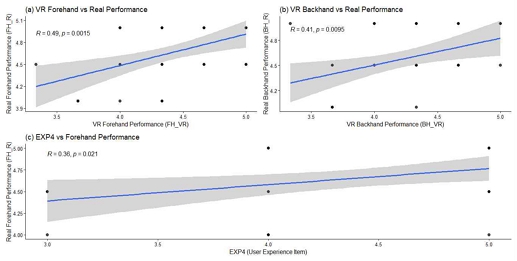
Scatter plots illustrating key relationships. (a) VR forehand performance (FH_VR) shows a strong positive relationship with real-world performance (FH_R). (b) VR backhand performance (BH_VR) also demonstrates a positive relationship with real performance (BH_R). (c) EXP4 shows a moderate positive relationship with forehand performance, while other user experience variables were not significant
Our finding that EXP4 (perceived usefulness) showed significant correlation with skill performance (r=0.364, p=0.021) aligns with Na, who identified perceived satisfaction as a key driver of VR game engagement in the Journal of Digital Contents Society, suggesting that VR-based training can leverage similar motivational mechanisms[41].
While trajectory visualization was incorporated as a feedback mechanism, its specific effect should be interpreted cautiously due to the lack of direct comparison. In addition, the integration of customizable racket skins and spin wheels was intended to enhance immersion and engagement. This design approach is supported by Tian & Woo, who reported that visually appealing game elements can increase user immersion and sustained engagement[42]. However, in the present study, these design features can not be independently evaluated, and their contribution to performance remains suggestive. Overall, the findings indicate that interaction-related factors may be more relevant than general usability in sports-specific VR-based training games.
Ⅶ. Conclusions
In conclusion, the VR-based training game demonstrates potential as a tool to support table tennis practice in a classroom setting. Positive associations were observed between in-game performance and real-world outcomes, suggesting that VR-based training may help facilitate skill practice.
While general user experience was not strongly associated with performance, specific aspects of experience may still play a role. These findings provide preliminary insights into the use of VR in sports education.
Future research should further validate these findings using randomized controlled designs with pre-post measures and more diverse participant groups (e.g., left-handed players and varied body types). In addition, detailed logging of level-specific performance (Level 1-3) should be incorporated to better evaluate progression within the stepwise training design, along with investigations into long-term skill retention.
References
-
T. M. D. Co and T. H. A. Nguyen, “The Status of Students’ Positive Qualities in Table Tennis 1 Course at Saigon University, Vietnam,” European Journal of Physical Education and Sport Science, Vol. 9, No. 6, 2023.
[https://doi.org/10.46827/ejpe.v9i6.4846]

-
N. T. Thu, N. N. Minh, and P. Q. Nguyen, “Application of Design Thinking to Implement Innovation Policy in Teaching Table Tennis for Students – The Case of Vietnam National University, Hanoi,” Conhecimento & Diversidade, Vol. 14, No. 35, pp. 119-130, 2022.
[https://doi.org/10.18316/rcd.v14i35.10692]
- D. N. Anh, “Applying 3D Technology to Make Videos about Basic Techniques to Teach Table Tennis to Students Majoring in Physical Education at Thai Nguyen University of Education,” International Journal of Health, Physical Education & Computer Science in Sports, Vol. 39, No. 2, pp. 63-66, 2020.
-
S. Zhang, G. Chen, Q. Wu, and X. Li, “The Interplay Between Table Tennis Skill Development and Sports Performance: A Comprehensive Review,” Pacific International Journal, Vol. 6, No. 3, pp. 150-156, 2023.
[https://doi.org/10.55014/pij.v6i3.433]
-
R. McAfee, Table Tennis: Steps to Success, Champaign, IL: Human Kinetics, 2009.
[https://doi.org/10.5040/9781718219250]
-
Y. Iino and T. Kojima, “Kinematics of Table Tennis Topspin Forehands: Effects of Performance Level and Ball Spin,” Journal of Sports Sciences, Vol. 27, No. 12, pp. 1311-1321, 2009.
[https://doi.org/10.1080/02640410903264458]
-
W. Hidayat and A. Falaahudin, “Comparison between Forehand and Backhand Stroke Techniques in the Accuracy of Strikes among Extra-Curricular Table Tennis Students at State Senior High School 1 Sedayu,” Education Achievement: Journal of Science and Research, Vol. 5, No. 1, pp. 125-133, 2024.
[https://doi.org/10.51178/jsr.v5i1.1777]
-
H. Oagaz, B. Schoun, and M.-H. Choi, “Performance Improvement and Skill Transfer in Table Tennis Through Training in Virtual Reality,” IEEE Transactions on Visualization and Computer Graphics, Vol. 28, No. 12, pp. 4332-4343, 2021.
[https://doi.org/10.1109/TVCG.2021.3086403]
-
S. C. Michalski, A. Szpak, D. Saredakis, T. J. Ross, M. Billinghurst, and T. Loetscher, “Getting Your Game on: Using Virtual Reality to Improve Real Table Tennis Skills,” PLoS One, Vol. 14, No. 9, e0222351, 2019.
[https://doi.org/10.1371/journal.pone.0222351]
-
T. Ma, W. Du, and Q. Zhang, “The Effect of Virtual Reality Technology in Table Tennis Teaching: A Multi-Center Controlled Study,” Sensors, Vol. 24, No. 21, 7041, 2024.
[https://doi.org/10.3390/s24217041]
-
Z. Huang and P. Hongseanyatham, “Effects of Using Virtual Reality Technology on Forehand and Backhand in Table Tennis,” International Journal of Sociologies and Anthropologies Science Reviews, Vol. 5, No. 1, pp. 407-418, 2025.
[https://doi.org/10.60027/ijsasr.2025.5292]
- TTHub. Huieson Table Tennis Stroke Training Machine [Internet]. Available: https://www.tabletennisHub.net/products/1371427471440, .
-
J.-J. Weng, Y.-H. Wang, C. Ku, D.-X. Wu, Y.-M. Lau, W.-L. Tsai, ... and T.-C. Wu, “Assist Home Training Table Tennis Skill Acquisition via Immersive Learning and Web Technologies,” in 2022 IEEE Conference on Virtual Reality and 3D User Interfaces Abstracts and Workshops (VRW), Christchurch, New Zealand, pp. 804-805, 2022.
[https://doi.org/10.1109/VRW55335.2022.00253]
-
C. Ku, J.-J. Weng, Y.-H. Wang, D.-X. Wu, Y.-M. Lau, W.-L. Tsai, ... and M.-C. Hu, “Table Tennis Skill Learning in VR with Step by Step Guides Using Forehand Drive as a Case Study,” in 2022 IEEE International Conference on Artificial Intelligence and Virtual Reality (AIVR), pp. 275-282, 2022.
[https://doi.org/10.1109/AIVR56993.2022.00057]
-
F. Farzinnejad, J. Rasti, N. Khezrian, and J. Grubert, “The Effect of an Exergame on the Shadow Play Skill Based on Muscle Memory for Young Female Participants: The Case of Forehand Drive in Table Tennis,” in 2023 IEEE International Symposium on Mixed and Augmented Reality (ISMAR), Sydney, Australia, pp. 1152-1160, 2023.
[https://doi.org/10.1109/ISMAR59233.2023.00132]
- P. M. Fitts and M. I. Posner, Human Performance, Belmont, CA: Brooks/Cole, 1967.
-
P. Caliari, “Enhancing Forehand Acquisition in Table Tennis: The Role of Mental Practice,” Journal of Applied Sport Psychology, Vol. 20, No. 1, pp. 88-96, 2008.
[https://doi.org/10.1080/10413200701790533]
-
R. M. Ryan and E. L. Deci, “Self-Determination Theory and the Facilitation of Intrinsic Motivation, Social Development, and Well-Being,” American Psychologist, Vol. 55, No. 1, pp. 68-78, 2000.
[https://doi.org/10.1037//0003-066X.55.1.68]
-
P. Bitrián, I. Buil, and S. Catalán, “Gamification in Sport Apps: The Determinants of Users’ Motivation,” European Journal of Management and Business Economics, Vol. 29, No. 3, pp. 365-381, 2020.
[https://doi.org/10.1108/EJMBE-09-2019-0163]
-
A. Suh, C. Wagner, and L. Liu, “Enhancing User Engagement Through Gamification,” Journal of Computer Information Systems, Vol. 58, No. 3, pp. 204-213, 2018.
[https://doi.org/10.1080/08874417.2016.1229143]
-
R. Brondi, G. Avveduto, M. Carrozzino, F. Tecchia, L. Alem, and M. Bergamasco, “Immersive Technologies and Natural Interaction to Improve Serious Games Engagement,” in Proceedings of the 4th International Conference on Games and Learning Alliance, GALA 2015, Rome, Italy, pp. 121-130, 2016.
[https://doi.org/10.1007/978-3-319-40216-1_13]
-
A. Gupta and S. Gomathi, “A Review on Gamification and Its Potential to Motivate and Engage Employees and Customers: Employee Engagement Through Gamification,” International Journal of Sociotechnology and Knowledge Development (IJSKD), Vol. 9, No. 1, pp. 42-52, 2017.
[https://doi.org/10.4018/IJSKD.2017010103]
-
A. Efendi and T. S. Qodr, “Improving Critical Thinking Skills of High School Students Through the Implementation of Mobile-Based Game Applications,” International Journal of Education and Practice, Vol. 11, No. 3, pp. 613-626, 2023.
[https://doi.org/10.18488/61.v11i3.3440]
-
A. Supnoon and R. Chonchaiya, “A Study on the Development of Eleventh Grade Students’ Critical Thinking Skills and Self-Efficacy Using Active Learning Pedagogy with Gamification,” International Journal of Education and Practice, Vol. 12, No. 2, pp. 447-466, 2024.
[https://doi.org/10.18488/61.v12i2.3718]
-
D. Checa and A. Bustillo, “A Review of Immersive Virtual Reality Serious Games to Enhance Learning and Training,” Multimedia Tools and Applications, Vol. 79, pp. 5501-5527, 2020.
[https://doi.org/10.1007/s11042-019-08348-9]
- M. A. Flores, D. Bercades, and F. Florendo, “Effectiveness of Shadow Practice in Learning the Standard Table Tennis Backhand Drive,” International Journal of Table Tennis Sciences, No. 6, pp. 105-110, 2010.
- M. Csikszentmihalyi and I. S. Csikszentmihalyi, Optimal Experience: Psychological Studies of Flow in Consciousness, New York, NY: Cambridge University Press, 1992.
-
S. Engeser and F. Rheinberg, “Flow, Performance and Moderators of Challenge-Skill Balance,” Motivation and Emotion, Vol. 32, pp. 158-172, 2008.
[https://doi.org/10.1007/s11031-008-9102-4]
-
M. Zyda, “From Visual Simulation to Virtual Reality to Games,” Computer, Vol. 38, No. 9, pp. 25-32, 2005.
[https://doi.org/10.1109/MC.2005.297]
-
B. Roungas and F. Dalpiaz, “A Model-Driven Framework for Educational Game Design,” in Proceedings of the 4th International Conference on Games and Learning Alliance, Rome Italy, pp. 1-11, 2015.
[https://doi.org/10.1007/978-3-319-40216-1_1]
- M. Csikszentmihalyi, Flow: The Psychology of Optimal Experience, New York, NY: Harper and Row, 1990.
-
J. Juul, Without a Goal: On Open and Expressive Games, in Videogame, Player, Text, Manchester, UK: Manchester University Press, pp. 191-203, 2024.
[https://doi.org/10.7765/9781526185600.00015]
-
K. Richter and M. Kickmeier-Rust, “Gamification in Physics Education: Play Your Way to Better Learning,” International Journal of Serious Games, Vol. 12, No. 1, pp. 59-81, 2025.
[https://doi.org/10.17083/ijsg.v12i1.858]
-
H. Yildiz, A. Reiter, D. Vrontis, and J.-P. Mouline, “Interacting in Virtual Reality: When the Proteus Effect Stimulates 3D MMORPG Players to Buy,” Technological Forecasting and Social Change, Vol. 201, 123205, 2024.
[https://doi.org/10.1016/j.techfore.2024.123205]
-
J.-F. Chen, W.-C. Lin, K.-H. Tsai, and S.-Y. Dai, “Analysis and Evaluation of Human Movement Based on Laban Movement Analysis,” Journal of Applied Science and Engineering, Vol. 14, No. 3, pp. 255-264, 2011.
[https://doi.org/10.6180/jase.2011.14.3.09]
-
S. Deng, J. A. Kirkby, J. Chang, and J. J. Zhang, “Multimodality with Eye Tracking and Haptics: A New Horizon for Serious Games?,” International Journal of Serious Games, Vol. 1, No. 4, pp. 17-34, 2014.
[https://doi.org/10.17083/ijsg.v1i4.24]
- G. D. Borich and M. L. Tombari, Educational Psychology: A Contemporary Approach, New York, NY: Pearson, 2021.
- M. Asgari and D. Kaufman, “Relationships among Computer Games, Fantasy, and Learning,” in Proceedings of the 2004 Informing Science and IT Education Joint Conference, pp. 563-570, 2004.
- R. Xia, B. Dai, W. Fu, N. Gu, and Y. Wu, “Kinematic Comparisons of the Shakehand and Penhold Grips in Table Tennis Forehand and Backhand Strokes When Returning Topspin and Backspin Balls,” Journal of Sports Science & Medicine, Vol. 19, No. 4, pp. 637-644, 2020.
-
G. Wu, F. C. T. van der Helm, H. E. J. Veeger, M. Makhsous, P. Van Roy, C. Anglin, ... and B. Buchholz, “ISB Recommendation on Definitions of Joint Coordinate Systems of Various Joints for the Reporting of Human Joint Motion—Part II: Shoulder, Elbow, Wrist and Hand,” Journal of Biomechanics, Vol. 38, No. 5, pp. 981-992, 2005.
[https://doi.org/10.1016/j.jbiomech.2004.05.042]
-
J.-Y. Na, “A Study on Factors Affecting VR Game Usage Trends and Perceived Satisfaction,” Journal of Digital Contents Society Vol. 25, No. 9, pp. 2689-2698, 2024.
[https://doi.org/10.9728/dcs.2024.25.9.2689]
-
S.-L. Tian and T. Woo, “Study on the Influence of Game Character Design on Users’ Continuous Immersion,” Journal of Digital Contents Society, Vol. 20, No. 6, pp. 1097-1104, 2019.
[https://doi.org/10.9728/dcs.2019.20.6.1097]
저자소개

2009년:University of Science and Education, Department of Information Technology
2015년:University of GreenWich, Department of Computing & Information Systems (Master’s)
2010년~현 재: Professor, Faculty of Computer Science, Vietnam-Korea University of Information and Communication Technology, The University of Danang
2024년~현 재: Kyung Hee University, Ph.D course’s
※관심분야:Interaction, Character Design, Virtual Reality

2004년:경희대학교 (공학사-컴퓨터공학, 예술학사-멀티미디어)
2007년:Academy of Art University (MFA-Animation & VFX)
2020년:경희대학교 (예술학박사-애니메이션)
2008년~2010년: Big Fish Games, Inc.
2010년~2012년: 한국과학기술원
2012년~2020년: 영남대학교
2020년~현 재: 경희대학교 디지털콘텐츠학과 교수
※관심분야:비주얼스토리텔링(Visual Storytelling), 애니메이션(Animation), 캐릭터디자인(Character Design)

2021년~현 재: Undergraduate student, Faculty of Computer Science, Vietnam-Korea University of Information and Communication Technology, The University of Danang
※관심분야:Game Development, Virtual Reality, 3D Art, AI & Gameplay Systems

2021년~현 재: Undergraduate student, Faculty of Computer Science, Vietnam-Korea University of Information and Communication Technology, The University of Danang
※관심분야:Game Development, Game Design, Virtual Reality, Technical Art, AI & Gameplay Systems

2021년~현 재: Undergraduate student, Faculty of Computer Science, Vietnam-Korea University of Information and Communication Technology, The University of Danang
※관심분야:3D Rigging & Animation, Game Design

2021년~현 재: Undergraduate student, Faculty of Computer Science, Vietnam-Korea University of Information and Communication Technology, The University of Danang
※관심분야:3D Artist, Game Design, Concept Artist

2021년~현 재: Undergraduate student, Faculty of Computer Science, Vietnam-Korea University of Information and Communication Technology, The University of Danang
※관심분야:3D Modeling, 3D artist, Game Design, Game Developer