User Experience of Game Character Design Using Traditional Cultural Elements
Copyright ⓒ 2026 The Digital Contents Society
This is an Open Access article distributed under the terms of the Creative Commons Attribution Non-CommercialLicense(http://creativecommons.org/licenses/by-nc/3.0/) which permits unrestricted non-commercial use, distribution, and reproduction in any medium, provided the original work is properly cited.

Abstract
This study analyzed the representation methods in game character design using traditional cultural elements across three aspects: realistic, modern, and creative representations. Players’ responses were categorized into perceptual, acceptance, and evaluative attitudes via an online survey. Differences were tested using independent-samples t-tests, one-way ANOVA, and linear regression. Perceptual attitudes differed significantly by gender, whereas acceptance attitudes were strongly associated with immersion time. Evaluations were more positive when the designs balanced cultural authenticity with creativity. This study aims to make a small but meaningful contribution to the traditional-culture-based game character design industry by providing more specific, objective evidence for the efficient use of traditional elements in character-production workflows.
초록
본 연구는 전통문화 요소를 활용한 게임 캐릭터 디자인에서의 표상 방식에서 사실적 재현, 현대적 재현, 창의적 재현 세 가지 측면으로 분석을 진행하였다. 온라인 설문 조사를 통해 게임 플레이어가 전통문화 요소를 활용한 게임 캐릭터의 반응 태도를 지각 태도, 수용 태도, 평가 태도로 나누어 독립표본 t-검정, 일원 분산 분석과 선형회귀분석으로 차별적 반응을 분석하였다. 분석 결과, 지각 태도는 성별에 따라 유의미한 차이를 보였다. 수용 태도는 게임 몰입 시간과의 관련성이 깊은 것으로 분석되었으며, 게임에 대한 평가 태도는 전통문화 요소가 문화적 진정성과 창의성을 동시에 충족할 때, 긍정적 영향을 미친다는 사실이 도출되었다. 본 연구의 결론으로 향후 게임 캐릭터 디자인 제작 과정에서 전통문화 요소의 효율적인 활용 방식에 대한 보다 구체적이고 객관적인 데이터를 공유함으로써 전통문화 요소를 활용한 게임 캐릭터 디자인 산업 발전에 작으나마 기여 해주기를 바란다.
Keywords:
Game Character Design, Traditional Cultural Element, Visual Representation, Cultural Authenticity, Player Attitude키워드:
게임 캐릭터 디자인, 전통문화 요소, 시각적 표상, 문화적 진정성, 플레이어 태도Ⅰ. Introduction
Against the backdrop of the rapid development of digital media, games have evolved beyond being mere entertainment products to become important carriers of cultural transmission and aesthetic expression. Especially in a globalized context, games leverage narrative, interactivity, and symbolic representation to exhibit cultural value and social significance that extend beyond their entertainment function. As Daniel Bell suggests, the dominant elements in contemporary society are visual concepts, sounds, and spectacles[1]. Among these, visual elements are the most direct carriers of culture in games and constitute the primary semiotic language through which audiences perceive the constructed game world. The appearance, attire, and symbolic features of characters not only shape a unique virtual atmosphere but also fulfill a cultural narrative function. In particular, the incorporation of traditional cultural elements into character design can further enhance game immersion and narrative tension, thereby increasing players’ emotional engagement and sense of cultural identity.
However, existing studies on the visual reproduction of traditional culture have primarily focused on film, stage performance, and cultural and creative products, while relatively limited attention has been given to its specific modes of presentation and its impact on user experience within game character design. Moreover, most prior research relies on qualitative methods, leaving a gap in quantitative analysis regarding how players actually perceive, interpret, and evaluate these cultural elements. Therefore, the relationship between the visual presentation of traditional culture and player experience remains an area that requires further exploration.
Based on this gap, the present study first clarifies the scope of traditional cultural elements to ensure the focus of analysis. In this research, traditional cultural elements refer mainly to visual cultural symbols, including costume styles, traditional motifs, character imagery, and symbolic visual elements. The study is limited to the visual design of game characters and does not involve cultural elements embedded in music, narrative text, or gameplay mechanics.
Methodologically, this study adopts a mixed approach combining case analysis and questionnaire surveys to examine how player characteristics—such as gender and gameplay immersion time—affect their perception and acceptance of traditional cultural elements. Furthermore, the study analyzes the role of traditional cultural elements in character visual design from two dimensions: creative design and cultural respect. It also investigates how realistic representation, modernized representation, and creative representation influence players’ overall evaluation of the game. The aim of this research is to reveal how visual traditional cultural elements shape user experience and contribute to cultural transmission in games, thereby offering new perspectives and theoretical foundations for cultural expression in game character design.
Ⅱ. Research Background
In contemporary game design, the integration of traditional cultural elements has become an important means of achieving cultural expression. By either faithfully reproducing typical cultural symbols or simplifying, reconstructing, and creatively reinterpreting them, games not only fulfill the function of cultural dissemination but also create a distinctive aesthetic experience for players. However, the representation of traditional culture in character design is not a mechanical replication of historical artifacts or symbols; rather, it is a process of selective, artistic reconstruction and creative expression. Danto’s theory of representation provides a theoretical foundation for this process. He posits that representation encompasses two levels: one relates to the internal meaning inherent in a model or imitation, and the other pertains to the external meaning associated with what the model denotes[2].
The three modes of representation examined in this study—realistic representation, modernized representation, and creative representation—correspond to Danto’s internal–external structure of representation. Specifically, realistic representation emphasizes fidelity to external form, modernized representation highlights the adaptation of form to contemporary contexts and aesthetic expectations, while creative representation focuses on the reconstruction of external meaning. Consequently, when presenting traditional cultural elements in game characters, designers must balance fidelity and recognizability while also considering aesthetics and entertainment. Such a balance enables players to develop cultural identification and emotional resonance through an immersive gaming experience.
In summary, the theoretical background of this study not only examines how traditional culture is visually represented but also highlights the representational differences among the three modes and how these distinctions may influence players’ cognition, aesthetic judgment, and overall gameplay experience. This theoretical foundation further informs the categorization of the three representation modes, the subsequent case analyses, and the design of questionnaire variables, thereby establishing a coherent and logically integrated research framework.
Ⅲ. Case Studies and Questionnaire Analysis
3-1 Presentation Approaches and Cultural Significance
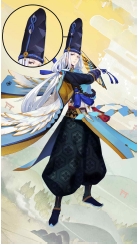
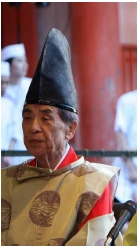
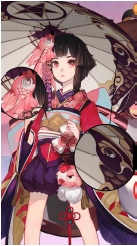
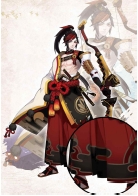
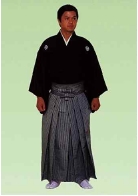
In game design, the most direct approach to presenting traditional cultural elements is through the faithful reproduction of existing cultural symbols. For example, as shown in Table 1, the card game Onmyoji is set in the Heian period, and its overall aesthetic style closely reproduces the regional cultural characteristics of that era.

Traditional cultural elements in the game Onmyoji
The designs of characters such as Abe no Seimei, Kagura, and Minamoto no Hiromasa demonstrate that the game not only presents meticulous cultural research in visual details but also reinforces the coherence of character identity and narrative logic. For instance, Abe no Seimei,’s eboshi hat highlights his authority; the carp motifs on Kagura’s attire symbolize agility and courage; and Minamoto no Hiromasa’s samurai costume emphasizes his familial background[3].
This approach of realistic representation not only enhances the historical atmosphere and immersion of the game but also strengthens the recognition and influence of traditional Japanese aesthetics in global dissemination, allowing players to perceive and identify with the culture through virtual interaction.
In the context of globalization and a diverse player base, games increasingly emphasize cultural expression and player experience. Presenting complex cultural elements in an intuitive and easily understandable manner not only enhances players’ recognition and understanding of a specific culture but also facilitates cross-cultural dissemination. Through this process of transformation, traditional culture can be preserved and transmitted in forms that align with contemporary aesthetics[6].
For example Fig. 1, the character Yun Jin in Genshin Impact draws on typical elements of Peking opera costumes, such as headdresses, shoulder drapes, and command banners, but these elements are visually simplified and modernized. Compared to traditional Peking opera stage attire, Yun Jin’s design is more dynamic and fashion-forward, maintaining cultural roots while appealing to the aesthetic preferences of younger players. This approach gives traditional art new vitality in digital media, increasing global audiences’ awareness of Chinese culture while promoting the rejuvenation and international dissemination of local cultural heritage.
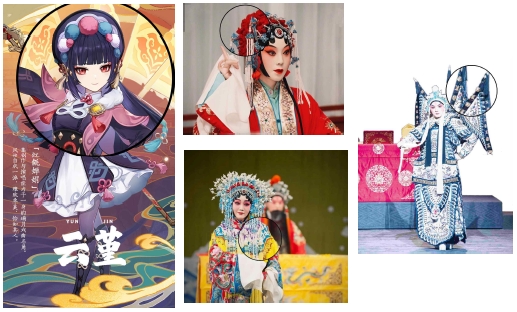
Yunjin character design and design reference*The image is the official character poster, with the Chinese section displaying the character's name and introduction.
Such visual reinterpretation of traditional culture preserves cultural recognizability while balancing players’ aesthetic tastes, thereby facilitating the global spread of cultural elements. From a cultural perspective, simplification and reconstruction are not merely visual translation strategies but mechanisms for cultural adaptation and transmission. They transcend cultural boundaries, enabling traditional symbols to be shared and re-acknowledged in a global gaming context, thereby enhancing cultural soft power.
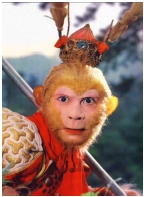
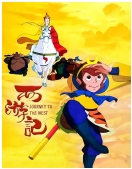
Cultural authenticity is not a singular or static replication of original forms rather, it is a process of multiple expressions and continual evolution. Taking China as an example, its long and rich history has produced diverse cultural traditions. When representing a particular cultural image or element, it is often interpreted in varied ways depending on different historical contexts and artistic styles. Sun Wukong, as a classic symbol in Chinese literature and mythology, has been continuously reconstructed across different historical periods and media since the publication of Journey to the West. As shown in Table 2, these representations illustrate how the character has evolved, transformed, and been creatively reinterpreted over time.
The image of Sun Wukong
Sun Wukong first appeared in Wu Chengen’s Journey to the West during the Ming Dynasty, where descriptions of his appearance emphasized wildness, portraying him more as a supernatural creature than a human. With the evolution of media forms, the character’s image has undergone significant changes. In the 1986 television adaptation of Journey to the West, portrayed by Liu Xiao Ling Tong, Sun Wukong’s humorous, righteous, and clever characteristics became deeply ingrained in the public imagination, establishing a widely recognized standard version. In various animated adaptations, the character has been redesigned to appeal to children, emphasizing traits such as cuteness, agility, and justice, while largely omitting the original depiction of his supernatural ferocity.
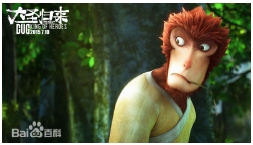
The game Black Myth: Wukong offers a novel interpretation within this cultural lineage. As illustrated in Fig. 2, its character design not only restores the monkey-demon traits from the original novel but also integrates realistic facial details and rugged features, challenging the conventional perception of a beautified, anthropomorphized Sun Wukong. Compared with film and animation, this gamified design combines realism with innovation, enhancing the character’s sense of unfamiliarity and visual impact.
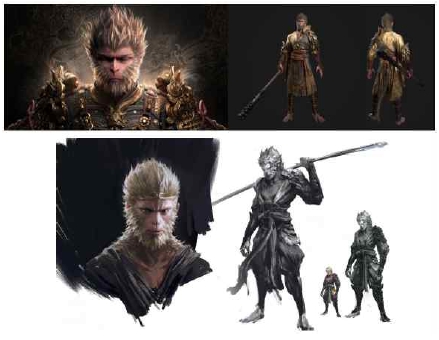
Wukong character in the game Black Myth: Wukong
From a cultural value perspective, such design injects new narrative energy into a classic character while stimulating players’ renewed interest in traditional Chinese literature and mythology. It demonstrates the unique potential of digital games as platforms for cultural reproduction, capable of reshaping classics and fostering cultural dialogue.
In summary, the presentation of traditional cultural elements in game characters can generally be categorized into three approaches: realistic representation, Modernized representation, and Creative representation. These different levels of representation not only shape distinctive character imagery but also promote cultural identification, resonance, and dissemination. The application of traditional cultural elements in games has thus transcended mere decorative purposes, becoming a vital medium for cultural communication and reconstruction.
3-2 Research Hypotheses and Questionnaire Design
Based on the preceding analysis of the presentation approaches of traditional cultural elements in game characters, this study focuses on players with a certain level of gaming experience as respondents. It explores differences among audience groups in terms of variables such as gender and gameplay immersion time, as well as how players’ perceptions of cultural creativity and authenticity influence their overall evaluation of games. The following research hypotheses are proposed:
H1: Players of different genders exhibit significant differences in their perception of how traditional cultural elements are applied in games.
H2: The duration of gameplay immersion significantly affects players’ acceptance of traditional cultural elements presented through different approaches.
H3: The design of traditional cultural elements in game characters that balances creativity and cultural authenticity has a significant positive effect on players’ overall game evaluation.
The questionnaire consists of four sections, comprising a total of 12 items. Except for demographic information, all items were rated using a 5-point Likert scale. The first section collects demographic information, including respondents’ gender, age, and gameplay duration, providing the variable basis for subsequent hypothesis testing.
The second section focuses on players’ cognition of traditional cultural elements. By presenting images of different game characters—realistic representation (Kagura), modernized representation (Yun Jin), and creative representation (Wukong)—this section examines players’ ability to recognize and interpret the three modes of cultural representation, thereby testing hypothesis H1. The third section is related to H2, aiming to analyze whether the duration of gameplay immersion affects players’ acceptance of traditional cultural elements presented through different approaches. The fourth section addresses cultural authenticity and creativity, asking respondents to evaluate the innovative expression of traditional cultural elements in games based on authentic cultural foundations, thus testing H3.
3-3 Survey Result and Analysis
The online questionnaire survey was conducted via the Tencent Questionnaire platform over a period of three days, yielding a total of 159 valid responses. The collected data were analyzed using SPSS, and reliability, validity, and correlation analyses were conducted to ensure data usability and inter-variable associations. Independent-samples t-tests, one-way ANOVA, and linear regression analyses were subsequently employed to verify the proposed research hypotheses.
As shown in Fig. 3, among the 159 valid responses collected, 86 were male and 73 were female. The age distribution was primarily 20–29 years old (53.5%), followed by 30–39 years old (24.5%), under 20 years old (17%), and 40 years and above (8%). Regarding weekly gameplay duration, 39.6%(63) of respondents reported playing 8–15 hours per week, while 34.6% (55)reported 2–8 hours per week. Those who played more than 15 hours per week and those who played less than 1 hour per week accounted for 14.5%(23) and 11.3%(18), respectively.
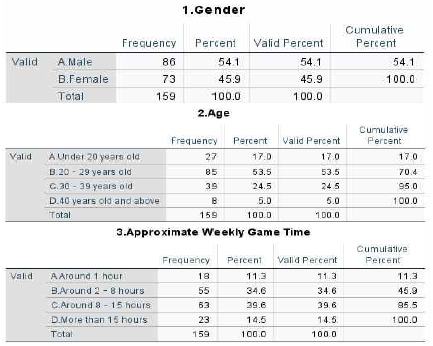
Survey questions 1-3 results
These demographic and gaming behavior characteristics provide the essential variables for the study, ensuring diversity in gender and gameplay immersion. They form the basis for analyzing differences in both the perception and acceptance of traditional cultural elements, thereby enhancing the representativeness and reliability of the research findings.
To verify the reliability and validity of the questionnaire data, items 4–12 were analyzed using SPSS, as shown in Fig. 4. The reliability test results indicated that the overall Cronbach’s α coefficient of the scale was 0.938 (Cronbach’s α based on standardized items = 0.939, N = 9), exceeding 0.9. This demonstrates a high level of internal consistency, indicating that the measurement results are stable and reliable.

Reliability and validity analysis
The validity test results showed a Kaiser-Meyer-Olkin (KMO) measure of sampling adequacy of 0.950 (> 0.8) and a significant Bartlett’s test of sphericity (p < 0.001), indicating that the questionnaire is effective in capturing players’ cognition and evaluation of traditional cultural elements in game characters, with good structural validity.
According to the Pearson correlation analysis shown in Fig. 5, variables such as Direct Application, Perception of Direct Application, Simplified Application, Perception of Indirect Application, Integrated Application, Perception of Integrated Application, Detailed Creative Design, and Respect for Culture all exhibited positive correlations. This indicates that, within the questionnaire, the presentation approaches of cultural elements, players’ perception, creative design, and respect for traditional culture are interrelated, providing a theoretical basis for further hypothesis testing.
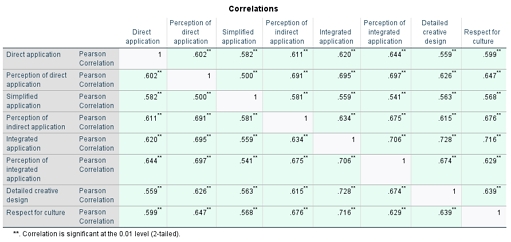
Correlation analysis
To test H1, an independent-samples t-test was conducted to examine the effect of gender on the perception of traditional cultural element application. As shown in Fig. 6, female respondents reported slightly higher perceptions than male respondents across the three dimensions of Direct Application, Simplified Application, and Integrated Application, with all differences reaching statistical significance (p < 0.05). This indicates that gender significantly influences the perception of cultural elements, thereby supporting H1.
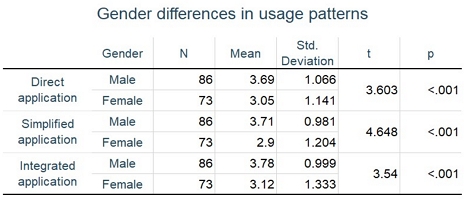
Gender differences in usage patterns
To test H2, the homogeneity of variances was first examined. The results indicated that for Acceptance of Direct Application, the significance value in the mean-based test was 0.059 (> 0.05); for Acceptance of Indirect Application, it was 0.240 (> 0.05); and for Acceptance of Integrated Application, it was 0.001 (< 0.05). These results suggest that most variables met the assumption of homogeneity of variance, with only Acceptance of Integrated Application showing a variance difference, as shown in Fig. 7.
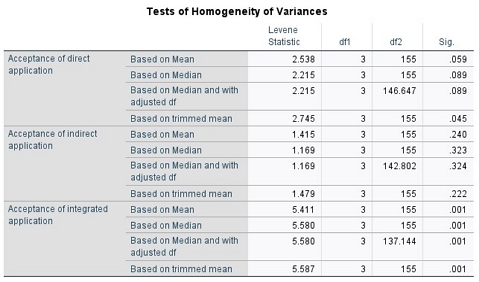
Tests of homogeneity of variances
Subsequently, a one-way ANOVA was conducted to examine the effect of gameplay immersion time on the acceptance of traditional cultural elements. In Fig. 8, the results indicated significant differences across groups for Acceptance of Direct Application (F = 17.367, p < .001), Acceptance of Indirect Application (F = 16.228, p < .001), and Acceptance of Integrated Application (F = 16.036, p < .001). This demonstrates that gameplay immersion time significantly affects players’ acceptance of traditional cultural elements presented through different approaches, thereby supporting H2.
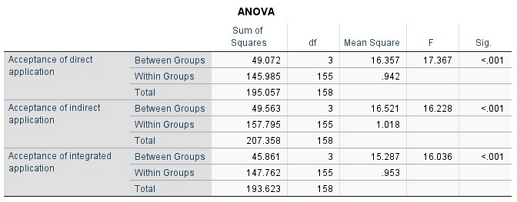
One-way ANOVA analysis
To test H3, a linear regression analysis was conducted to examine the effects of Detailed Creative Design and Respect for Culture on players’ overall game evaluation. According to the regression results shown in Fig. 9, the overall model was significant (F = 79.631, p < .001), with an R2 of 0.505, indicating that approximately 50.5% of the variance in the dependent variable can be explained jointly by the independent variables, suggesting strong explanatory power.
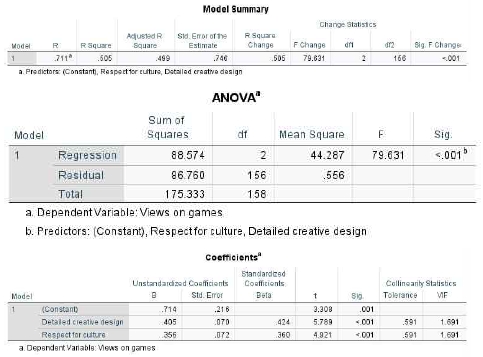
Linear regression analysis results
Examination of individual regression coefficients revealed that Detailed Creative Design (B = 0.405, β = 0.424, t = 5.789, p < .001) and Respect for Culture (B = 0.356, β = 0.360, t = 4.921, p < .001) had significant positive effects on the dependent variable. This indicates that the more players recognize creative details in character design and perceive that cultural elements are respected and accurately represented, the more likely they are to give positive evaluations of the game. Conversely, if details lack creativity or cultural elements are disrespected or distorted, negative evaluations are more likely to occur. Therefore, H3 is supported.
Ⅳ. Conclusion
This study examined traditional cultural elements in game character design, combining specific game examples with a systematic questionnaire survey to analyze how these elements are presented in games and their impact on players’ acceptance and cognitive experience. The primary objective was to explore differences in player experiences across various presentation approaches, as well as the role of cultural creativity and cultural respect in influencing overall game evaluation.
The results indicate that the presentation of traditional cultural elements in game character design can be categorized into three main approaches: realistic representation, Modernized representation, and Creative representation. Realistic representation emphasizes a high degree of historical and cultural fidelity. Modernized representation maintains cultural recognizability while achieving aesthetic optimization and alignment with the game’s stylistic design. Creative representation goes beyond traditional visual impressions, providing new interpretations of classical cultural symbols and evoking emotional resonance with players.
Analysis of the questionnaire data further validated hypotheses H1–H3. The findings show that gender significantly affects the perception of traditional cultural element application, with female respondents reporting slightly higher perception levels than males across the three dimensions of realistic representation, Modernized representation, and Creative representation. The duration of gameplay immersion also significantly influences players’ acceptance and understanding of cultural elements, with longer immersion associated with higher cultural recognition and experience evaluation. Linear regression analysis revealed that the creative presentation of traditional cultural elements and the degree of cultural respect in game character design have a significant positive effect on players’ overall evaluation. This suggests that the appropriate use of traditional cultural elements can enhance overall game value and player satisfaction.
In summary, traditional cultural elements in game character design serve not only as carriers of visual expression and aesthetic experience but also as important media for cultural communication and identity formation. The findings support design strategies that balance cultural authenticity with creativity, demonstrating that such approaches can enhance player immersion while effectively transmitting traditional culture. Based on these results, the digital entertainment industry can leverage traditional cultural elements in game design to improve player experience, strengthen cultural value, and provide new pathways for the global preservation and dissemination of traditional culture.
References
-
L. Ye and X. Tan, “Application and Significance of Traditional Cultural Elements in Chinese-Style Indie Games,” Packaging Engineering, Vol. 40, No. 24, pp. 144-149, 2019.
[https://doi.org/10.19554/j.cnki.1001-3563.2019.24.023]

- G. Dickie, Art and Value, New York, NY: Blackwell Publisher, 2001.
- W. Bao, Mobile Online Games on Traditional Culture Communication Research, Master’s Thesis, Southwest University of Political Science and Law, Chongqiong, 2019.
- W. Yu, Research on Japanese National Costume Culture in Hayao Miyazaki’s Animated Films, Master’s Thesis, Beijing Institute of Fashion Technology, Beijing, 2023.
- Q. Fan, L. Zhao, and K. Wang, “A Comparative Study on the Design Application and Productization of Dongba Pictographic Elements and Koi Flag Elements,” in Proceedings of the China Creative Design Yearbook 2012, Kunming, China, pp. 42-45, Jun. 2013.
-
Z. Danhong and W. Yan, “Symbolic Dissemination of Traditional Chinese Culture Abroad as Seen in the Online Game Genshin Impact,” Publishing and Distribution Research, No. 11, pp. 73-78, 2023.
[https://doi.org/10.19393/j.cnki.cn11-1537/g2.2023.11.003]
- C. Wu, Journey to the West, Wuhan: Changjiang Press, 2020.
- C. Wu, Journey to the West (Illustrated and Annotated Collector’s Edition), Beijing, China: China Children’s Press & Publication Group, 2017.
저자소개

2024.02:Department of Media & Entertainment, Sogang University
2021.03~2024.02: Department of Media & Entertainment, Sogang University, (BFA)
2024.03~Present: Department of Multimedia, Graduate School of Digital Image and Contents, Dongguk University (MFA)
※Research Interests:Contents Design, AI Art, Interaction Design, Visual Effects, etc

2014.02:Department of Video Design, Pyeongtaek University, (BFA)
2016.02:Department of Multimedia, Graduate School of Digital Image and Contents, Dongguk University (MFA)
2023.08:Department of Multimedia, Graduate School of Digital Image and Contents, Dongguk University (Ph.D Degree)
2014.10~2016.04: ABITS Communications
2016.12~2018.07: ableMEDIA
2018.08~2022.02: Associate Professor, School of Art, Shandong Yingcai University, China
2024.02~Present: Lecturer, School of Fine Arts and Design, University of Jinan, Shandong, China
※Research Interests:Contents Design, 3D Computer Graphic, Intelligent Product Development, AI Art, Interaction Design, etc

1992년:Department of Visual Design, College of Fine Arts, Hongik University KOR (BFA)
1999년:Computer Arts, Academy of Art University USA (MFA)
2001년~Present: Professor of Multimedia Department, Graduate School of Digital Image and Contents, Dongguk University
※Research Interests:VR, Contents Design, 3D Computer Graphic, Computer Animation, Visual Effects, AI Art, etc