3D Prototype Modeling Using Intelligent Component Segmentation on the Tripo Platform
Copyright ⓒ 2025 The Digital Contents Society
This is an Open Access article distributed under the terms of the Creative Commons Attribution Non-CommercialLicense(http://creativecommons.org/licenses/by-nc/3.0/) which permits unrestricted non-commercial use, distribution, and reproduction in any medium, provided the original work is properly cited.

Abstract
Generative AI has established image-driven 3D modeling as a vital tool for product prototyping. This study investigated the intelligent segmentation function provided by the Tripo platform, with a focus on semantic recognition, component partitioning, and geometric structure refinement. A standardized assessment framework was applied to three artifacts of varying complexity (i.e., a stool, robot, and car) to evaluate modeling efficiency, segmentation accuracy, and platform compatibility both quantitatively and qualitatively. The results showed that Tripo’s AI-driven completion mechanism effectively bridges visual generation with structural understanding, producing 3D models with clear component hierarchies. Furthermore, comparative analysis with traditional workflows revealed that Tripo provides distinct advantages in component editability and design iteration, thereby validating its practical utility in digital prototyping.
초록
생성형 AI는 이미지 기반 3D 모델링을 제품 프로토타이핑을 위한 핵심 도구로 정착시켰다. 본 연구는 의미론적 인식, 구성 요소 분할, 그리고 기하학적 구조 정제에 중점을 두고 Tripo 플랫폼의 지능형 세분화 기능을 고찰한다. 모델링 효율성, 세분화 정확도 및 플랫폼 호환성을 정량적 정성적으로 평가하기 위해, 서로 다른 복잡도를 가진 세 가지 대상물(스툴, 로봇, 자동차)에 표준화된 평가 프레임워크를 적용하였다. 연구 결과, Tripo의 AI 구동 완성 메커니즘은 시각적 생성과 구조적 이해를 효과적으로 연결하여 명확한 구성 요소 계층을 갖춘 3D 모델을 생성하는 것으로 나타났다. 나아가 전통적인 워크플로우와의 비교 분석을 통해 구성 요소 편집 용이성과 디자인 반복 측면에서 Tripo가 가진 차별화된 이점을 강조하였으며, 디지털 프로토타이핑 분야에서의 실질적 효용성을 검증하였다.
Keywords:
Tripo, Generative AI, Segmentation, Prototyping, 3D Modeling키워드:
생성형 AI, 세그멘테이션, 프로토타입, 3D 모델링Ⅰ. Introduction
1-1 Research Background and Current Status
With the rapid integration of Artificial Intelligence (AI) and Computer Graphics (CG), 3D modeling has evolved into a core technology underpinning product design, virtual simulation, and digital manufacturing[1]. Within the product development lifecycle, prototype design plays a critical role in structural verification, functional preview, and user experience testing. The quality and speed of prototyping directly influence iteration efficiency and the fidelity of final visualization. However, current mainstream modeling software—such as Blender, Maya, and Cinema 4D—while offering high-precision control and diverse construction capabilities, relies heavily on manual operations. These tools involve complex workflows and present steep learning curves, which hinder rapid modeling, particularly for non-professional users. Furthermore, traditional manual processes remain inefficient in tasks requiring frequent multi-version iterations, complex structure management, and seamless cross-platform migration[2].
In recent years, the advancement of Generative Artificial Intelligence (Generative AI) has accelerated the maturity of image-driven 3D modeling, enabling the automatic generation of 3D structures from natural language or image inputs[3],[4]. While emerging platforms like Meshy and Hunyuan3D have made significant strides in mesh generation quality and texture fidelity, they often produce models as monolithic meshes, lacking semantic distinction between components[5]. This limitation restricts downstream editability and rigging. Conversely, the Tripo platform integrates deep neural networks with semantic segmentation and geometric recognition to establish an automated, structured modeling workflow. Its newly introduced intelligent segmentation function allows for component-level semantic partitioning during model generation[6]. By automatically identifying component boundaries and outputting independent structural elements, this function addresses the long-standing challenge of "indivisible holistic models" in AI-based 3D modeling. It demonstrates significant potential in topology refinement, component editing, modular assembly, and cross-platform adaptability, with notable applications in fields such as furniture design, collectible toys, and industrial product prototyping.
1-2 Research Objectives and Significance
Despite these technical advantages, systematic evaluations of Tripo’s intelligent segmentation function remain limited in current literature. In particular, empirical validation regarding model generation efficiency, semantic recognition accuracy, and cross-platform adaptability is still lacking. To address this gap, this study constructs a comprehensive experimental framework, drawing upon established usability and geometric evaluation metrics. This framework encompasses the entire pipeline: image input, model generation, component partitioning, structural refinement, and cross-platform export.
To ensure the generalizability of the findings, three representative objects were selected to test varying levels of structural complexity: a stool (low complexity with clearly defined components), a robot (medium complexity with articulated joints and hierarchical structures), and a car (high complexity with multiple nested components). Through a systematic comparative analysis, this study aims to assess the performance of Tripo’s intelligent segmentation function in terms of semantic recognition, geometric completion, and workflow efficiency. Beyond validating its practical value in product prototype design, the findings explore the broader feasibility of advancing generative AI-based 3D modeling from mere visual generation toward structural understanding. This research thereby provides technical references and theoretical support for the future integration of AI-assisted structured modeling tools into industrial design, digital manufacturing, and interactive applications.
Ⅱ. Research Methods
2-1 Experimental Object Selection and Assessment Framework
This study aims to systematically evaluate the adaptability and performance of the Tripo platform's intelligent segmentation function under varying levels of structural complexity. To ensure objective results and distinct comparative data, three representative objects were selected as experimental samples: a stool (low complexity), a robot (medium complexity), and a car (high complexity). The complexity classification is strictly defined by quantitative geometric thresholds. Low-complexity models are characterized by fewer than 10 components and under 50,000 polygons; medium-complexity models range from 10 to 30 components with polygon counts between 50,000 and 200,000; and high-complexity models exceed 30 components and 200,000 polygons. This quantitative classification ensures that the selected samples represent distinct and measurable levels of structural variation, providing a consistent baseline for analyzing how the intelligent segmentation function performs across different modeling scenarios.
To eliminate subjective bias and ensure reproducibility, the study adopts a fully objective quantitative assessment framework utilizing measurable performance metrics derived from Human-Computer Interaction (HCI) efficiency standards and computer vision benchmarks. The framework focuses on five core metrics. First, Task Completion Rate (TCR) measures the percentage of structural components successfully generated and segmented compared to the ground truth, where a rate of 100% indicates a fully usable model. Second, Time on Task (ToT) records the total elapsed time in seconds from image upload to the completion of the export process via system logs. Third, Operation Count (OC) tracks the total number of discrete user inputs—including mouse clicks and keystrokes—required to complete the task, serving as a direct indicator of automation levels. Fourth, Segmentation Accuracy (SA) is calculated as the ratio of correctly semantically labeled components to the total number of segmented parts, verified against standard topological structures[7]. Finally, System Stability (SS) determines the success rate of error-free data exchange when exporting to external software (Blender/Unreal Engine), ensuring the absence of mesh corruption or crashes. Table 1 outlines the quantitative grading criteria established for these metrics.

Evaluation criteria
2-2 Experimental Control and Data Collection
To ensure the validity of these objective metrics, rigorous experimental controls were implemented. All modeling sessions were conducted on a standardized workstation equipped with an NVIDIA RTX 4070 GPU and a stable high-speed network connection to minimize latency variance. Data collection was automated wherever possible to reduce human error. System timestamps were utilized to log start and end times to the nearest second for Time on Task measurements, while screen recording software and input logging tools were employed to count the exact number of discrete user operations. Furthermore, exported FBX files underwent programmatic validation in Blender 4.0 to verify mesh integrity for the Stability metric, and were manually inspected against reference images to calculate Segmentation Accuracy. By relying exclusively on these objective data points and controlled procedures, the study minimizes human interpretation bias, providing a rigorous baseline for evaluating the efficiency and reliability of AI-driven segmentation tools.
Ⅲ. Model Generation Methods
3-1 Experimental Design (Case of a Chair)
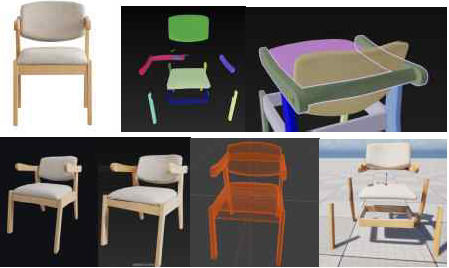
In the initial phase of the experiment, a single orthographic image of a chair was imported into the Tripo platform to trigger the automated modeling pipeline. At this stage, the platform's built-in deep learning architecture executed spatial feature extraction and semantic parsing to construct an initial 3D geometric structure[8],[9]. Following the generation of this base model, the intelligent segmentation function was deployed to systematically decompose the holistic mesh into distinct semantic components, specifically identifying the seat, backrest, legs, and supporting crossbars. The resulting segmentation demonstrated a rigorous semantic organization, providing a robust topological foundation for subsequent component-level manipulation. To address the geometric discontinuities often inherent in AI-generated meshes, the system performed a boundary precision assessment for each segmented element. For regions exhibiting topological defects, gaps, or irregular edges, an intelligent completion mechanism utilizing AI-driven geometric patching algorithms was employed. This process enhanced both structural continuity and visual consistency by performing surface filling and edge smoothing. Furthermore, the platform facilitated multi-region selection for component merging—such as integrating crossbars with legs into a unified support structure—while retaining unique component IDs and attribute tags. This data preservation ensures the traceability and reversibility of the structural hierarchy, thereby supporting future modular reconstruction. To further refine the model for specific downstream applications, the retopology function was utilized to optimize the mesh structure, offering configurable options for quad-dominant topology and polygon density. This flexibility allowed the generated models to be adapted for either high-fidelity rendering or lightweight real-time interactions. Additionally, the integrated AI texture engine automatically synthesized high-resolution textures based on geometric and material parameters[10], while the texture repainting function provided capabilities for local correction and stylistic adjustment in cases of projection misalignment.
Upon the completion of modeling, segmentation, and geometric refinement, the resulting chair model was exported in FBX format to validate its interoperability across professional digital content creation (DCC) environments. A preliminary post-processing phase was conducted in Blender 4.0, which involved scale normalization, nomenclature optimization, texture path correction, and pivot point realignment. These steps were essential to ensure the logical consistency and integration of the geometric structure within standard workflows. Subsequently, the optimized model was imported into Unreal Engine 5 for rigorous application testing. The evaluation focused on three critical dimensions: the preservation of component independence and semantic hierarchy, the fidelity of texture and material reproduction under real-time lighting, and the functionality of basic interactive operations such as dynamic component selection and physics-based responses. These validation procedures confirmed that models generated via Tripo’s intelligent segmentation function not only achieved structural clarity and semantic accuracy but also maintained robust compatibility across disparate software ecosystems, establishing a solid foundation for the broader comparative analysis presented in the subsequent section.
3-2 Experimental Results Analysis
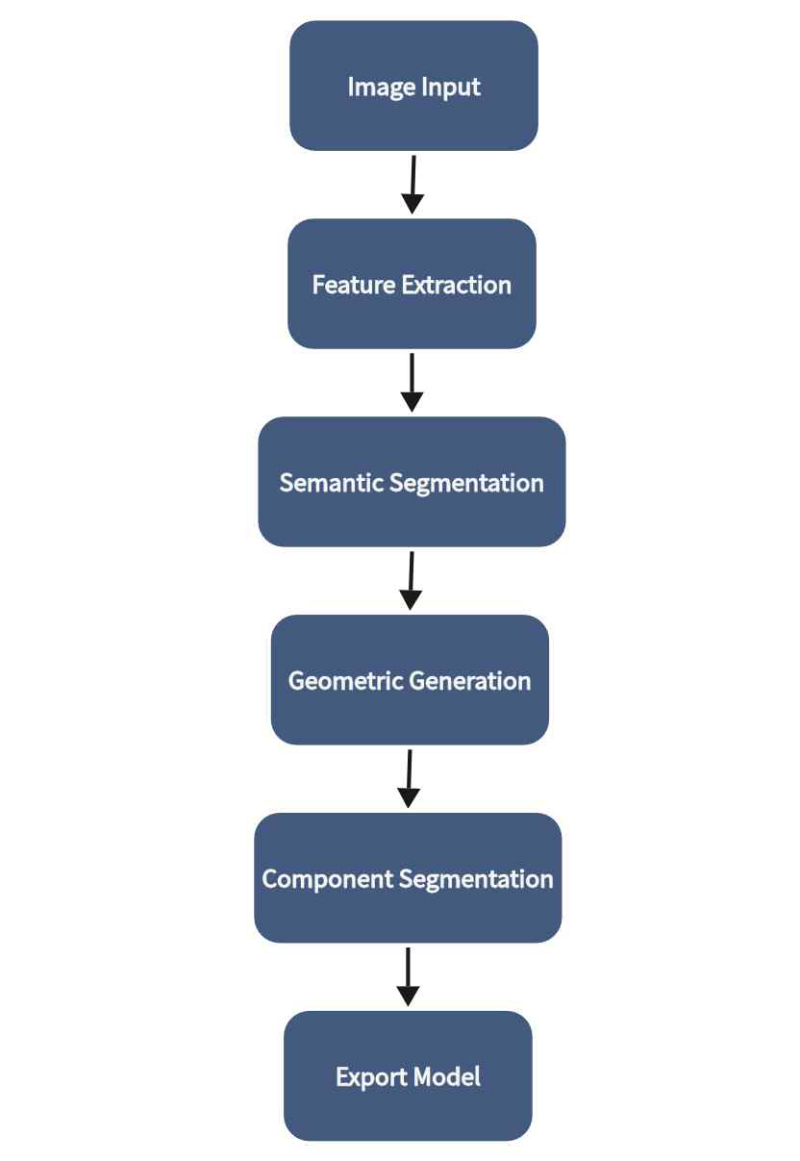
The intelligent segmentation function of the Tripo platform embodies a structured methodological pipeline that progresses from 2D image input to structured 3D model output. This workflow represents a significant departure from direct image-to-mesh transformation; instead, it functions as a multi-layered process bridging visual generation with structural understanding. The system transitions from holistic, indivisible model generation to a component-level organizational paradigm, thereby overcoming the limitations of traditional generative models which often produce static, monolithic meshes. This methodological shift provides the necessary structural logic for subsequent modular editing, part replacement, and cross-platform adaptability. The complete operational pipeline is illustrated in Fig. 1.
Workflow diagram
To empirically assess the technical advantages of the intelligent segmentation function, a comparative analysis was conducted between the traditional holistic generation workflow and the enhanced intelligent segmentation workflow using identical image inputs. In the traditional process, models were generated as unified holistic meshes, which, while preserving the overall silhouette, lacked internal component semantics and structural logic[11]. Consequently, edge details were frequently incomplete or coarse, and the topology was often non-manifold, significantly limiting usability in editing, animation rigging, and secondary development. By contrast, when the intelligent segmentation function was applied, the platform automatically performed component-level recognition, outputting structurally independent units with defined boundaries. Supported by auxiliary tools such as intelligent completion, retopology, and texture repainting, this enhanced workflow produced models characterized by clearer structural organization, watertight boundaries, and superior flexibility for localized editing. Cross-platform validation further underscored the superiority of the enhanced workflow. Models generated with intelligent segmentation exhibited higher stability upon import into Blender and Unreal Engine, maintaining consistent naming conventions, standardized UV layouts, and well-preserved material channels. Conversely, traditional models frequently suffered from artifacts in texture mapping, coordinate misalignment, and poor interactive responsiveness. These results, summarized in Table 2, collectively confirm that the intelligent segmentation function significantly improves modeling accuracy, editing flexibility, and practical applicability, establishing Tripo as a robust solution for structured 3D model generation[12].
Comparison of old and new methods
Ⅳ. The Application of Generative Models
4-1 Experimental Design
Following the chair experiment, which primarily verified the feasibility of the intelligent segmentation workflow, two additional test cases were selected to further evaluate the generalizability of the Tripo platform under higher structural complexity: a medium-complexity robot and a high-complexity automobile. These cases were chosen to capture the challenges of semantic segmentation across varying levels of structural hierarchy and geometric nesting.
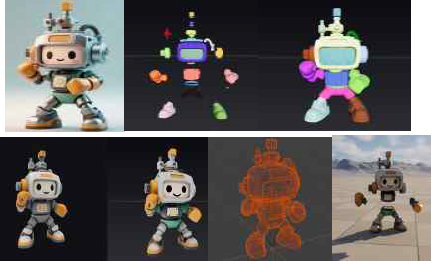
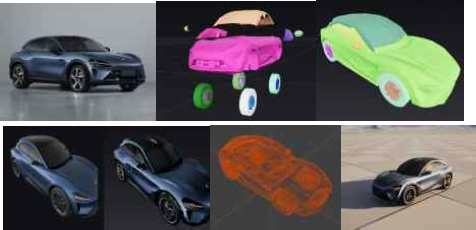
The robot model included key components such as the torso, limbs, and joints, characterized by segmented mechanical features and articulated connections. This structure introduced challenges in boundary recognition, particularly at smaller joint interfaces, thereby providing a representative scenario for evaluating segmentation accuracy and geometric completion. The automobile model, by contrast, represented a high-complexity industrial object, containing multiple nested components such as wheels, windows, lights, and internal frameworks. Its intricate interconnections and overlapping parts tested the limits of the platform’s boundary detection and component organization.
Both experiments followed the standardized framework established earlier: single orthographic images were used as inputs, generated models were exported in FBX format, and cross-platform validation was conducted in Blender and Unreal Engine 5. These supplementary experiments focused on identifying the unique challenges posed by higher structural complexity, allowing for a comparative evaluation of the platform’s segmentation capability, geometric integrity, and adaptability under progressively complex modeling tasks.
4-2 Quantitative Results Presentation
Study subject A analysis results
Study subject B analysis results
Study subject C analysis results
4-3 Analysis and Discussion
From a product-level prototyping perspective, the three case studies (stool, robot and automobile) reveal how Tripo’s intelligent segmentation behaves under increasing structural complexity. For the low-complexity stool, the generated mesh maintained stable topology and clean watertight surfaces, and the legs, seat, and support bars were clearly separated as independent components. In practice this allowed the model to be imported into Blender and Unreal Engine without additional repair and to be used directly as a product-level prototype for checking proportions, overall dimensions and basic structural balance. According to the evaluation in Table 3, this task achieved the highest ratings among the three cases in task completion rate, time on task, operation count and segmentation accuracy, indicating that the proposed workflow is sufficient for rapid prototyping of simple furniture products.
For the medium-complexity robot, Tripo correctly recognized and separated the torso, head and major limb segments, but smaller joints, cable-like structures and overlapping parts were sometimes merged into single components. As a result, manual refinement was required in areas where precise articulation or assembly relationships are important. Nevertheless, the model was still adequate as a product-level concept prototype: designers were able to verify silhouette, pose range and basic part layout, and the automatic segmentation reduced the number of repetitive selection and detaching operations compared with the original workflow, as summarized in Table 4. In other words, the proposed process already provides practical efficiency gains at the product level, even though fine-grained mechanical constraints must still be adjusted by hand.
The high-complexity automobile represents the most challenging case for product-level use. While the system successfully separated major exterior elements such as the body shell, wheels and windows, the boundaries of nested structures (for example, wheel housings, interior frames and fine trim details) were only partially identified. This limits direct use of the generated model as a manufacturing-ready prototype, but it is still suitable for visual product prototyping scenarios such as design reviews, color and material studies, and early-stage marketing imagery. As seen in Table 5, both segmentation accuracy and operation count degrade under this level of complexity, clarifying that the current intelligent segmentation is more appropriate for medium-detail product prototypes than for fine engineering models.
Overall, these observations specify more concretely how the proposed process contributes to product-level prototyping. The workflow reliably delivers editable, component-based 3D models that can be immediately reused across mainstream digital content tools, and it significantly shortens the time and effort required to reach a usable prototype state. At the same time, the analysis also makes clear that the generated 3D models are best positioned as concept- and design-stage product representations; for final engineering and manufacturing, additional manual modeling or CAD-based refinement is still necessary.
Ⅴ. Conclusion
This study systematically examined the intelligent segmentation function introduced in the Tripo platform through a standardized, image-driven 3D modeling workflow. By selecting three representative objects—a stool, a robot, and an automobile—to correspond to low, medium, and high-complexity modeling tasks, the research evaluated the platform's performance using a rigorous quantitative framework covering task completion, operation efficiency, segmentation accuracy, and system stability. The empirical findings reveal that Tripo effectively bridges the gap between visual generation and structural understanding. It is capable of generating 3D models with clear component hierarchies and enhanced geometric integrity, supported by an intelligent completion mechanism that effectively repairs defective regions to ensure topological continuity. Cross-platform validation further confirmed that the generated models maintain strong interoperability when integrated into Blender and Unreal Engine 5, demonstrating direct applicability in rapid prototyping, interactive design, and modular assembly.
The quantitative results indicate that Tripo’s intelligent segmentation function offers distinct advantages in three key areas: the efficient automation of structured modeling, flexible support for modular editing, and reliable adaptability across mainstream digital content environments. In low-complexity scenarios, the platform achieved near-perfect task completion and accuracy, significantly accelerating the design process compared to traditional manual workflows. However, the study also identified notable limitations. Performance metrics declined inversely with structural complexity; specifically, the high-complexity automobile case exhibited reduced segmentation accuracy in regions involving nested geometries or overlapping materials. Furthermore, geometric completion showed diminished precision on irregular surfaces, and the lack of a robust "undo" function in the segmentation interface constrained iterative workflow efficiency. These findings suggest that while the tool is highly effective for conceptual prototyping, high-fidelity industrial modeling still requires human-in-the-loop refinement.
In conclusion, the intelligent segmentation function of the Tripo platform demonstrates significant potential as a transformative solution for image-driven 3D modeling. By shifting the paradigm from monolithic mesh generation to semantic component organization, it not only lowers the technical entry barrier for non-professional users but also provides a verifiable technical foundation for the future development of AI-assisted design tools. Its broad applicability in product prototyping, virtual presentation, and interactive media underscores its value as both a practical tool and a pivotal research direction, paving the way for the next stage in the evolution of generative AI-based 3D modeling.
References
-
Q. Zhong, “Application of AI-Assisted Parametric Modeling in Jewelry Design,” Beijing Institute of Fashion Technology, pp. 2-8, 2020.
[https://doi.org/10.26932/d.cnki.gbjfc.2020.000297]

-
S. Xue, “AI 3D Modeling Tools Keep Emerging, Blender Still Worth Learning,” Computer Newspaper, pp. 1-10. August 2024.
[https://doi.org/10.28184/n.cnki.ndina.2024.000646]
-
S. Xue, “Complete Modeling and Shading in 10 Minutes: AI-Enhanced 3D Design Workflow,” Computer Newspaper, pp. 6-8, July 2024.
[https://doi.org/10.28184/n.cnki.ndina.2024.000509]
-
S. Bai and J. Li, “Progress and Prospects in 3D Generative AI: A Technical Overview Including 3D Human,” arXiv:2401.02620, , 2024.
[https://doi.org/10.48550/arXiv.2401.02620]
- B. Poole, A. Jain, J. T. Barron, and B. Mildenhall, “DreamFusion: Text-to-3D Using 2D Diffusion,” in Proceedings of the Eleventh International Conference on Learning Representations (ICLR), 2023.
-
S. J. Kwak, “Performance Comparison and Evaluation of AI-Based 3D Modeling Tools - Geometric, Topological, and Visual Analysis of Rodin and Meshy -,” Journal of Cultural Product & Design (KIPAD), Vol. 79, pp. 199-214, 2024.
[https://doi.org/10.18555/kicpd.2024.79.017]
-
Y. He, H. Yu, X. Liu, Z. Yang, W. Sun, S. Anwar, and A. Mian, “Deep Learning Based 3D Segmentation: A Survey,” arXiv:2103.05423, , 2021.
[https://doi.org/10.48550/arXiv.2103.05423]
- S. Wu, Y. Lin, F. Zhang, Y. Zeng, J. Xu, P. Torr ... and Y. Yao, “Direct3D: Scalable Image-to-3D Generation via 3D Latent Diffusion Transformer,” in Proceedings of Thirty-Eighth Annual Conference on Neural Information Processing Systems, Curran Associates, 2024.
-
D. Tochilkin, D. Pankratz, Z. Liu, Z. Huang, A. Letts, Y. Li, ... and Y.-P. Cao, “TripoSR: Fast 3D Object Reconstruction from a Single Image,” arXiv:2403.02151, , 2024.
[https://doi.org/10.48550/arXiv.2403.02151]
-
S. Chen and B. Lee, “Application of AI Technology in 3D Texture Production – Focusing on Cartoon-Style Character Modeling,” Journal of Basic Design & Art, Vol. 25, No. 4. pp. 405-416, 2024.
[https://doi.org/10.47294/KSBDA.25.4.28]
-
C.-H. Lin, J. Gao, L. Tang, T. Takikawa, X. Zeng, X. Huang, ... and T.-Y. Lin, “Magic3D: High-Resolution Text-to-3D Content Creation,” IEEE Conference on Computer Vision and Pattern Recognition (CVPR), pp. 300-309, 2023.
[https://doi.org/10.1109/CVPR52729.2023.00037]
-
Y. Na, “Comparative Analysis of 3D Modeling with AI and Traditional Tools – Efficiency, Aesthetic Quality, and Market Acceptance,” Journal of Basic Design & Art, Vol. 26, No. 2, pp. 127-140, 2025.
[https://doi.org/10.47294/KSBDA.26.2.10]

2022~2024: Department of Multimedia Engineering, Dongguk University, (BEng)
2024~Present: Department of Multimedia, Graduate School of Digital Image and Contents, Dongguk University (MFA)
※Research Interests:Computer Graphics, AI Art, Animation Design, Interaction Design, etc

1992:Department of Visual Design, College of Fine Arts, Hongik University KOR (BFA)
1999:Computer Arts, Academy of Art University USA (MFA)
2001~Present: Professor of Multimedia Department, Graduate School of Digital Image and Contents, Dongguk University
※Research Interests:VR, Contents Design, 3D Computer Graphic, Computer Animation, Visual Effects, AI Art, etc

2014:Department of Video Design, Pyeongtaek University, (BFA)
2016:Department of Multimedia, Graduate School of Digital Image and Contents, Dongguk University (MFA)
2023:Department of Multimedia, Graduate School of Digital Image and Contents, Dongguk University (Ph.D Degree)
2014~2016: ABITS Communications
2016~2018: ableMEDIA
2018~2022: Associate Professor, School of Art, Shandong Yingcai University, China
2024~Present: Lecturer, School of Fine Arts and Design, University of Jinan, Shandong, China
※Research Interests:Contents Design, 3D Computer Graphic, Intelligent Product Development, AI Art, Interaction Design, etc